A buyer in Lakewood once showed up to closing with a cashier’s check and left two hours later with nothing signed. During the final search, an old mechanic’s lien from a roofing contractor had surfaced. That’s exactly what a careful title company is supposed to catch early and a careless one misses. I’ve bought houses all over Northeast Ohio for years now. When a closing takes forty minutes instead of dragging into a second month, the biggest reason is usually the title company sitting in the middle of it.
What Is a Title Company and What Does It Do?
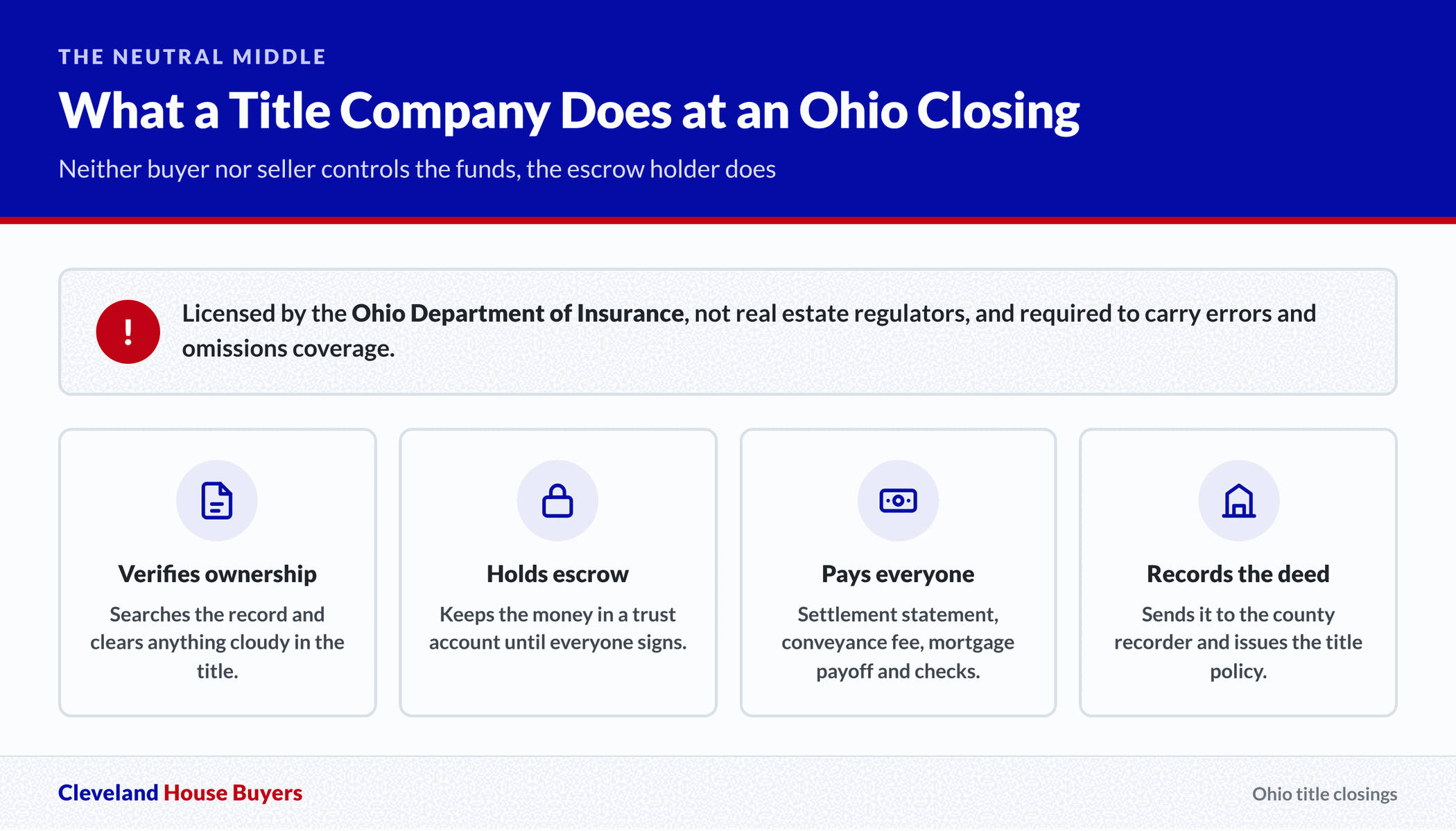
Sitting in the middle is the whole job. In Ohio, that neutral third party confirms who legally owns a property and clears up anything cloudy in the ownership record. It holds the money in escrow, then makes sure the deed gets recorded with the county once everybody signs.
Neither you nor the buyer controls the money between contract and closing; the escrow holder does.
In Ohio, these outfits get their licenses from the Department of Insurance, not from real estate regulators. State law requires every title insurance agent or agency to carry an errors and omissions policy at or above the superintendent’s minimum limits. Agents also have to keep an interest-bearing trust account for non-directed escrow funds. That trust account rule exists for a good reason, since sale proceeds shouldn’t sit in somebody’s operating account.
Closing day keeps it busy. It prepares the settlement statement, collects the conveyance fee owed to the county auditor, pays off your mortgage, cuts the checks, and sends the deed to the county recorder. By that evening everyone has been paid and the paperwork is where it belongs. The firm also issues the insurance policy protecting the ownership rights you just paid for.
One seller I worked with inherited a house along with two siblings who lived out of state, and all three wanted a clean exit. Our firm pulled the probate record, confirmed the transfer-on-death language, and had all three signatures notarized remotely. The closing took eleven days.
Why Does Every Home Sale Need a Title Company?
“I bought this place twenty years ago and the title was fine then, so why pay for it again?” I hear some version of that every month. Twenty years gives a judgment lien, a tax certificate, an unreleased second mortgage, or a contractor’s claim plenty of time to attach itself to your property. Each one sits quietly in the county record until someone pulls the chain of title and finds it.
Ohio doesn’t put an attorney at the closing table the way some East Coast states do. That means the title search carries more weight here than it might elsewhere. If nobody checks the record, nobody catches the problem.
Deed fraud has turned into a real problem for vacant and inherited properties in older Ohio neighborhoods. A forged quitclaim filed at the recorder’s office looks just like a legitimate one until somebody studies the signatures and notary stamps.
For most buyers, the mortgage lender settles the question anyway. No lender in Ohio funds a loan without a lender’s title insurance policy, and that policy requires a full search first. Cash buyers are the only ones with a real choice. Even so, I’d tell a cash buyer to get the owner’s policy. Skipping it saves a few hundred dollars once and leaves you exposed for as long as you own the house.
Without a policy, you’re paying a real estate attorney out of your own pocket. With one, the underwriter defends the claim.
What Does a Title Company Check Before Closing?
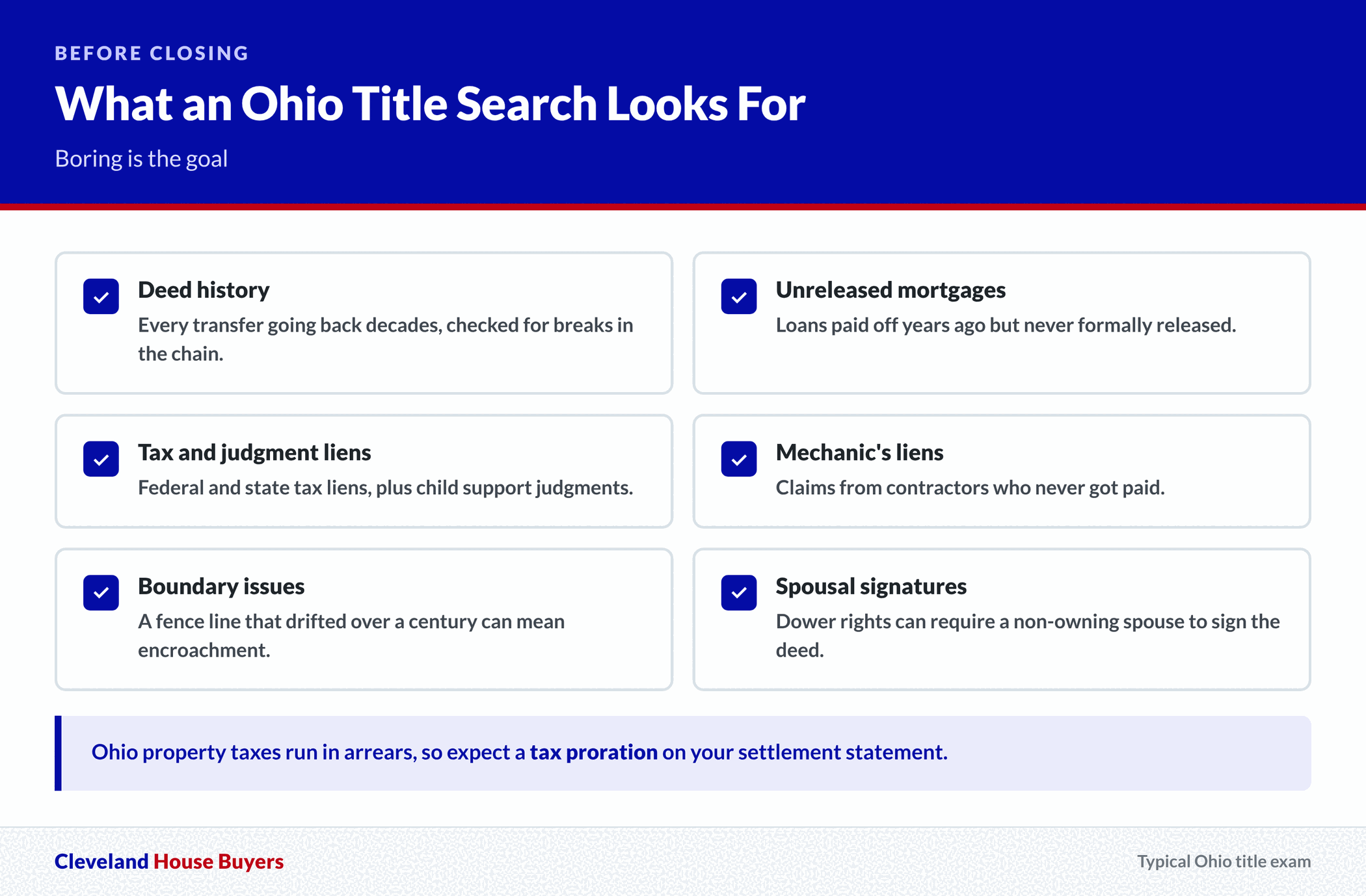
Most title searches in Ohio are duller than people fear, and that’s the whole point. The examiner pulls decades of deed history, usually from the county recorder’s indexed records. Then they trace every transfer from owner to owner, hunting for breaks in the chain.
Ohio collects property taxes in arrears, so there’s nearly always a proration to work out.
Next come the liens. The examiner looks for mortgages that were paid off but never formally released, federal and state tax liens, child support judgments, and mechanic’s liens from unpaid contractors. In suburbs like Avon or Westlake, where associations are common, HOA assessments get checked too.
Older Ohio housing stock turns up boundary and survey problems more often than newer subdivisions. Cleveland and Youngstown have plenty of homes platted before 1920. A fence line that drifted three feet over a century raises a real encroachment question.
Divorce decrees matter as well, since a spouse who never signed off on a transfer may still hold a claim.
Marital status matters more than most people plan for. Dower rights exist in Ohio, so a non-owning spouse may still need to sign the deed even if their name was never on the title. I’ve watched closings stall because a seller’s husband was out of the country and nobody caught the signature requirement until that morning. Ask early whether your specific deed needs a spousal signature.
Can You Trust a Title Company Someone Else Picked?
Ohio builders, brokerages, and lenders regularly steer people toward a closing firm they partly own, or one that shares their office suite. That setup is legal when it’s properly disclosed under federal rules. It isn’t automatically in your interest, though.
Mechanic’s liens show why the choice matters. If you hired contractors for a roof, a furnace, or a kitchen before selling, any unpaid subcontractor can file a lien against your house. A careful title company spots those claims early and gathers lien waivers before closing day.
Land history matters too. A lot in a Medina County subdivision may have been farmland twenty years ago. Farmland comes with old oil and gas leases, drainage easements, and mineral rights reservations that survive the subdivision process.
Subdivision restrictions and declarations get recorded against your parcel as well. A firm that knows the local plats catches them before they surprise anyone at the closing table.
Do you have to accept the other side’s preferred title company? Not always. Federal law gives the buyer the right to pick the settlement agent in most home sales. A seller or builder can suggest a firm, yet it cannot require it as a condition of the sale. Get at least one competing quote before you accept an in-house option.
Ask any firm you’re considering how it handles a lien that turns up late. A good one walks you through the payoff or waiver process in plain terms, so you’re never the one chasing it.
What Makes a Title Company Trustworthy in Ohio?
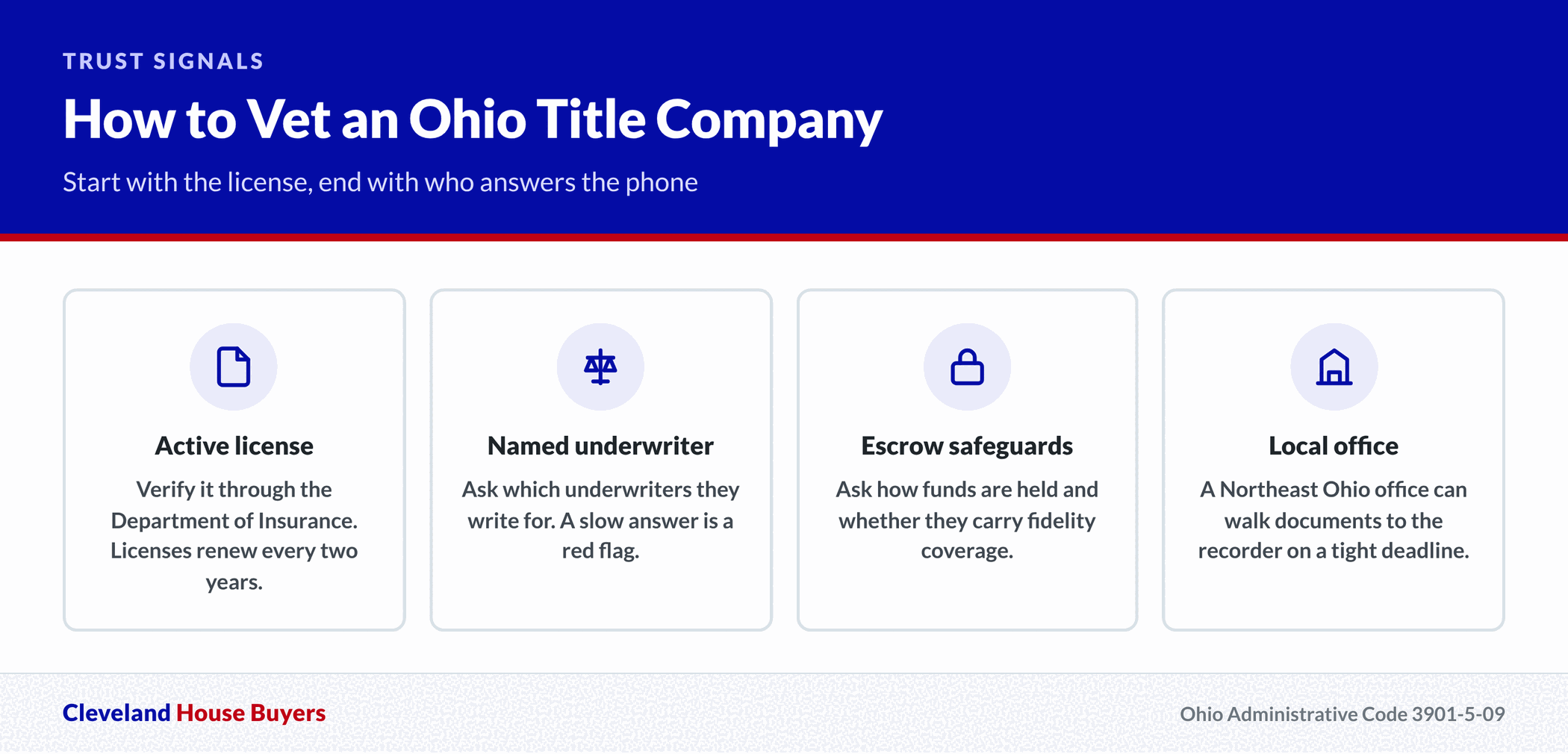
“How do I know they’re legit?” Check the license first. Under Ohio Administrative Code 3901-5-09, any title insurance agent or agency handling escrow, settlement, or closing services needs a license from the Department of Insurance. The locator tool at insurance.ohio.gov lets you verify an agent or agency.
Title licenses in Ohio renew every two years, and each renewal requires continuing education. If a firm lets its license lapse, that tells you something about how it runs everything else.
Every title company works as an agent for a larger underwriter, and the underwriter is the one that actually pays a claim. Ask which underwriters they write for. No quick answer? Keep walking.
How a firm handles escrow separates the pros from everyone else. The trust account statute exists because escrow theft, though rare, wipes people out completely. Take it seriously even if you’re sure it won’t happen to you. Ask how funds are held and whether they carry fidelity coverage beyond the required errors and omissions policy.
A title company that picks up the phone on a Tuesday afternoon beats one with a slicker website. We’ve closed with firms across Cuyahoga, Summit, and Lorain counties. The ones we keep going back to share one trait: somebody calls you before you have to call them.
Local knowledge counts in Ohio, because county practices really do differ. Recording procedures, auditor transfer rules, and turnaround times in Cuyahoga County aren’t the same as in rural Holmes County. At Cleveland House Buyers, we keep a short list of title partners who know the quirks of every county office we work with.
How Do I Choose a Title Company in Ohio?
Your agent hands you a name, you nod, and the decision’s made. Usually that works out fine. Sometimes, though, the name comes from a referral relationship built on convenience instead of performance. You won’t learn which kind you got until a complicated file hits their desk.
Shop at least two. Prices vary, service varies even more, and each quote takes one phone call.
Ask directly about turnaround time. Statewide in Ohio, homes sold for a median price of $260,608 in October 2026 and spent a median of 44 days on the market. Those figures measure time to contract, not time to close. A title company that needs three weeks to produce a commitment can blow a thirty-day financing deadline on its own.
Pick a firm that fits your situation. A renovated duplex in Tremont with a tangled permit history is a different job from a 2019 colonial in Strongsville. Probate sales, tax-lien properties, and homes with multiple heirs need an examiner who’s done them before.
Find out who’ll sit at the closing table. Some Ohio title companies send a mobile notary who can’t answer one question about the settlement statement, while others put a licensed closer in the room.
When a deadline gets tight, a title company with a real office in Northeast Ohio can walk documents over to the recorder. Remote-only shops can’t.
Actually read the commitment when it shows up. Schedule B lists every exception the policy won’t cover, and surprises like to hide there. Any title company worth hiring will go through those exceptions line by line without rushing you.
What Should I Ask a Title Company Before Hiring One?
Cuyahoga County charges a total conveyance fee of $4 per $1,000 of the sale price, paid to the county fiscal office when the deed is recorded. Your county’s rate may be different. Ohio sets a mandatory state conveyance fee of 0.1% and lets counties add a permissive tax on top. So the first question is simple: what’s the total rate in my county, and does your estimate already include it?
After that, get specific about the file. Will they run a full chain of title or an abbreviated search, and how many years back will it go? Who physically attends your closing, and can you meet them ahead of time? What’s their current average from contract to clear-to-close?
Ask how they verify wiring instructions and whether they’ll ever send them by email. The right answer involves a phone call to a number you already have, and you make the call, not them.
Find out what a title update costs if closing gets pushed back. Delays are constant in Ohio, especially in winter, when a December inspection finds a cracked heat exchanger.
Does the quote include everything? It should list search, exam, commitment, binder, settlement fee, courier, recording service, and policy premium. A low settlement fee with four add-ons stacked behind it isn’t a bargain.
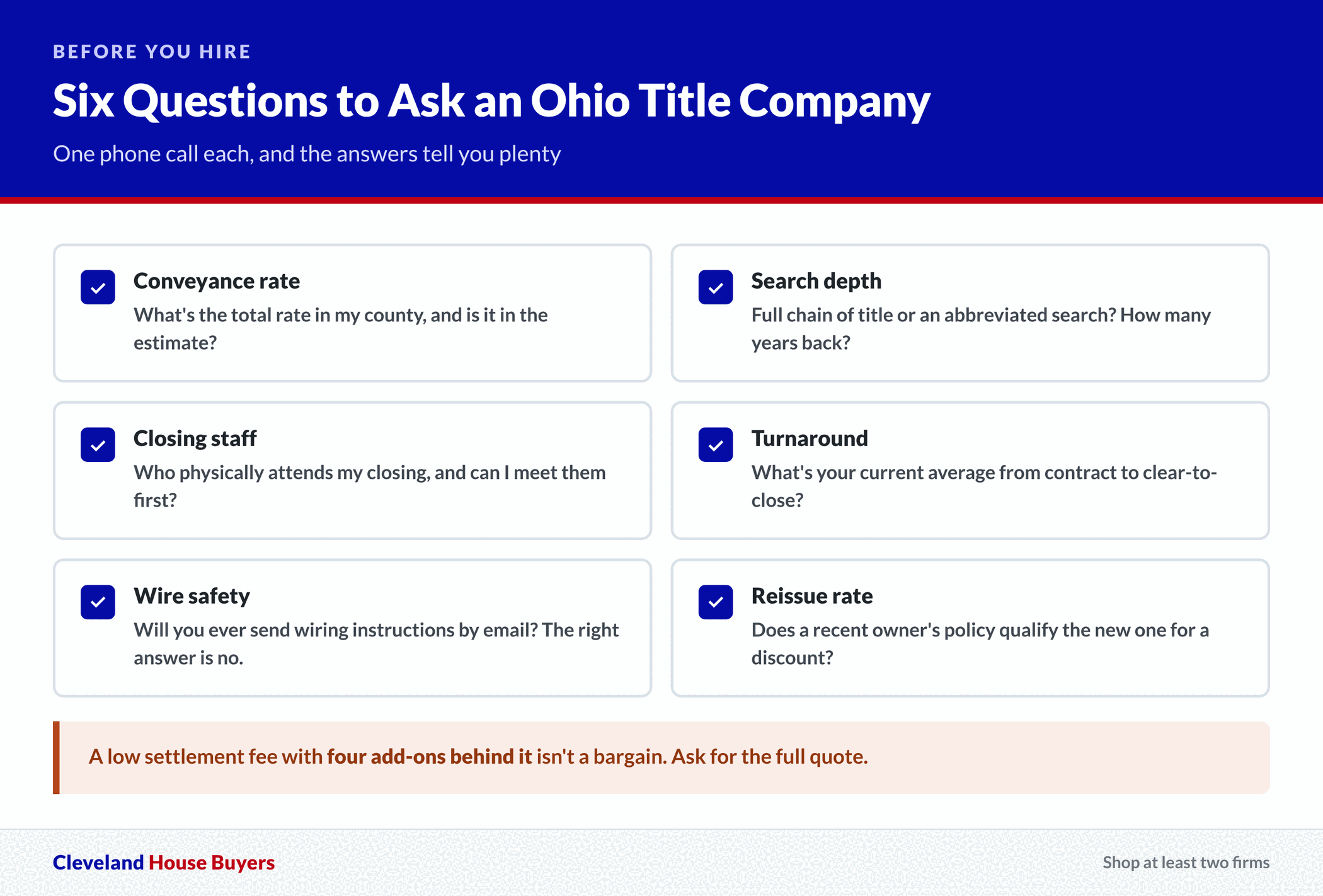
Ask about a reissue rate, too. When the seller bought an owner’s policy within the last several years, many underwriters discount the new policy. Plenty of title companies never bring it up unless you ask.
How Much Does an Ohio Title Company Charge?
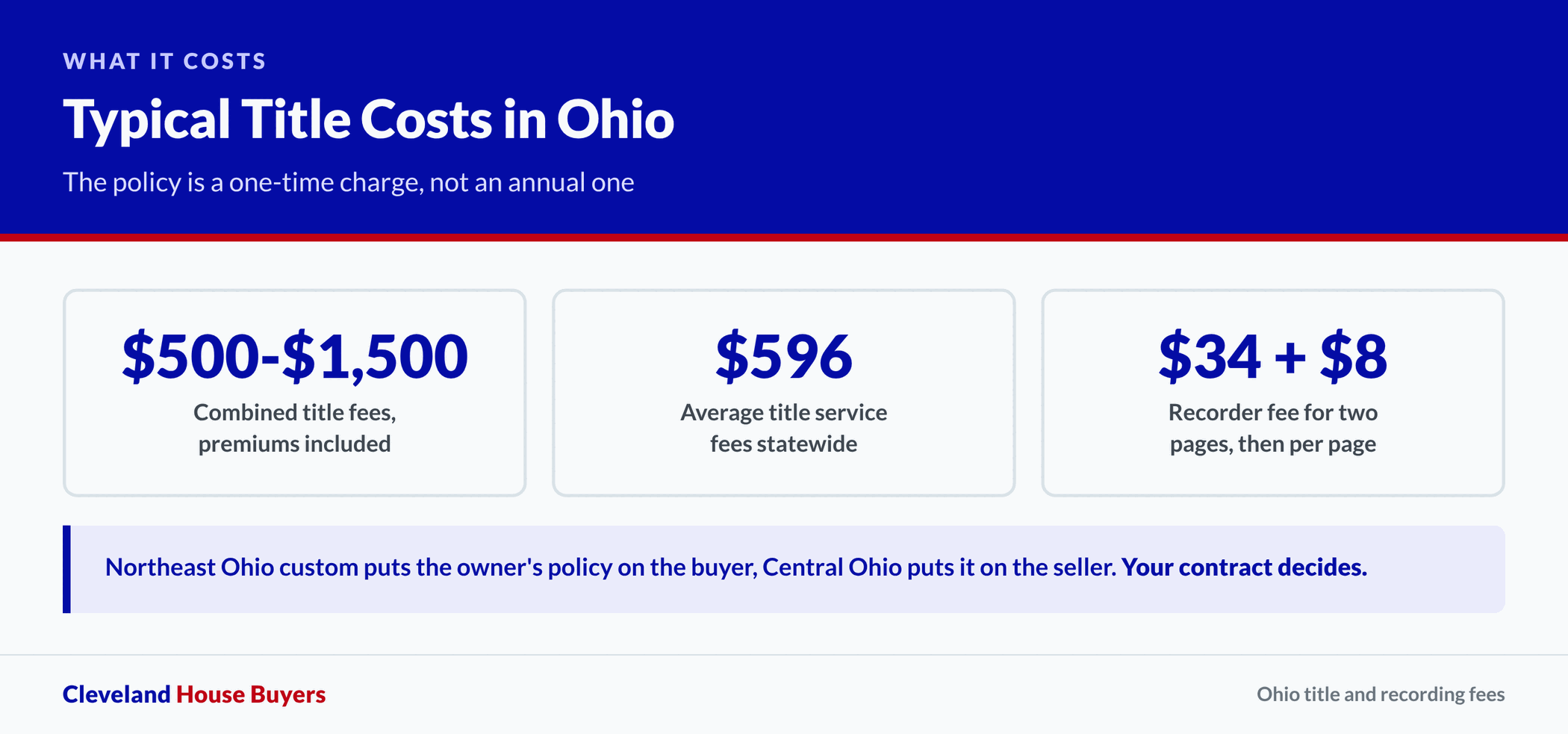
Real numbers help, since guessing is worse than the bill. Combined title fees in Ohio, insurance premiums included, commonly run $500 to $1,500. Title service fees alone average about $596 statewide.
County recorders in Ohio generally charge about $34 for the first two pages of a deed or mortgage, plus $8 for each extra page.
Who pays for what isn’t uniform across the state, and that catches people moving between metros off guard. In Northeast Ohio, buyer and seller usually split the owner’s policy, while Central Ohio custom puts it on the seller. Your purchase contract controls no matter what custom says, so read that line before you sign.
Title insurance premiums in Ohio rise with the purchase price, and the policy is a one-time charge, not an annual one. You pay at closing, and coverage lasts as long as you hold an interest in the property. Spend your attention on the ancillary fees rather than the premium. That’s where one title company can charge four hundred dollars more than another for identical work.
Watch for a “document preparation” fee and an “attorney review” fee on the same closing. Ask what separates the two, and if the answer comes back vague or rambling, push back.
Last year a man from Parma called me on a Wednesday afternoon. He’d moved for work, bought a second house, and spent almost a year quietly carrying two mortgages while a finished basement sat empty in the first one. Someone had told him his old house had a clouded title from a 1990s refinance that was never released. He figured the fix would cost thousands. A title company ran the search and found the release had been recorded under a misspelled name. One corrective affidavit cleared it, for ninety dollars.
Wondering if the title company in front of you is the right one? Or maybe your property has a tangled history you’d rather not discover the hard way. We’re glad to talk it through either way. There’s no pressure and no obligation, and it costs nothing to pick our brains about what we’ve seen work across Ohio.
Frequently Asked Questions
How Long Does a Title Company Take to Clear Title in Ohio?
On a clean real estate file, the search is rarely the slow part. An unreleased mortgage, a missing spousal signature or an unpaid contractor’s lien adds time while the title examiner chases down releases and signatures. Before you hire a firm, ask for its current average from contract to clear-to-close and what usually holds files up in your county.
Who Picks the Title Company in a Home Sale?
Usually whoever pays for the policy gets the say. In Ohio, that depends on your region’s custom and on what your contract spells out. Buyers with a mortgage almost always choose, since their lender’s policy drives the transaction. Federal law protects a buyer’s right to pick the settlement agent in most transactions, so a seller or builder can suggest a title company without forcing the choice. When the two sides want different firms, it turns into one more negotiating point.
How Much Does a Title Company Charge at Closing?
Plan on a bundle of line items, not a single number. You’ll see the search and exam, a settlement or closing fee, the policy premium, and small charges for couriers and recording service. Your county’s conveyance rate and recorder fees come through the same settlement statement. Get a written estimate up front, and hold it against a second title company’s quote before you commit.
Can a Title Company Fix a Title Problem Before Closing?
Often, yes. A good examiner chases down missing mortgage releases, gets lien payoff letters, and prepares a corrective affidavit when a name was recorded wrong. Some problems need more work, like a probate filing or a quiet title action in court. Ask any firm you’re considering how it handles that curative work and whether it charges extra. The answer shows how hard it’ll push to keep your closing on schedule.
Title Work in the Cleveland Market
Cleveland keeps busy. Redfin counted 1,051 home sales in the city in October 2026, and every one of those deeds had to be recorded in Cuyahoga County. A title partner who knows that office well can shave days off your closing.
We also buy houses across the suburbs, including homes in Parma.
That includes sellers in Lakewood looking for a second opinion on a title issue.
Get a Second Opinion on Your Closing
Your closing date might be coming up fast, or your house might have a title problem you’d rather not untangle alone. Reach out to Cleveland House Buyers and we’ll share what we’ve seen work. You can also fill out the short form below for a no-obligation cash offer.
Helpful Ohio Blog Articles
- How to Find a Realtor in Another State
- Can I Sell My House Before Paying Off the Mortgage
- What Home Sellers Must Legally Disclose to Buyers
- What Happens to Homeowners Insurance When You Sell Your House
- How Soon Can You Sell Your House After Chapter 7 Bankruptcy
- How to Choose a Title Company in Ohio
- How Long Does a Real Estate Contract Last in Ohio
- Selling Shares of Your Home