

Your coverage has no idea your buyer’s lender is three days from funding. Until the deed records, the house is still yours, and so is every dollar of damage it takes. That’s the uncomfortable truth under every pending sale. Few sellers stop to ask what their homeowners insurance is doing in those weeks, and that blind spot is where real money gets lost.
Why Keep Homeowners Insurance Active While Your Home Is on the Market?
One seller I worked with canceled her policy the same week she accepted an offer, pleased to save two months of premium. Eleven days later, her buyer’s financing fell apart. She spent the next month uninsured in a house that was still, on paper, entirely hers.
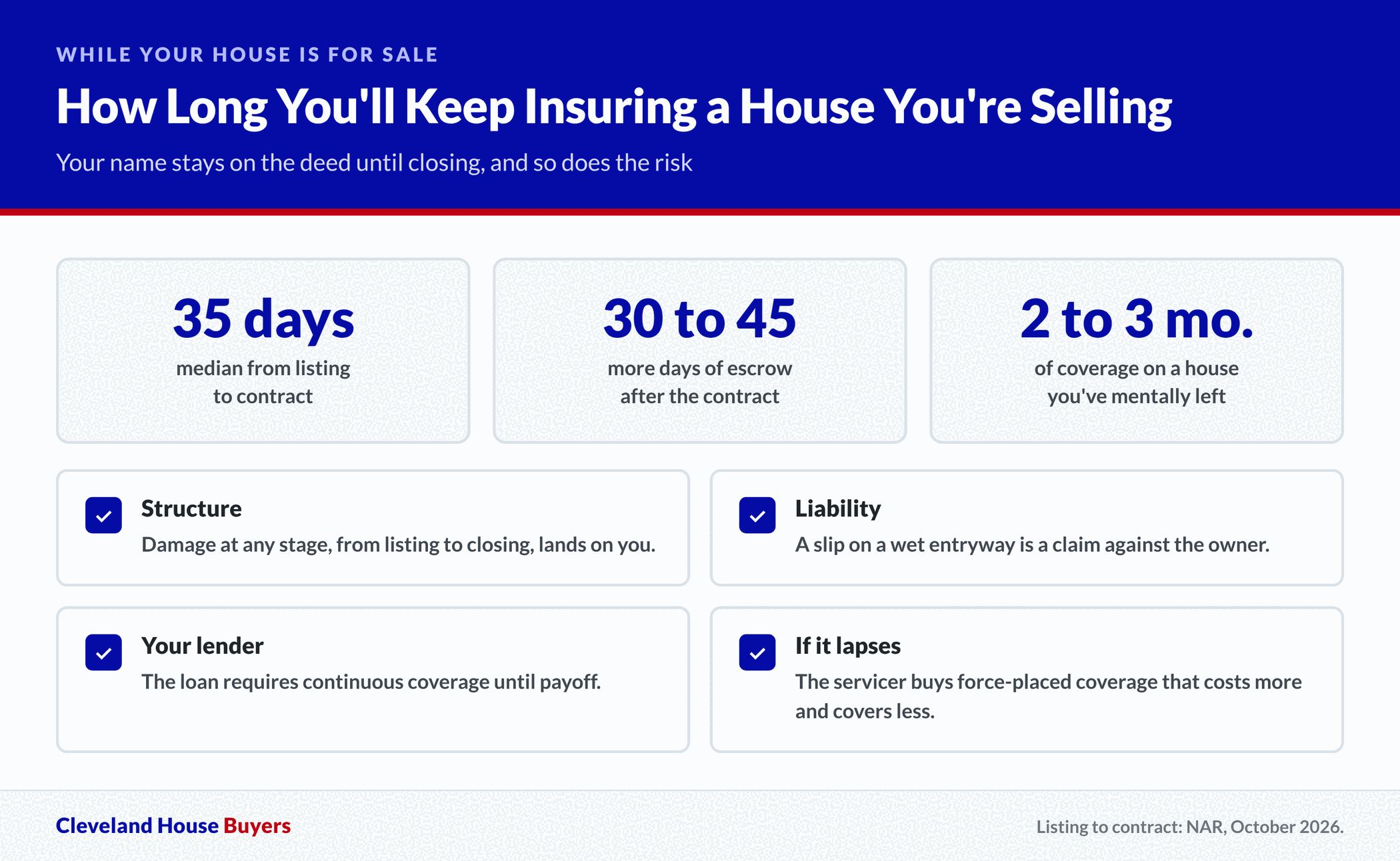
The deed keeps your name on it through every stage: listing, offer, inspection, appraisal, underwriting, closing. Damage at any of those points lands on you. Keeping homeowners insurance active isn’t excess caution. It’s the only thing between a kitchen fire and a loss you’d cover out of pocket.
Liability deserves as much attention as the structure. If someone slips on a wet entryway, that becomes a claim against you, and the liability side of your homeowners insurance is what responds.
Your mortgage lender won’t let you drop coverage anyway. The loan contract requires continuous insurance on the collateral until payoff, and if the policy lapses, the servicer buys force-placed coverage and sends you the bill. It costs more and covers less.
Timing stretches this out longer than most sellers plan. Homes took a median of 35 days to go from listing to contract in October 2026, up from 33 days the month before, according to the National Association of Realtors. Then add 30 to 45 days of escrow. That’s two or three months of insuring a house you’ve already left in your head.
A while back I bought a house from a family who’d quietly carried two mortgages for almost a year after relocating for work. All those months, they were also paying for homeowners insurance on a house nobody lived in.
How Do You Keep Your House Protected Until Closing with Homeowners Insurance?
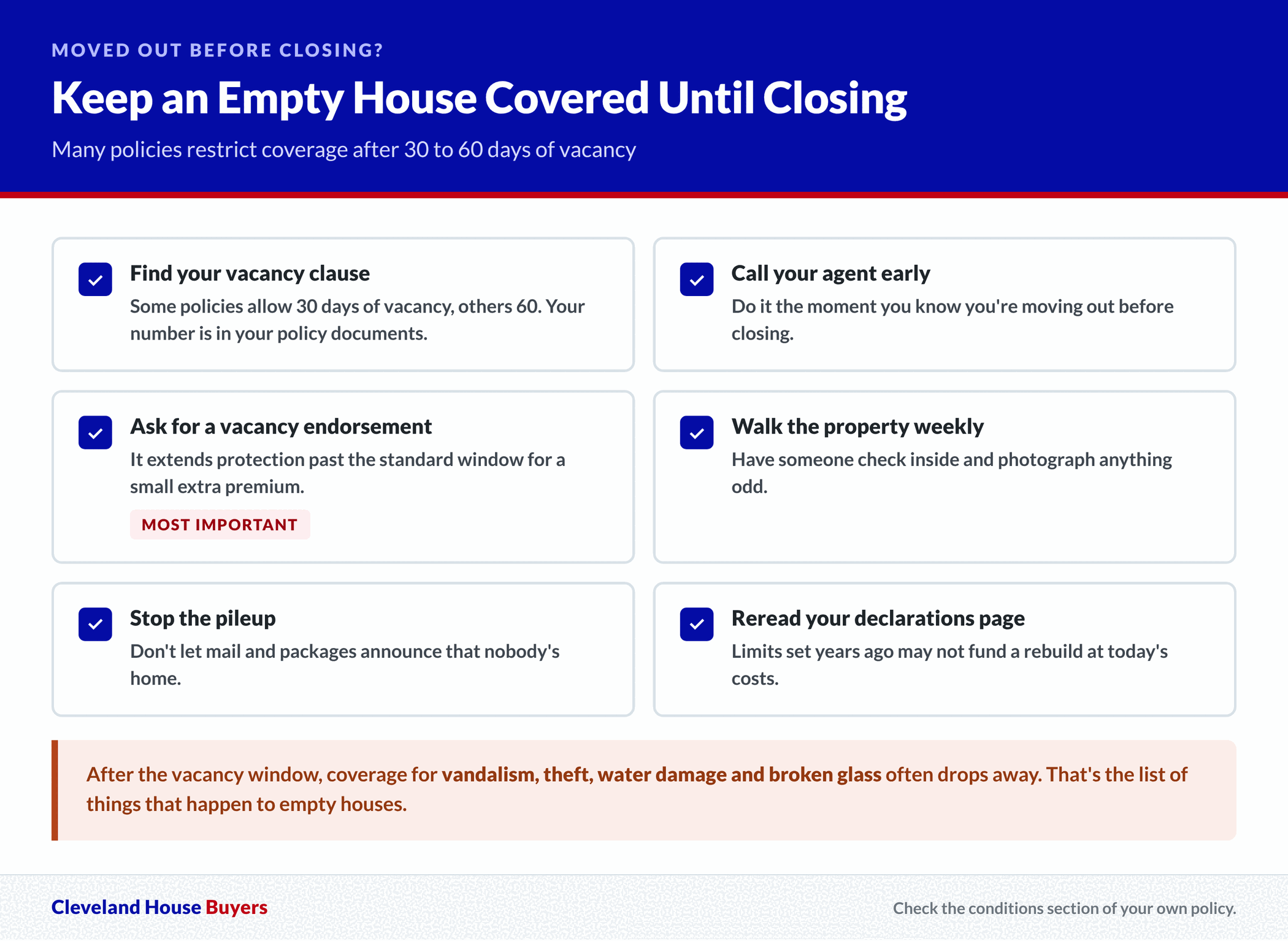
Thirty days is all some standard policies allow an empty house before the vacancy clause starts carving holes in your coverage. Others allow 60. In general, standard homeowners policies restrict or void coverage after 30 to 60 consecutive days of vacancy. The exact cutoff depends on the insurer and the policy form. Your own number sits in the conditions section of your documents.
Once that happens, coverage for vandalism, theft, water damage and broken glass usually falls away, and the insurer can cancel or decline to renew you. Those are exactly the things that happen to empty houses.
Call your agent as soon as you know you’ll be moving out before closing. Carriers see this all the time. A vacancy endorsement stretches your existing policy’s protection for a set period past the standard window, and the added premium is tiny next to an uncovered claim.
Have someone walk through the property once a week and photograph anything that looks off. Don’t let mail and packages stack up on the porch announcing that nobody’s home.
If you haven’t reread your declarations page since you bought the house, now’s the time. Coverage limits set in 2017 won’t rebuild a house at 2026 construction costs, and a partial loss during escrow can sink a sale when the payout won’t cover the repair.
Insurers charge more for a vacant, unheated house, and for good reason. Sellers juggling an empty property and a deadline sometimes decide a direct sale is the simpler route, and that’s a conversation Cleveland House Buyers has with homeowners weekly.
When Should You Cancel Homeowners Insurance on a House You’re Selling?
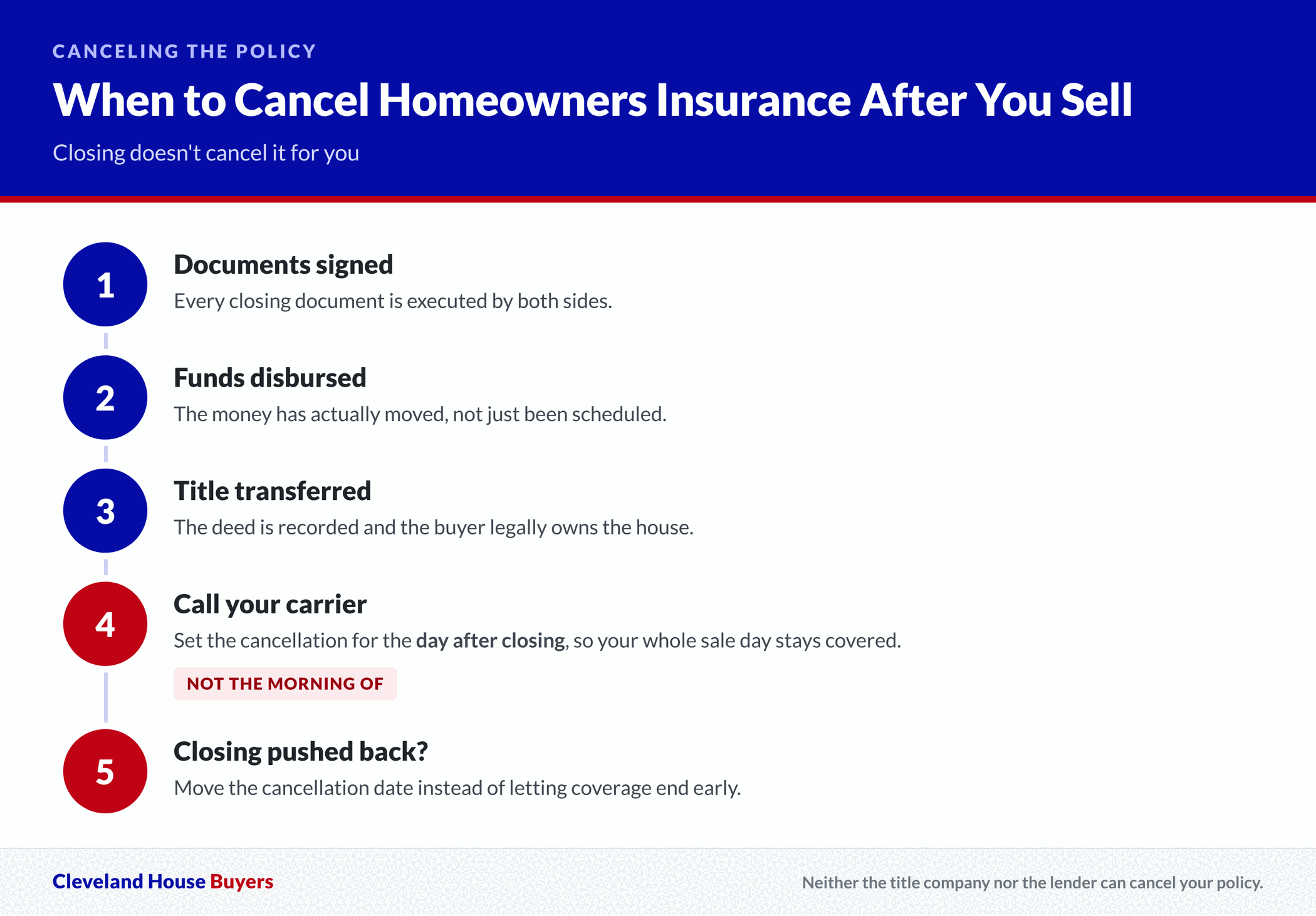
Closing day doesn’t cancel anything on its own. The title company handles the legal transfer of the property, and the lender handles the loan payoff. Neither can cancel your private insurance contract, so that job is yours. Your mortgage servicer will close out the escrow account automatically, but the policy keeps running until you pick up the phone.
Set the cancellation date for the day after closing. Not the morning of. Ending it the day after your closing keeps your whole sale day protected, all 24 hours of it. Deeds get recorded at odd hours and funding slips past lunch, and saving a few pennies isn’t worth a gap of even a few hours.
Before you call, confirm three things: the documents are signed, the funds are disbursed, and the title has transferred. Canceling only after the deed records and the buyer legally takes possession leaves no question about who owned what, and when.
Sales fall apart late. Canceling a policy the minute you get a closing date is a bet that underwriting goes smoothly, and I’ve watched it sink closings I thought were locked in. I’d never make that bet. Appraisals come in short. Buyers change jobs. A last-minute credit pull turns up a new car loan.
If your closing gets pushed, call your carrier and move the cancellation date rather than letting coverage lapse. Keeping homeowners insurance in place through a delayed closing costs a few dollars a day and protects your position completely. Sellers who’ve already moved into a new house are the likeliest to forget, since their attention has moved on to the new address.
Does Homeowners Insurance Transfer to the Home’s New Owner?
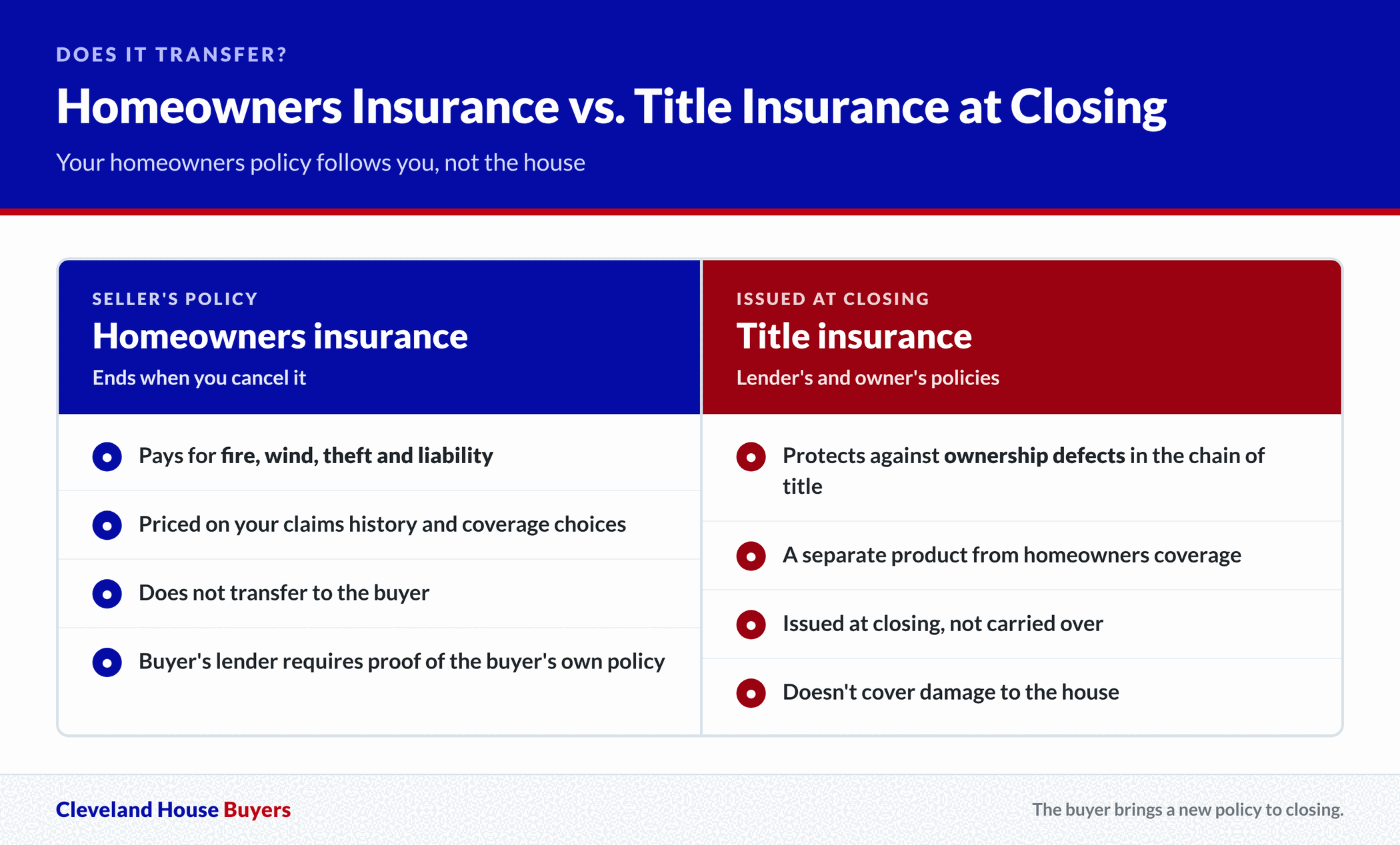
Your homeowners insurance is a contract between you and your carrier, covering your interest in one specific structure. The buyer isn’t part of that agreement. Underwriters priced your policy on your claims history, your credit profile, and your coverage choices. None of that transfers to the next owner along with the house.
Buyers line up their own coverage before closing, and their lender wants proof. A binder or evidence of insurance goes to the closing agent days before anyone sits down to sign.
Title insurance confuses a lot of people at this stage, so it’s worth separating the two. A lender’s title policy and an owner’s title policy are both issued at closing, and they protect against ownership defects in the chain of title. Homeowners insurance is a different product entirely, covering fire, wind, theft, and liability from here on.
Buyers and sellers do share one thing: the claims history tied to the address. Insurers check a shared loss-history database, so earlier water or dog-bite claims at your property can raise what the next owner pays. Honest disclosure beats surprise every time. An insurance quote that comes back high in the middle of escrow can scare a nervous buyer off.
The misunderstanding I run into most at kitchen tables is the idea that the policy goes with the keys. People assume anything attached to a house transfers with it, but homeowners insurance follows the person, not the structure.
How Do You Cancel a Homeowners Insurance Policy After Closing?
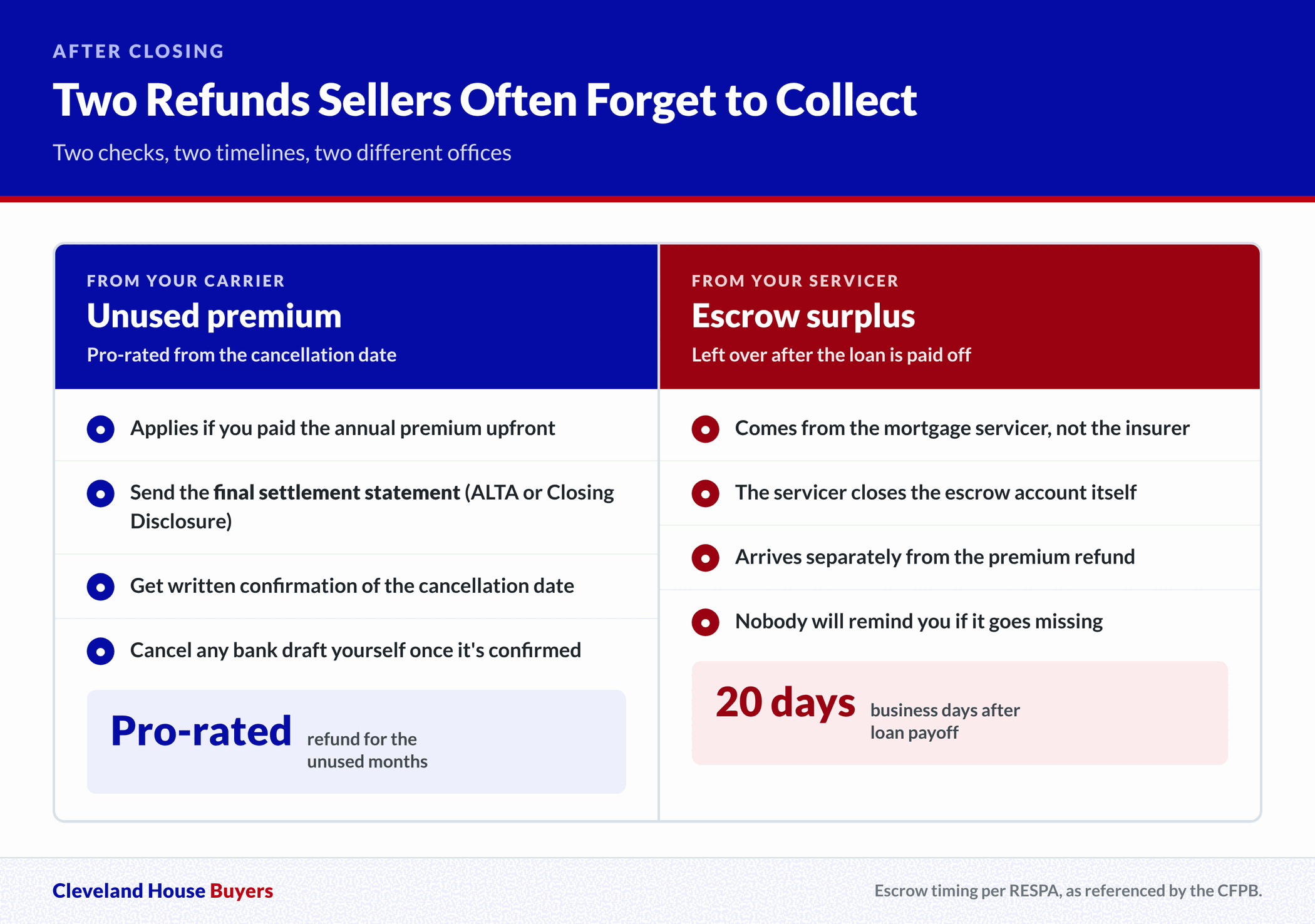
For years I figured the refund check just showed up. It doesn’t, and plenty of sellers leave hundreds of dollars with a carrier that has no reason to track them down.
Most carriers want a copy of the final settlement statement, also called the ALTA statement or Closing Disclosure, before they’ll process the cancellation and release your refund. Ask for written confirmation of the cancellation and its effective date, and file it away.
That money comes back from two different places, which confuses people. If you paid the annual premium upfront, directly or through escrow, you’re usually owed a pro-rated refund for the unused portion, counted from the cancellation date.
The second check is your escrow balance, and it comes from your mortgage servicer. Under RESPA, lenders must return the escrow surplus within 20 business days of the loan payoff, per federal guidelines the Consumer Financial Protection Bureau references. That’s a separate check on its own timeline, from a different office.
Bundling discounts often hang off the homeowners insurance policy, so canceling it can quietly raise what you pay elsewhere. Have your agent requote the bundle before anything lapses.
Then there are automatic payments. If premiums came straight out of your bank account rather than escrow, cancel the draft yourself once the carrier confirms termination. Sellers find months of unnecessary debits more often than you’d think, and getting that money back takes phone calls nobody enjoys.
Can You Transfer Your Homeowners Insurance Policy to a New Property?
An heir I bought from had inherited a ranch house and was moving into her own condo across town that same week. She wanted to know whether her homeowners insurance could just follow her there.
Policies don’t move between addresses. Your carrier will issue a new homeowners insurance policy for the new property and cancel the old one, often during the same phone call. It may be the same company, the same agent, even the same account number in some systems, but it’s a separate contract with its own underwriting.
That’s because the new structure gets rated on its own facts, like age, roof, square footage, distance to a fire station, and local weather risk. A newer house with an updated electrical panel might cost less to insure than the place you’re leaving. A coastal move or a county with wildfire exposure can push the price hard the other way.
Your continuous coverage history does follow you, though, and it’s worth protecting. Insurers price new policies partly on whether you’ve stayed covered without a break. Even a few weeks between policies can bump your rate at renewal and sometimes knock you out of a preferred tier.
Overlap on purpose. If you close on the new house before selling the old one, you’ll carry two homeowners insurance policies for a while, and that’s the right call.
Thinking about a different carrier altogether? Shop before you move, not after. A policy can be canceled and moved to another company at any time on a pro-rated basis. With a pro-rated cancellation, the carrier can’t penalize you or charge a fee to stop coverage. Use that freedom, because staying loyal to a carrier that’s raised your rate five years running earns you nothing.
How Does Homeowners Insurance Change When You Move to a New Home?
That new policy is where most sellers get their first real surprise. The national average premium for homeowners insurance now runs about $2,490 a year for $400,000 of dwelling coverage, per Ramsey’s 2026 state-by-state analysis, and it varies enormously from state to state. Rebuilding costs and weather losses have stacked up for years, so rates keep climbing.
Set dwelling coverage by what it costs to rebuild, not by what you paid. Those two numbers can be far apart.
Most people ignore the deductible, and it’s a real lever. Raising it from $1,000 to $2,500 cuts your premium noticeably, as long as you can absorb that hit after a storm. Many regions also use separate percentage-based deductibles for wind, hail, or hurricane, figured on your dwelling limit instead of a flat dollar amount.
Flood is its own world. Standard homeowners insurance excludes flood damage everywhere in the country, so that coverage has to come through the National Flood Insurance Program or a private carrier.
Moving a household raises more coverage questions than people expect. Jewelry and firearms usually carry sublimits, home office equipment may need a rider, and belongings in transit often aren’t covered by either policy. Cover all of it in one call with your agent.
A landlord called me in the middle of a divorce, splitting assets with his ex and wanting the rental sold without showings, tenants, or a single open house. The property’s detached garage was stuffed with tools neither of them wanted to divide. On a Tuesday, he told me he mostly just wanted the whole thing off his plate.
Key Takeaways on Homeowners Insurance When Selling a House
Keep the coverage until the money moves.
Your homeowners insurance belongs to you, not to the house. It stays in force through listing, contract, inspection, and escrow, because your name is on the deed for all of it. The buyer shows up at closing with a brand new policy on their own terms, and yours ends when you call and end it.
An empty house changes the math. Vacancy clauses quietly narrow your protection, with no letter and no phone call. A short conversation with your agent fixes it, and that’s a lot easier than scrambling after a claim gets denied.
Collect what you’re owed. The pro-rated premium refund from your carrier and the escrow surplus from your servicer are separate payments on separate schedules, and nobody’s going to remind you if one goes missing.
Market conditions drag all of this out. Existing-home sales fell to a 3.75 million annual pace in October 2026, the slowest reading since 2010, and inventory climbed to a 5.1-month supply. A longer timeline means more months carrying a property you’ve already left, and more months for a coverage gap to hurt you.
Some sellers can ride that out. For others, paying two mortgages and insuring an empty house with no end date in sight stops making sense, and that’s where a direct sale with a firm closing date earns its keep.
Frequently Asked Questions
Am I Required to Cancel My Homeowners Insurance After I Sell?
No law requires you to cancel, but nobody else can do it for you, and an open policy means paying premiums on a house you don’t own anymore. Your carrier won’t know about the sale until you tell them. Call once the deed is recorded and the funds have disbursed, set the end date for the day after closing, and get it confirmed in writing.
What Happens If a Storm Damages the House Before Closing?
You file the claim on your own policy, since the property is still yours. Most purchase contracts also give the buyer rights when damage passes a certain threshold, including the choice to cancel or to go ahead and take the insurance proceeds. Tell your agent and the closing agent that same day. Repairs or a negotiated credit usually need to be settled before funding.
Does Selling a House to a Cash Buyer Change Any of This?
The insurance side works the same way. Only the timeline gets shorter. You keep coverage until the title transfers, then cancel and claim your refund. A shorter escrow just means fewer weeks of premium on a property you’re leaving, and fewer weeks of vacancy risk if you’ve already moved out.
If you’re weighing a listing against a direct sale, or you’re just tired of insuring a house you don’t live in, we’re glad to talk it through. The team at Cleveland House Buyers will look at your situation honestly and tell you if listing makes more sense, even when that means we don’t buy it. There’s no pressure and no obligation, only a straight conversation whenever you’re ready.
Insuring a House for Sale in Greater Cleveland
Cleveland-area homes tend to sell faster than the national figures suggest. Redfin’s mid-year review put the metro’s median days on market at 29 for the first half of 2026, with about 2.4 months of supply.
A quicker sale helps, but a vacant house in Cleveland or its suburbs still needs coverage every day it sits. We buy houses as they are from homeowners in Parma, which can shorten the stretch you’re paying to insure an empty property.
Lakewood sellers have the same option: an as-is cash offer and a closing date they choose.
Ready to Stop Insuring a House You’ve Left?
If carrying a policy on an empty house is getting old, a direct sale gives you a firm closing date and a clear day to cancel. Reach out to Cleveland House Buyers with your questions, or fill out the form below for a no-obligation cash offer.