
The homeowner called me the same afternoon her discharge order showed up in the mail, ready to list. She’d picked a Realtor already. The garage was packed. What she hadn’t checked was whether her case was actually closed, and that one gap nearly cost her the sale. Chapter 7 bankruptcy ends in stages rather than all at once, and the stage that controls your right to sell isn’t the one that arrives in a celebratory envelope.
You’ve got plenty of company, too. Americans filed 581,570 non-business bankruptcy cases in the twelve months ending June 30, 2026, a 12 percent jump over the prior twelve months. Plenty of those households own property. When you’re free to sell comes down to a few things you can check yourself.
How Does the Chapter 7 Bankruptcy Process Work?
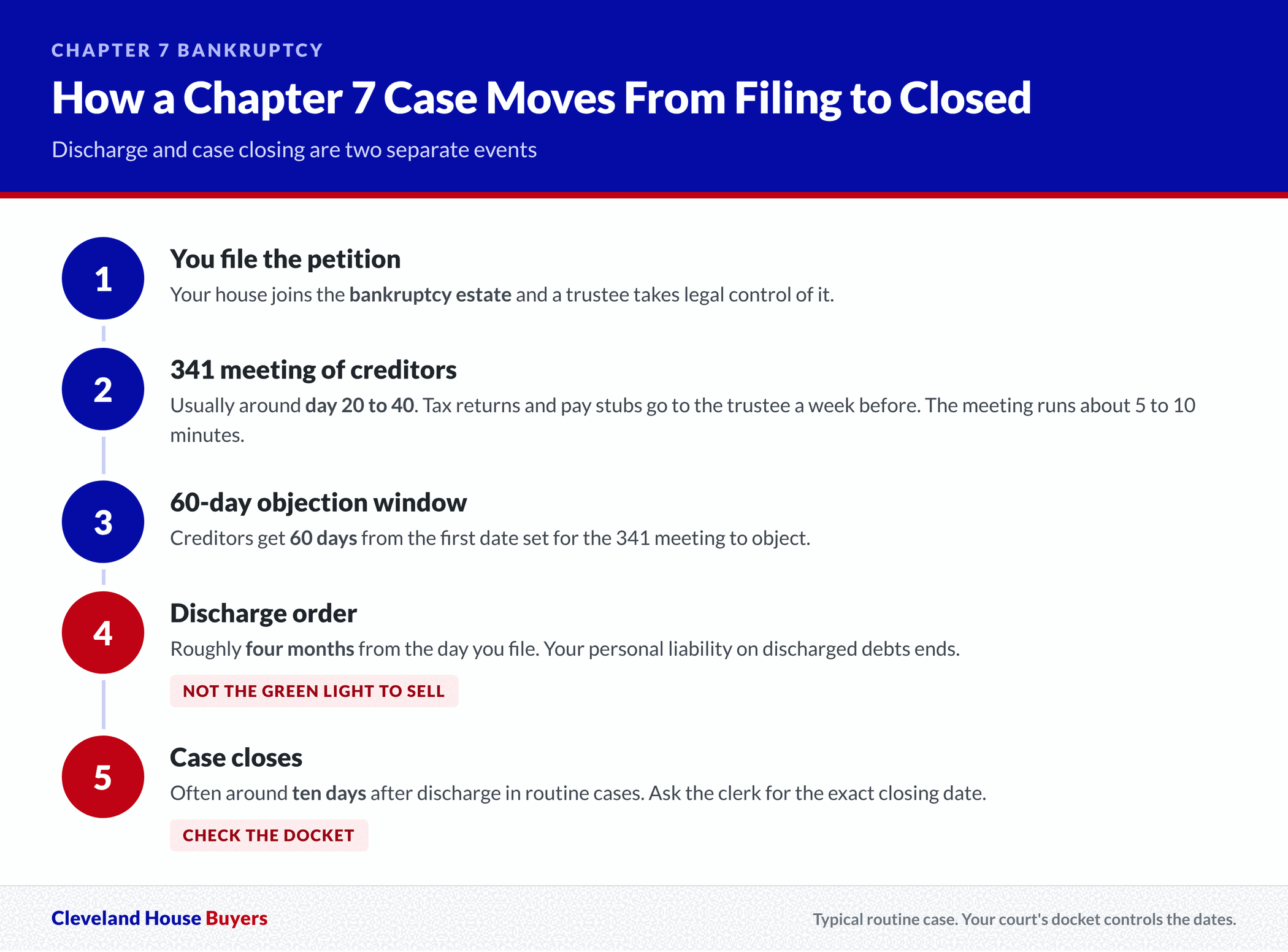
Filing feels like pulling a lever. Sign the petition, wipe out the debt, get on with your life. The lever just isn’t wired to anything that fast. The moment you file, your house becomes part of what the code calls the bankruptcy estate, and a trustee has legal control of it before your paperwork is even put away.
Your first real appointment comes quickly. Court flowcharts put the 341 meeting of creditors at roughly day 20 to 40 after filing, and the trustee wants your tax returns and pay stubs a week ahead of it. It’s short, usually five to ten minutes of questions from the trustee, under oath, about your petition and assets. Most people expect a courtroom. They get a conference room and a brief interview.
After that, you wait. Federal rules give creditors 60 days from the first date set for the 341 meeting to object, and if that window closes with nothing pending, the court has to grant the discharge promptly. The U.S. Courts’ own Bankruptcy Basics guide puts the whole stretch at roughly four months from the day you file.
Your homestead exemption is where the money question gets settled. Each state sets its own protected amount, and some let you pick the federal set instead. If the trustee finds too little non-exempt equity to justify a sale, or decides selling costs would swallow the benefit, the trustee can abandon the property. At that point the estate’s interest is gone, and almost everything after flows from this one decision.
This is where a bankruptcy attorney earns the fee. Exemption amounts change, and some states make you live there for a minimum period first. A wrong guess turns protected home equity into cash a trustee can hand to creditors. Get it confirmed instead of assuming. Your attorney or the clerk of your bankruptcy court can tell you which exemption set applies.
What Happens to Your House After a Chapter 7 Discharge?
Four months in, most filers are holding a discharge order and assuming the deed is clean. That’s only accurate once two separate things are true: the debt is discharged, and the property has left the estate.
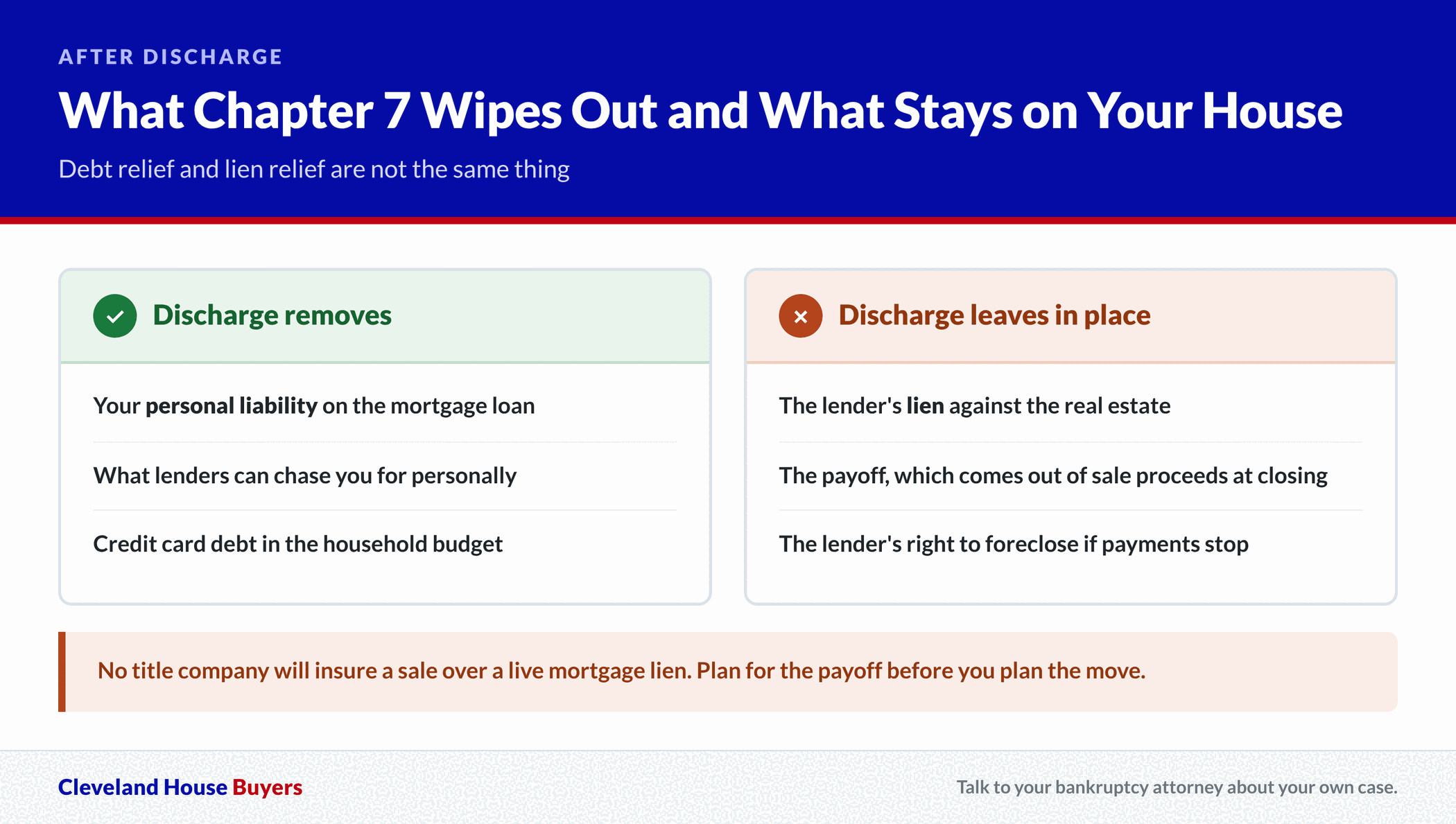
Those two events don’t happen together. When a Chapter 7 bankruptcy case closes and the discharge is entered, exempt or abandoned property usually comes back under your control. Meanwhile, the lender’s lien tends to stay exactly where it was. That part is worth reading twice. Your personal liability for the loan can disappear while the lien against the real estate survives untouched.
You’ll feel that at the closing table. Your payoff still comes out of the proceeds, because no title company in America will insure a sale over a live mortgage lien. The discharge changed what lenders can chase you for personally. It didn’t erase the debt tied to the dirt.
Not long ago, three adult siblings called me about their late mother’s ranch house. A Chapter 7 bankruptcy had tangled up the family’s finances, and thirty years of belongings filled every room. I still picture a 1970s sewing machine in the garage, buried under boxes nobody wanted to open. They wanted a clean exit instead of a six-month sorting project, so we bought it with everything still inside.
Equity is the other moving piece, and sellers tend to underestimate how much timing matters. Redfin reported a median U.S. home sale price of $388,634 in October 2026, down 0.4 percent from a year earlier and the first annual decline since May 2023. When prices soften, the equity math a trustee ran months ago changes, and that can work for you.
What Should I Do Once My Chapter 7 Bankruptcy Case Settles?
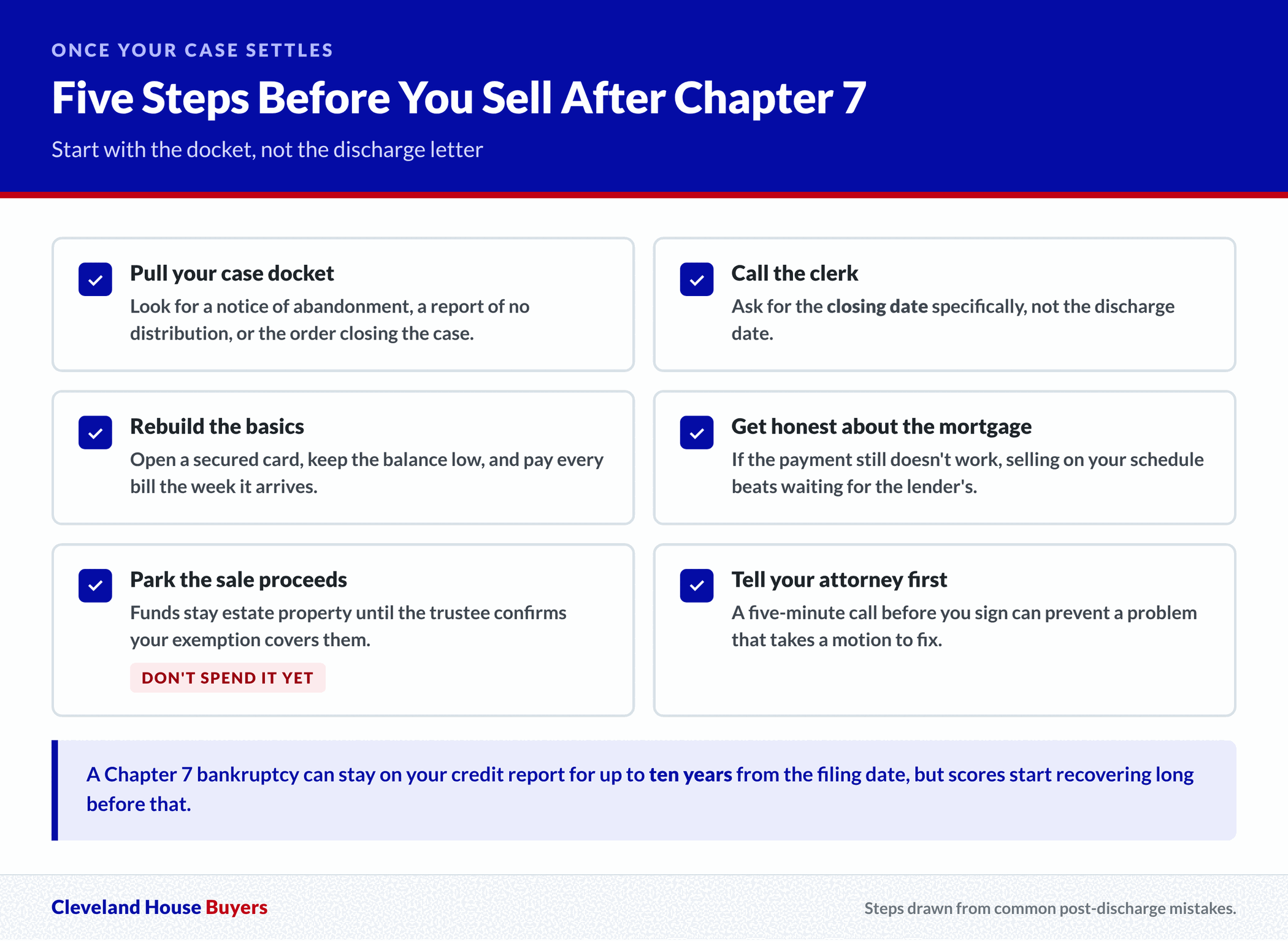
Pull your case docket first. Not the discharge letter. The docket.
Your house remains property of the estate until it’s abandoned or the case is fully administered and closed. The discharge has nothing to do with whether an asset still belongs to the estate. Those run on two separate clocks. If you sell before abandonment, a trustee can still claw back the proceeds after discharge.
In the docket, look for a notice of abandonment, a report of no distribution, or the order closing the case. Routine cases usually close about ten days after discharge, but “usually” isn’t something you’d want to bet a closing on. Call the clerk and ask for the closing date itself, not the discharge date.
Next, rebuild the basics. Open a secured card, keep the balance low, and pay each bill the week it shows up. A Chapter 7 bankruptcy can sit on your credit report for up to ten years from the filing date, though scores start climbing long before it drops off.
Third, get honest about the mortgage. Plenty of filers leave a Chapter 7 bankruptcy with a payment they couldn’t afford going in and still can’t afford coming out. The discharge cleaned up the credit cards. It didn’t fix the household budget. If the payment doesn’t work, selling on your own schedule beats waiting for a lender to pick one for you.
The mistake I see over and over is people spending sale proceeds before the trustee signs off. Funds from a sale stay estate property until the trustee confirms your exemption covers them. Park the money. Don’t repay a relative or buy a truck, and don’t shift it to another account until your attorney says you’re clear.
How Soon After Chapter 7 Can I Sell My House?
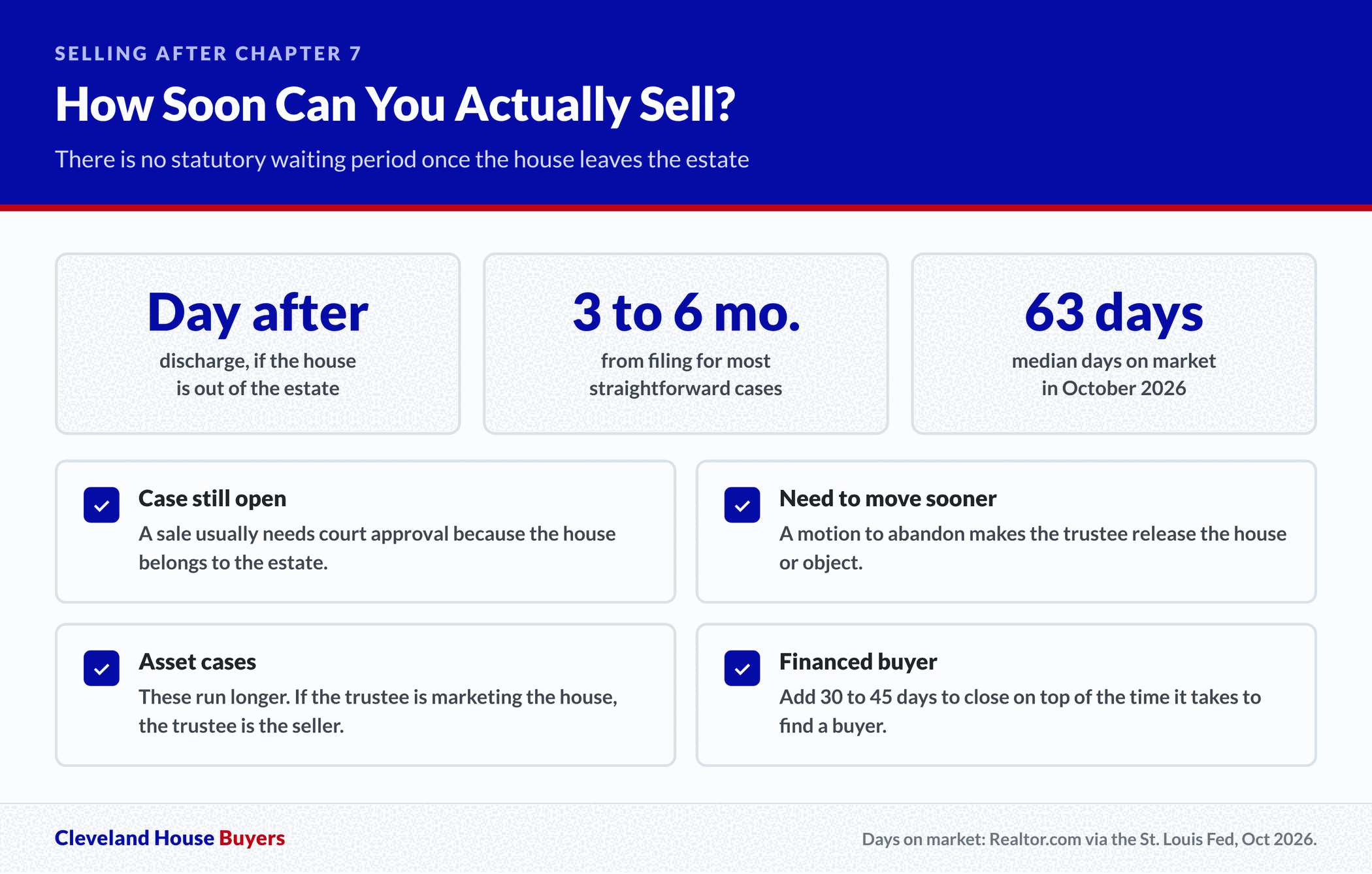
That brings us to the actual number, and it’s shorter than most people expect. You can sell your house the day after your Chapter 7 discharge is entered, as long as the property is truly out of the estate. There’s no statutory waiting period standing between you and a buyer.
While the case is open, it’s a different story. Selling during an active bankruptcy usually takes court approval, since the house belongs to the estate and you can’t list it yourself. You can file a motion asking the court to abandon the house from the estate. That forces the trustee to release title back to you or object. If you’re up against a deadline, it’s a real option, and one to talk through with your bankruptcy attorney.
For a straightforward Chapter 7 bankruptcy, most homeowners are in the clear somewhere between three and six months after filing. Asset cases take longer. If your trustee is actively marketing the house to pay creditors, the trustee is the seller, not you.
How fast you need to be out decides which path makes sense. Realtor.com data published through the St. Louis Fed shows median days on market at 63 in October 2026, up from 53 in June. Add 30 to 45 days for a financed closing, and a traditional listing can easily run past three months from yard sign to money in hand.
One more wrinkle. A few states put conditions on homestead proceeds after a sale, so check before you assume the money is simply yours. California, for one, has reinvestment rules tied to protected homestead money. Ask your attorney whether your state has anything similar before you deposit the check.
What Are My Options for Selling a House After Chapter 7 Bankruptcy?
For years I told sellers that listing with an agent always nets more money. I quit saying it because it’s wrong too often. Net proceeds and sale price stop being the same number once you subtract commissions, repairs, carrying costs, and three more mortgage payments.
Listing still makes sense when your house shows well and you aren’t in a hurry. Price it against real comparables rather than whatever your neighbor asked in 2022. Redfin’s four-week snapshot ending October 25, 2026 put the average sale-to-list ratio at 98.3 percent, with 21.5 percent of listings taking a price cut. Buyers are negotiating again.
Selling as-is to a direct buyer sits at the opposite end. You give up some price for speed and certainty: no repairs, no showings, no appraisal that falls apart, no financing contingency. Cleveland House Buyers regularly works with homeowners coming out of a Chapter 7 bankruptcy, and what they want is nearly always the same: a date you can count on.
A short sale comes into play when you owe more than the property is worth. Your lender has to sign off, the servicer sets the pace, and it nearly always takes longer than people hope. After discharge, you aren’t negotiating away personal liability, because that’s already gone. You’re negotiating a lien release.
Renting it out tempts a lot of folks. Think hard about it. Becoming a landlord with thin reserves, right after a Chapter 7 bankruptcy wiped out your cushion, is how people land back in financial trouble. One bad tenant or one dead furnace can erase a year of rent.
Auctions and family-member sales are also on the table, and each brings its own paperwork. Whatever route you choose, tell your bankruptcy attorney before you sign anything. A five-minute call now heads off the kind of problem that takes a motion to fix later.
What Happens When You’re Finally Able to Sell After Chapter 7?
Verifying first is what separates a smooth closing from a mess. Skip it and your buyer’s title company turns up the open bankruptcy case during its search. The closing stops cold, and you’re the one explaining to a buyer with a moving truck why nobody can sign. Sales fall apart over delays like that.
If you did it right, closing after a Chapter 7 bankruptcy looks like any other closing. The title company orders a payoff, clears liens, and cuts you a check for what’s left, and the signing itself is uneventful. Some title companies want a copy of the discharge order and the case closing order, so keep both handy as PDFs.
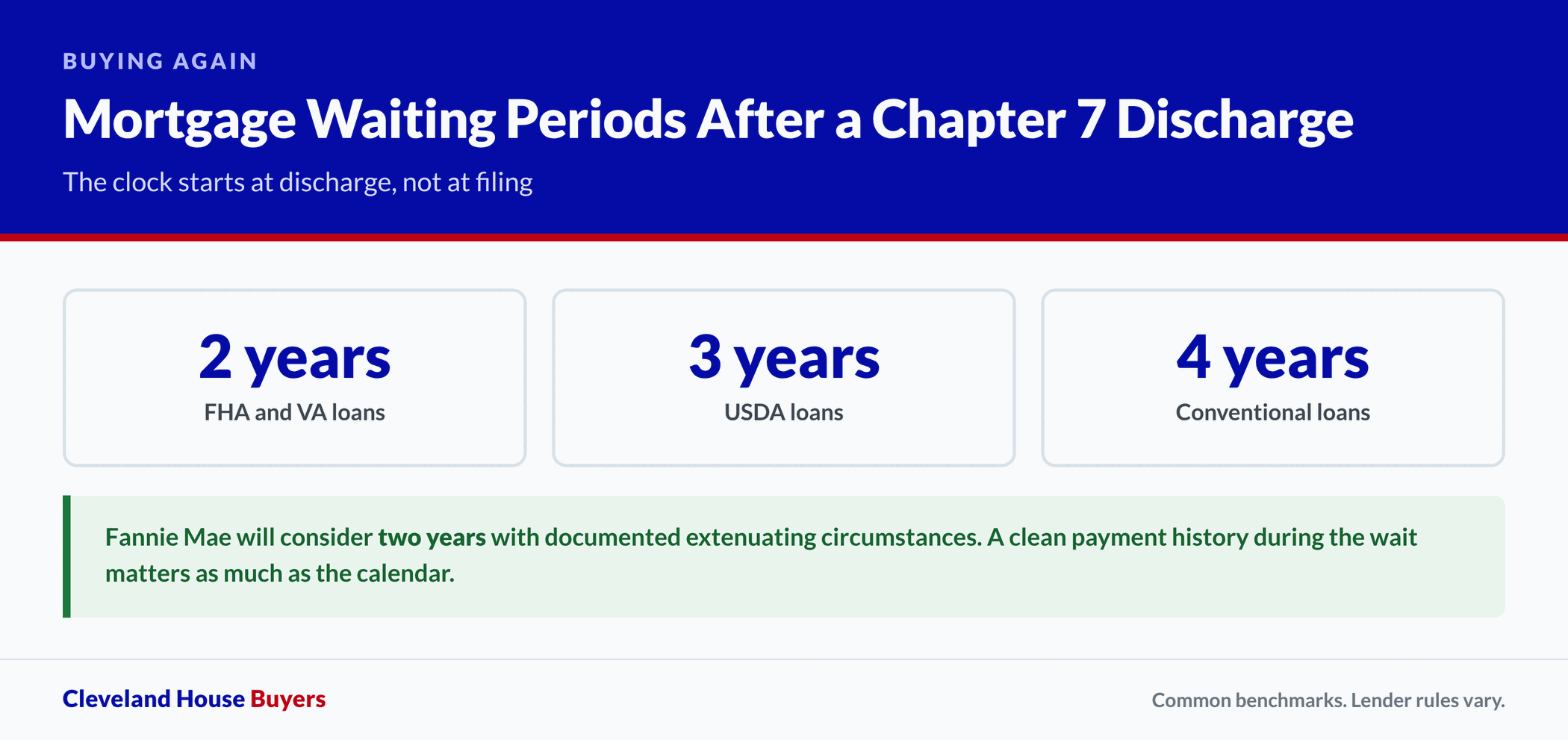
Once the estate has no claim, the proceeds are yours. Protected equity can cover a rental deposit, a future down payment, or just some breathing room. Financing also comes back faster than the ten-year credit report shadow suggests, because lenders don’t use the number that scares people on paper. FHA and VA loans commonly use a two-year benchmark after discharge, USDA generally wants three years, and conventional mortgages ask for four. Fannie Mae will consider two years with documented extenuating circumstances.
Taxes get one sentence. The federal capital gains exclusion on a primary residence comes with ownership and use requirements, and a CPA can tell you in a single conversation whether your sale triggers anything.
A man called me on a Tuesday afternoon, three months behind on his mortgage with an auction date already set. He’d finished his Chapter 7 bankruptcy and figured the discharge had stopped the foreclosure clock. It hadn’t, because the lien survived. We closed before the sale date, and he kept equity that would otherwise have disappeared on the courthouse steps.
I see that pattern more than any other. People mix up debt relief with lien relief, and it costs them real money.
Frequently Asked Questions
Does My Mortgage Disappear When My Debts Are Discharged?
No, and it trips up more homeowners than anything else in a Chapter 7 bankruptcy. Your personal obligation to repay can be wiped out while the lender’s recorded lien on the real estate stays put until it’s paid off or released. That’s why a foreclosure can still go forward on a discharged loan once the payments stop.
Do I Have to Tell a Buyer About My Bankruptcy?
Not as a property disclosure, since a past bankruptcy isn’t a physical defect. The title company finds the case in its search anyway, so there’s nothing to gain by being cagey. Hand your closing agent the discharge and case closing documents early, and the transaction runs like any other.
Should I Sell Before Filing or After?
After, in most cases, and I mean that as a real opinion rather than a hedge. Selling first can turn protected home equity into cash in a bank account, where a trustee has a far easier time claiming it for creditors. Talk to a bankruptcy attorney before you list anything, since the order of those two decisions changes how much money you keep.
What If My House Is Worth Less Than I Owe?
Oddly enough, you have fewer moving parts than someone with equity. A trustee has no reason to sell a property that holds nothing for creditors, so abandonment tends to come quickly in those cases. After that, you’re either negotiating a short sale with the lender or deciding whether surrendering the property beats fighting for it.
If you’re on the far side of a Chapter 7 bankruptcy and wondering whether selling makes sense, we’re happy to talk it through. Bring your questions about timing, equity, or what your house would realistically bring as-is, and we’ll give you a straight answer either way. You can reach the team at Cleveland House Buyers whenever you’re ready. There’s no pressure and no obligation, and no hard feelings if you’d rather list with an agent.
Selling After Chapter 7 in Greater Cleveland
Timing matters after a bankruptcy because of equity, and Cleveland-area sellers have more of it than they did a year ago. Redfin put the metro’s median sale price at $245,072 for the first half of 2026, up 5.7% from a year earlier. That shift alone can change the equity math a trustee ran when your case opened.
If you own a house in Cleveland or a nearby suburb, check today’s numbers before you decide how to sell. We buy houses as they are from homeowners in Parma and across Cuyahoga County.
Lakewood sellers get the same option: an as-is cash offer and a closing date they pick.
Talk Through Your Sale After Chapter 7
Every Chapter 7 case closes on its own schedule, and the right way to sell depends on where yours stands. If your house is out of the estate and you’d prefer to skip repairs and showings, we can make you a cash offer and let you choose the closing date. Contact Cleveland House Buyers with your questions, or fill out the form below to get started.