

Plenty of Ohio homeowners assume a property transfer is one signature and a trip to the mailbox. Sign the quitclaim deed, mail it off, done. Then the auditor kicks the deed back. Or worse, they learn months later that the transfer never hit the public record, because nobody mentioned Ohio’s two-stop sequence. Auditor first, recorder second. That gap between what people picture and what Ohio law demands trips up sellers, divorcing couples, and heirs.
How Is an Ohio Quitclaim Deed Different From Other Deeds?
A warranty deed makes promises. The grantor swears they own the property, swears the title is clear, and gives the grantee the right to sue if either is false. A quitclaim deed promises nothing. Your grantor passes along whatever interest in the property they hold, and you take the property as-is, liens and clouds included. No guarantees. No recourse when a lien surfaces two years later. If you’re still sorting out which document actually moves ownership at closing, start with whether a deed is required to sell a house in Cleveland.
That distinction matters more than it sounds in practice. Someone buying from a stranger has every reason to refuse a quitclaim deed. Between family members, business partners, divorcing spouses, or when you’re moving a property into a living trust, it’s usually the right tool. Cleveland’s average home value sat at $120,419 in Zillow’s August 2026 reading, down 1.4 percent on the year. Even a modest duplex is real money if the deed gets recorded wrong.
A while back, I worked with a landlord in Lakewood who’d held a rental duplex with his ex-wife years after the divorce, and he just wanted his name off the deed. A quitclaim deed handled the ownership transfer, recorded at the county within a week. If you’d rather not handle any of this yourself, here’s how we buy houses in Cleveland.
What Is an Ohio Quitclaim Deed?
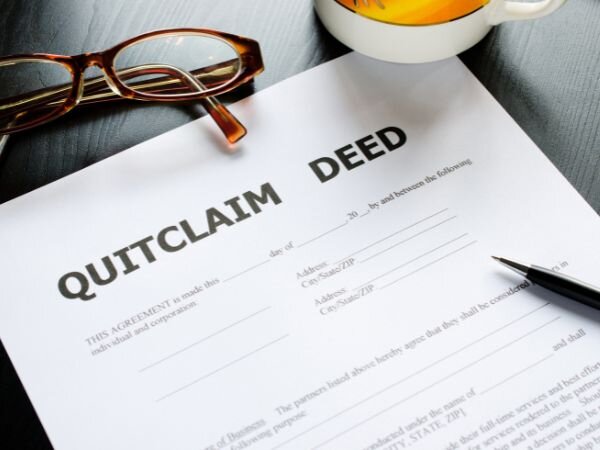
Ohio Revised Code Section 5302.11 lays out the statutory form. A deed that substantially follows it, executed under Chapter 5301, has the force and effect of a deed in fee simple to the grantee. That runs to the grantee’s heirs, assigns, and successors too, with no covenants of any kind on the grantor’s part. Translation. The transfer is binding and permanent, and nobody is promising anything about the title being passed along.
Notice the spelling: Ohio’s statute calls it a quit-claim deed, hyphenated, and county offices and template sites use both, which means the same either way. A judgment lien sitting on the property rides along with the deed to the grantee.
What Are the Different Versions of an Ohio Quitclaim Deed?
Ohio codifies several statutory deed forms, and picking the wrong one has consequences.
Under Section 5302.11, a quitclaim deed carries no covenants at all. Section 5302.05 gives you the general warranty deed, where the grantor vouches for the title back through every prior owner. Section 5302.07 covers the limited warranty deed, which defends only against claims arising under that grantor. For family transfers, trust funding, and divorce conveyances, a quitclaim deed wins on simplicity, since nobody is relying on a title guarantee. In an arm’s-length sale to a stranger, that same simplicity is the problem.
What to Include in an Ohio Quitclaim Deed
Read the Ohio statutory form, and you’ll see how little it asks for. The grantor’s marital status and county, a statement that valuable consideration was paid, the grantee’s name and tax-mailing address, and a legal description of the real property. Short list. Every blank on it has to be right.
Dower is the trap. Ohio still recognizes it under ORC Section 2103.02, an old rule giving a spouse a life estate in one-third of any real property the other spouse owned during the marriage. If the grantor is married, the spouse should sign the dower release printed on the form. Skipping it won’t void the deed, since Section 5301.071 says an instrument isn’t defective just for failing to release dower. What it leaves behind is a possible dower claim after the owner dies, the kind of cloud a title search turns up years later. Clouds like that are the reason selling a house with title issues in Cleveland drags on far longer than a clean sale.
One more thing people forget is the prior instrument reference, the volume and page where the current deed sits in county property records. ORC Section 5301.011 asks for it and says omitting it doesn’t invalidate the deed. Cuyahoga County’s transfer standards require it anyway, so a blank line gets your quitclaim deed handed back. Same story with the grantee’s tax-mailing address, which ORC Section 319.20 requires.
Step-by-step Instructions for Filling Out an Ohio Quitclaim Deed
Recording is the finish line, though a few things happen in order first, starting with costs. ORC Section 317.32 puts the base recording charge at $34 for the first two pages, $8 for every page after, and counties may add a preservation surcharge of up to $5. Most quitclaim deeds run two or three pages.
Start with a form that substantially follows ORC Section 5302.11. Fill in the grantor’s full legal name, marital status, and county of residence. Add the grantee’s name, tax-mailing address, and a proper legal description of the property, not the street address alone. Copy the prior instrument reference off the existing deed. Married grantor? Then the spouse signs that release line too.
Signing comes next, and Ohio gets specific. Under ORC Section 5301.01(A), the grantor signs the quitclaim deed and acknowledges that signature before a notary public, or before a judge, clerk of a court of record, county auditor, county engineer, or mayor. The notary’s certificate is what makes the deed recordable. No witnesses are required, not since February 1, 2002, when Ohio dropped the two-witness rule and the current statutory forms took effect. Make copies once it’s notarized, since the original heads downtown.
How to File a Quitclaim Deed in Ohio

Ohio runs two stops for every deed transfer, and the first one isn’t optional.
Before any Ohio deed reaches the recorder, the auditor has to transfer the property on the tax list and endorse the deed under ORC Section 319.20. Getting that endorsement means handing the auditor a completed Real Property Conveyance Fee Statement of Value and Receipt, Form DTE 100, per ORC Section 319.202. Exempt transfer? Then Form DTE 100EX goes in instead: the Statement of Reason for Exemption from Real Property Conveyance Fee.
Fees get collected at that same auditor’s window. ORC Section 319.54(G)(3) sets a mandatory conveyance fee of $1.00 or 10 cents per $100 of value, whichever is greater. Counties may add a permissive real property transfer tax of up to 30 cents per $100 under ORC Section 322.02. Cuyahoga charges the full permissive amount, so the combined bill runs $4.00 per $1,000, plus a $0.50 transfer fee per parcel. That $0.50 applies even on exempt transfers.
Then the recorder. ORC Section 5301.25 requires deeds to be recorded in the county where the property sits, and until they are, they’re fraudulent against a later good-faith buyer who knew nothing about them. That’s why the recorder’s stamp matters. Homeowners here catch a break, since Cuyahoga County folds the auditor and recorder duties into one office, the Fiscal Officer, with transfer and recording at 2079 East Ninth Street. Call ahead and confirm counter hours.
Cleveland House Buyers has walked this two-stop process on dozens of Cuyahoga County transactions and can point you to the right counter.
Where to Find Ohio Quitclaim Deed PDF and Word Templates
Bad templates cause more Ohio deed rejections than bad handwriting. A form missing the prior instrument reference or the grantee’s tax-mailing address fails quietly, with no warning until somebody at the county auditor’s counter says no.
Begin with the statutory language itself, at Ohio Laws, Section 5302.11, which is free and which everything else copies. Franklin County Law Library keeps an Ohio Deeds guide worth bookmarking, since it maps the relevant code sections and links to them. Paid services offer fillable PDF and Word versions, which is fine, but check the marital status field, the dower release line, and the prior instrument reference first.
Property held in a trust or an LLC? Then the entity’s authorized officer signs the deed, not an individual, and the form language must reflect that. Attorney review on a trust transfer costs little next to unwinding a bad one.
What Other Ohio Legal Documents Might You Need?

Every transfer needs a conveyance form, gifts between family included. Cite the wrong exemption code on the DTE 100EX, and you’re back in line, with the recording date sliding with you.
Dower release language on the deed itself covers the spouse’s interest in most situations. A mortgage is a different animal, since quitclaiming the property moves title and does nothing to the loan. The mortgage lien stays attached until somebody pays it off or refinances. Grantees tend to learn that at the worst possible moment.
Estate and trust transfers can need more than the deed. An Ohio attorney can tell you whether a certificate of transfer or an affidavit of successor trustee belongs in the file, the latter under ORC Section 5302.171. Your county recorder’s office will confirm which supporting documents they want, so call before you show up.
I had a landlord reach out from Euclid, three months behind on his mortgage, with a foreclosure auction already on the calendar. His problem needed more than a deed transfer, since the lender had to be at the table, which took longer than a normal closing. Cleveland House Buyers worked the timeline and closed ahead of the auction date. If the paperwork has gotten ahead of you and you’d rather hand the whole thing off, we buy houses in Ohio and can walk the timeline with you.
Frequently Asked Questions
Can You Prepare Your Own Quitclaim Deed in Ohio?
Yes, you can prepare your own quitclaim deed in Ohio without an attorney. The statutory form language is public, sitting right there in Ohio Revised Code Section 5302.11, and no law requires professional help. If a trust, an estate, a lender, or a disputed ownership interest is involved, paying an attorney to read the deed first is money well spent.
What Are the Downsides of Using a Quitclaim Deed?
No title guarantees whatsoever, and that’s the downside in a single line. Should a lien, judgment, or competing ownership claim surface after the transfer, the grantee has no recourse against the grantor under the deed itself. A quitclaim deed also leaves any existing mortgage right where it was, attached to the property, no matter whose name holds title. For an arm’s-length sale to a stranger, a warranty deed is the safer instrument.
How Much Does a Quitclaim Deed Cost in Ohio?
Two offices, two bills. At the county recorder, Ohio Revised Code Section 317.32 sets a base of $34 for the first two pages and $8 for each additional page, plus a preservation surcharge of up to $5. Cuyahoga County has charged $39 for the first two pages since October 24, 2024. At the county auditor, the mandatory conveyance fee is $1.00 or 10 cents per $100 of value, whichever is greater, plus any permissive transfer tax up to 30 cents per $100. In Cuyahoga, that’s $4.00 per $1,000 of value. Gifts to family and transfers of property into your own living trust may qualify for an exemption. The $0.50 per-parcel transfer fee still applies, and you have to cite the right code on the DTE 100EX.
Handling a quitclaim deed and wondering whether holding onto the property still makes sense? We’re happy to talk it through, no pressure either way. Cleveland House Buyers has worked with sellers in Parma, Brook Park, Lakewood, and Garfield Heights who wanted a straight answer about their options. Reach out whenever you’re ready.
Helpful Ohio Blog Articles
- Selling A House That Failed Inspection In Ohio
- Who Pays HOA Fees At Closing In Ohio
- How To File A Quitclaim Deed in Ohio
- Can Medical Bills Take Your House In Ohio
- How To Sell Your House With Septic Tank Problems In Ohio
- Can the Seller Back Out of a Contract in Ohio?
- How to Split Home Equity Fairly in an Ohio Divorce
- Should You Remodel Your Kitchen Before Selling Your Home
- Can I Sell My House in Ohio If My Spouse is in Jail
- How to Take Your House Off the Market in Ohio
- Do I Need a Lawyer to Add a Name to a House Deed in Ohio
- Selling a Home with a Reverse Mortgage in Ohio
- How to Show Your House While Still Living in It