
Three siblings inherit a ranch house. Two want cash. The third wants to keep it, and by Thanksgiving nobody can agree on anything. Thousands of families land in that standoff every year, and it nearly always ends with someone asking whether they can sell a share of a house without dragging everyone else along. You can. It just won’t look like a normal home sale, and the price you get leans heavily on the route you pick.
What Is Shared Ownership and How Does Selling a Share of a House Work?
A deed looks simple enough. Two names, one address, and that’s it. Underneath, though, each co-owner holds what’s called an undivided interest. You own a percentage of the property, yet you have the same right as everyone else to use every room of it.
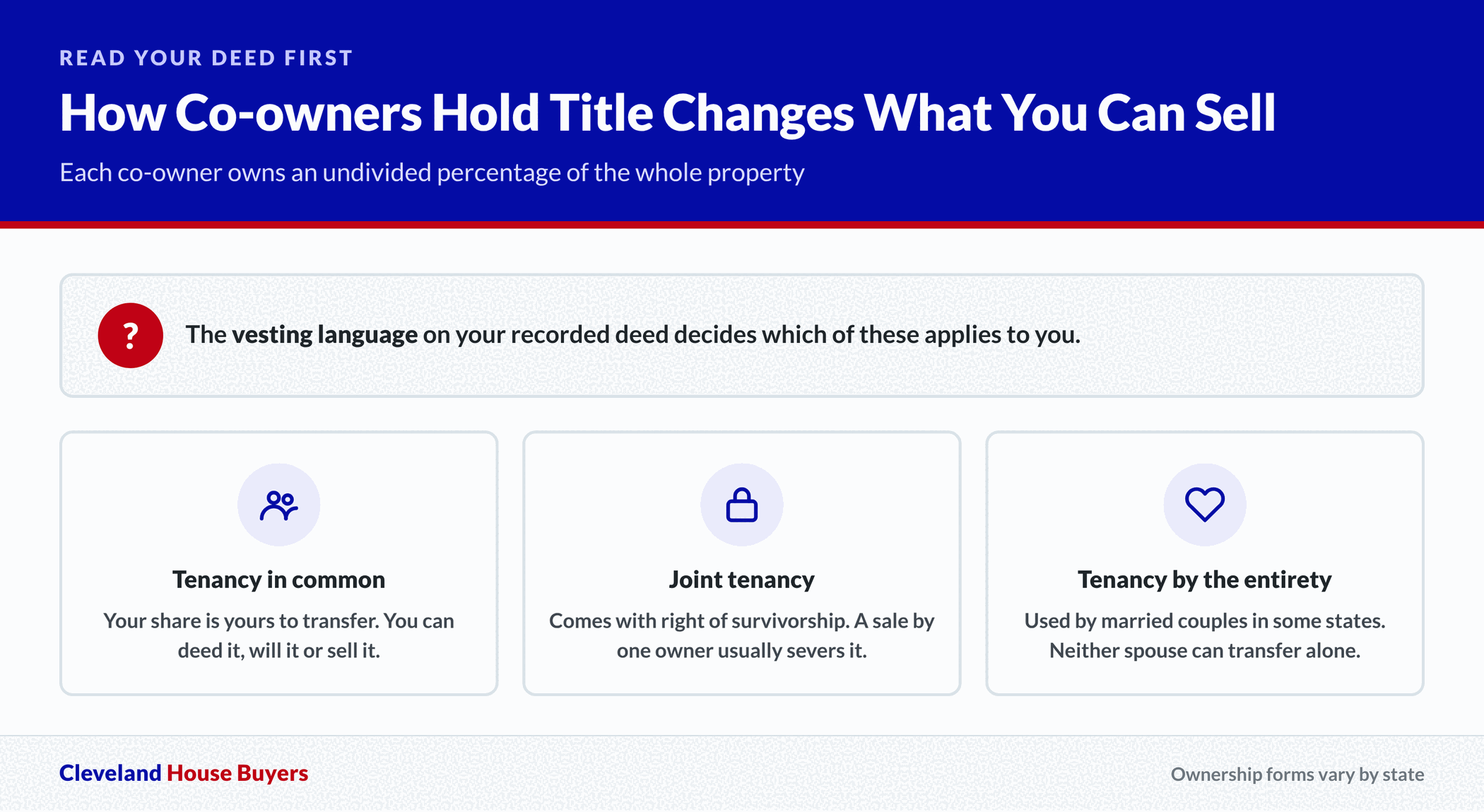
Most co-owners end up as tenants in common, especially after a parent dies without clear instructions. That form lets you transfer your ownership interest on your own. Deed it, leave it in a will, or sell it. Joint tenancy with right of survivorship works another way, and a sale by one owner usually breaks the survivorship feature. In some states, married couples hold title as tenants by the entirety, and neither spouse can transfer alone. Your deed says which one applies. If the wording confuses you, paying a real estate attorney to read it costs less than guessing wrong.
Selling your share of a house to an outside buyer is legally permitted in most situations.
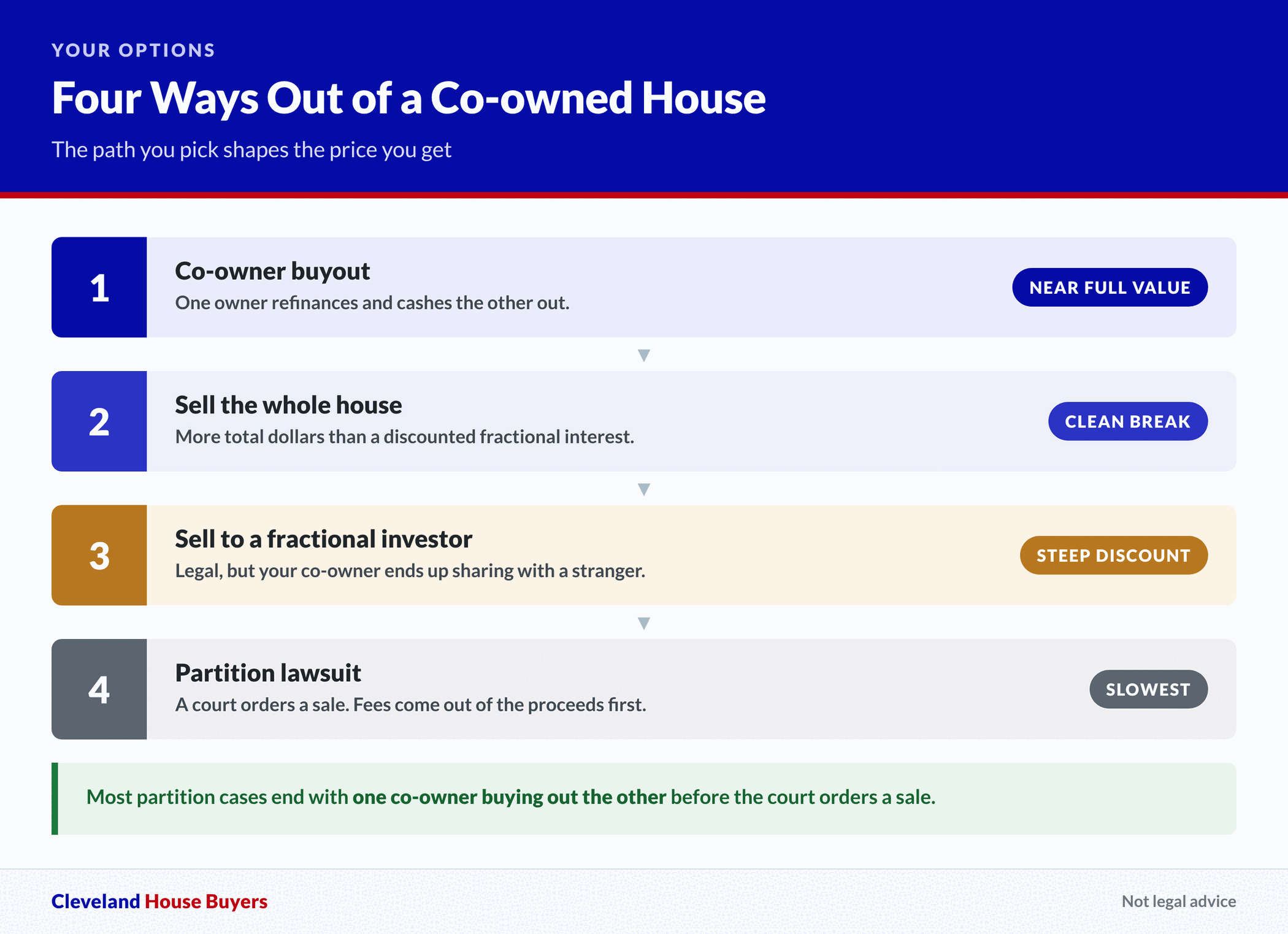
Think about who’d want 40 percent of a house they can’t fully control. They can’t easily finance it, and they may end up sharing it with a stranger who resents them. Mortgage lending mostly dries up here, since conventional lenders want a lien on the whole property, not a slice. That’s why fractional interests trade at a discount. Realistically, the buyer pool shrinks to two groups: your co-owners and specialty investors who buy fractional interests.
What I see work most often is pretty plain. One owner gets a valuation and proposes a buyout number. The other refinances to cash them out. That refinance carries the load: the departing owner signs a quitclaim or warranty deed, the lender pays them, and the owner who stays takes over the full mortgage.
Why Do Co-owners Want to Sell Their Share of a House?
Divorce drives a huge share of these conversations. Inheritance is close behind, with three or four heirs suddenly owning a house none of them live in. Unmarried partners who bought together and then split face the same problem with fewer legal guardrails, and I’ve seen that version get uglier than most divorces. Sometimes an owner takes a job across the country. Other times someone needs cash for medical bills or a down payment on a place of their own.
Taxes, insurance, the roof, the furnace, the lawn: those bills arrive whether or not the co-owners are speaking.
A longtime landlord in Cleveland, Ohio, called me a few years back about a four-bedroom his mother had left to him and his two sisters. Three owners, one house, nobody in charge of deciding anything. I’ve run into that exact setup more times than I can count.
The market adds its own pressure. National Association of Realtors figures for October 2026 showed existing-home sales falling 5.5% to a 3.75 million annual rate. Inventory rose to a 5.1-month supply, and the median price was $416,700 that month. Buyers notice numbers like that, and softer demand makes co-owners jumpy. One wants to sell before prices slide any further, and the other would rather wait it out. Neither one is wrong. That disagreement is usually what sends someone hunting for a way to sell it independently.
Deadlocks rarely soften on their own.
What to Consider Before You Sell Your Share of a House
One line of vesting language on a recorded deed can overturn every assumption you have about selling your share. So pull the deed first. Get the actual recorded document, not the summary in your closing packet. That vesting language controls your options more than anything a relative tells you.
Next, read your mortgage. Most loans include a due-on-sale clause, and transferring an ownership interest can set it off. Lenders don’t always call the loan due, but you want to know that risk before you sign. If both names are on the note, deeding away your portion of the house does not remove you from the debt. You stay on that loan until someone refinances it or pays it off. A late payment by your co-owner still hits your credit.
Federal law lets qualifying sellers shield part of the gain from the sale of a main home. The IRS excludes up to $250,000 of gain for single filers and up to $500,000 on a joint return, as long as you pass both the ownership test and the use test. Owning and living in the home for at least 24 months out of the five years before the sale usually satisfies both, and the two periods don’t have to overlap. The rules are on the IRS page for Topic 701 if you’d like to check. Heirs who never lived in the property usually won’t qualify. Inherited property does come with a stepped-up basis, though, and that often shrinks the gain anyway.
Sell a fractional interest to an outside investor and your sibling or ex suddenly co-owns with a stranger whose business model is pressure. That’s legal. It’s also the quickest way to turn a strained relationship into a permanent rift.
I ask every seller one question early: what would you actually do with the money? The answer shapes the whole strategy. If you need cash in 30 days, negotiate a buyout or a whole-property sale. If you can wait six months, you’ve got leverage to hold out for a better number.
How Much Is My Share of a House Worth?
Redfin’s U.S. housing market data put the national median sale price at $388,634 in October 2026, down about 0.35% from a year earlier. Picture a house at roughly that value with $150,000 left on the mortgage. The equity comes to about $238,000. Split two ways, each half-interest works out to around $119,000 on paper.
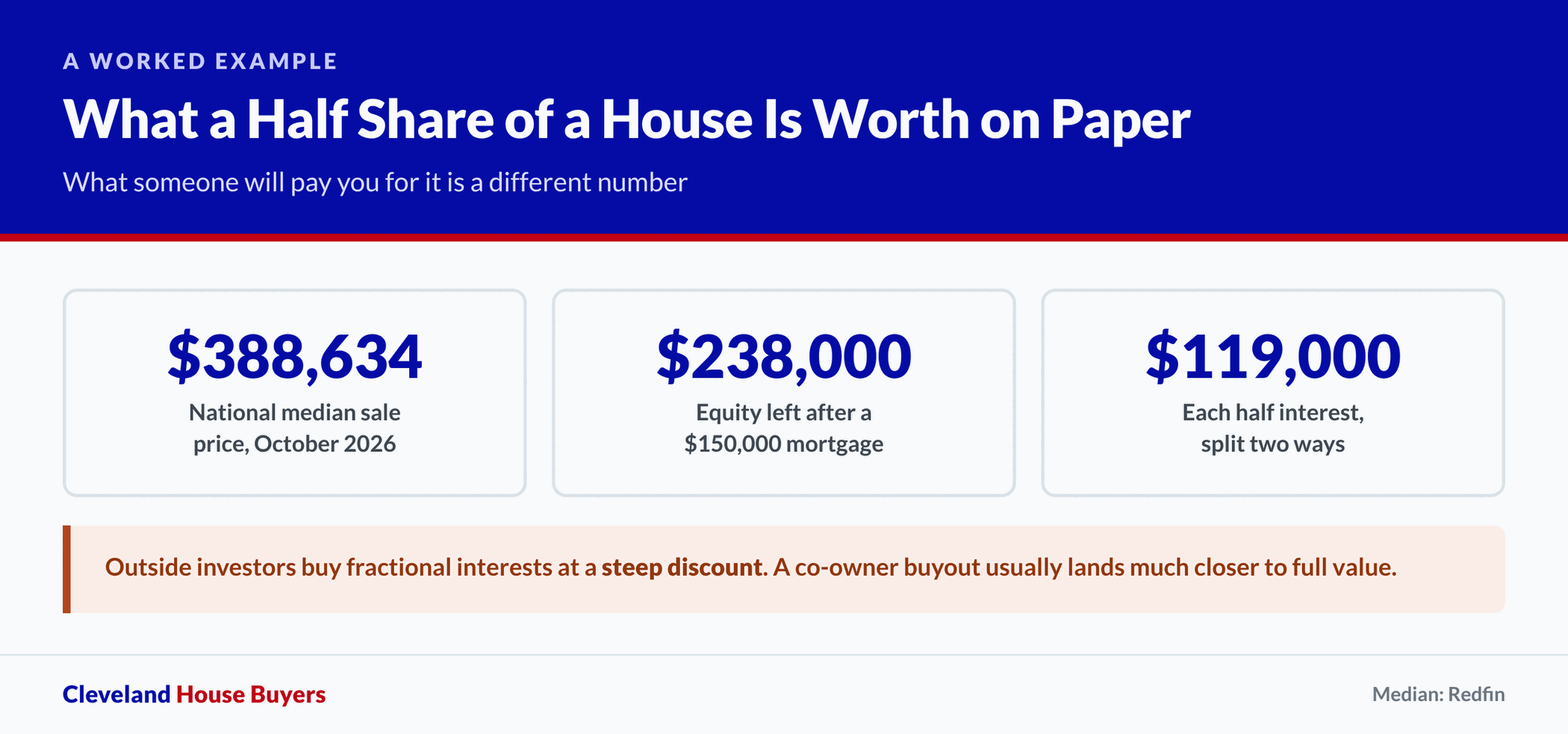
Two separate numbers matter when you value a partial ownership stake. One is your proportional slice of the equity. The other is what somebody will actually pay you for it today, and the gap between them can be wide. Third-party investors who buy fractional interests usually pay a steep discount to proportional value. The buyer inherits a partner they didn’t pick and a property they can’t sell alone. A buyout from your co-owner tends to land much closer to full proportional value, since they’re buying control rather than a headache.
Before you name a figure, adjust for three things. Start with unequal contributions. If one owner covered the down payment and seven years of taxes, courts and appraisers often credit that. Condition matters next, since deferred repairs drag down what any buyer will pay. Then there’s time. Every month of carrying costs eats into whatever you finally collect.
A licensed appraisal costs a few hundred dollars, and it carries weight a free online estimate never will. The Uniform Partition of Heirs Property Act even builds an independent appraisal into its core protections. That tells you how heavily courts lean on them.
Plenty of sellers who want a clean read on what the whole property would bring as-is get a no-obligation offer alongside the appraisal. Cleveland House Buyers handles that kind of valuation conversation, no commitment required. A real as-is number in hand makes co-owner negotiations a lot less theoretical.
Can I Sell My Share of a House If the Other Owner Refuses?
Saying no doesn’t end the story. A partition action is a lawsuit that forces the sale of a house when a co-owner won’t agree. In most states any co-owner can file one, no matter how small their percentage. The right to partition is widely described as absolute, so the other owner’s objection doesn’t block it.
There are two main forms. Partition in kind physically divides the land, which suits acreage and almost never suits a single-family home. Partition by sale orders the property sold, with the proceeds split by each owner’s interest.
Inherited property gets extra protection in a growing number of states. The Uniform Partition of Heirs Property Act, approved in 2010, had passed in 22 states plus the District of Columbia and the U.S. Virgin Islands by mid-2024, and New Jersey adopted it in 2025. Together they cover more than half the U.S. population. Under the act, heirs get mandatory notice, and heirs who didn’t ask for the sale get a right to buy out the ones who did. Judges also have to favor dividing the property in kind, and any sale happens on the open market rather than at a courthouse auction. The American Bar Association’s summary covers how states have adapted it. Maryland, Virginia, California, and D.C. went further and applied those procedures to all partition actions, not just heirs property.
Whether your state adopted heirs-property protections, and how your local court handles these cases, varies enough that you’ll want an attorney licensed where the house sits. Most partition cases end the way they could have started: one co-owner buys out the other before the court orders a sale.
What Are the Costs of Selling a Share of a House?
People tend to assume fees are the big cost here. Time is the bigger expense, and the fees just make it sting.
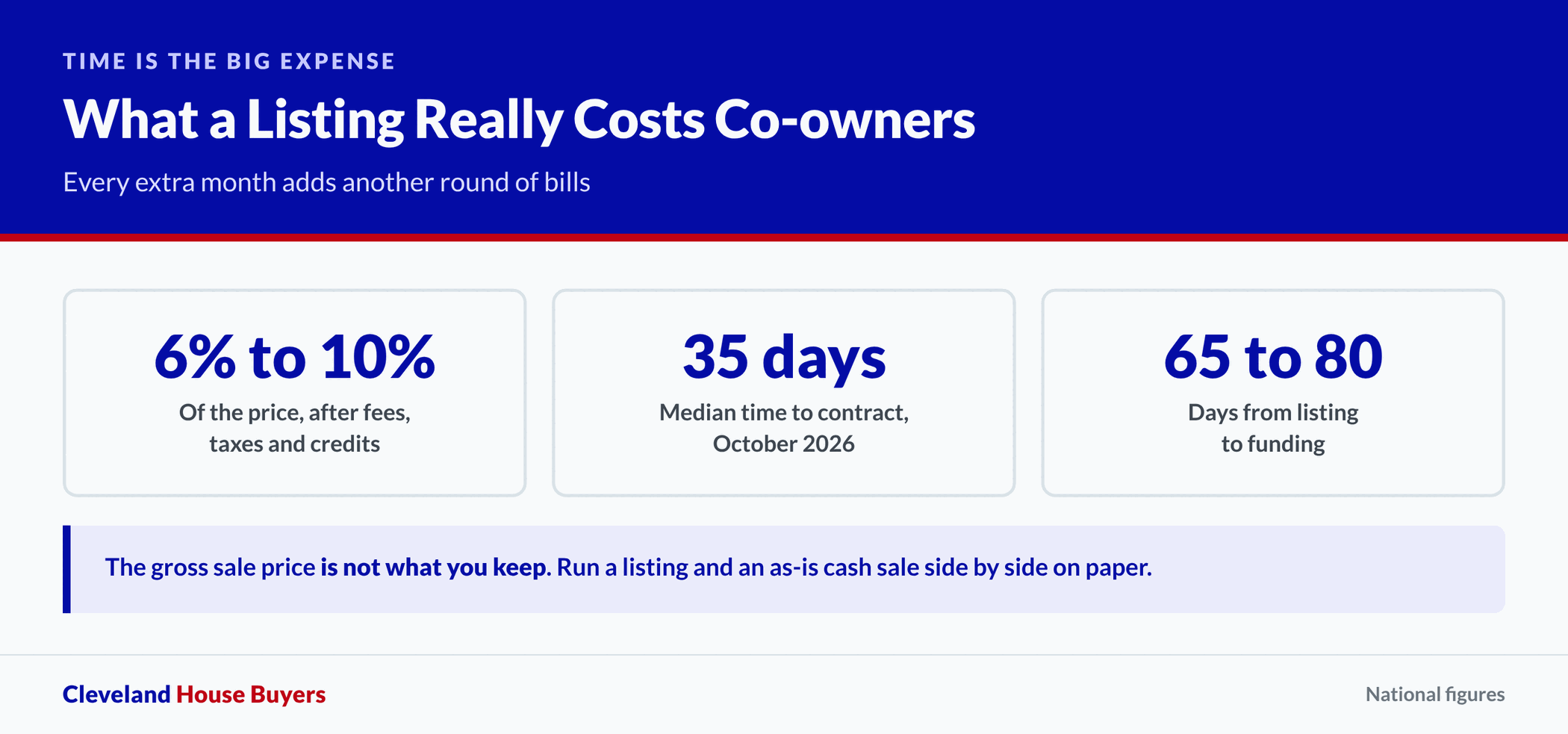
Add up agent commissions, title charges, transfer taxes, and the credits buyers negotiate, and a conventional listing eats somewhere between 6 and 10 percent of the sale price. That’s when co-owners agree to sell the whole property together. A longer timeline only makes it worse.
In October 2026, homes took a median of 35 days to go under contract, up from 33 days in September. A financed closing adds another 30 to 45 days, which puts you at roughly 65 to 80 days from listing to funding if nothing falls apart. That’s two more mortgage payments and two more insurance bills. Depending on your county’s schedule, it may be another quarter of property taxes too.
Partition costs sit on another scale entirely. Attorney retainers, filing fees, service of process, appraisal costs, and a court-appointed referee’s pay all come out of the proceeds before anyone sees a dime. If a case drags through discovery and motions, it can swallow a real chunk of the equity everyone was fighting over.
Deferred maintenance piles up on a co-owned property for an obvious reason: nobody agreed to fix anything. Buyers have regained some negotiating room in this market, and they price that neglect in.
An as-is cash sale trades price for certainty. You give up some money, and in return you skip commissions, repairs, staging, and most of the holding period. Co-owners burning cash every month on a property neither of them wants often come out ahead on that trade, even against a higher gross number on an MLS listing. Run both scenarios on paper before you decide. The gross sale price isn’t what you keep.
Tips for a Smoother Sale When You Sell Your Share of a House
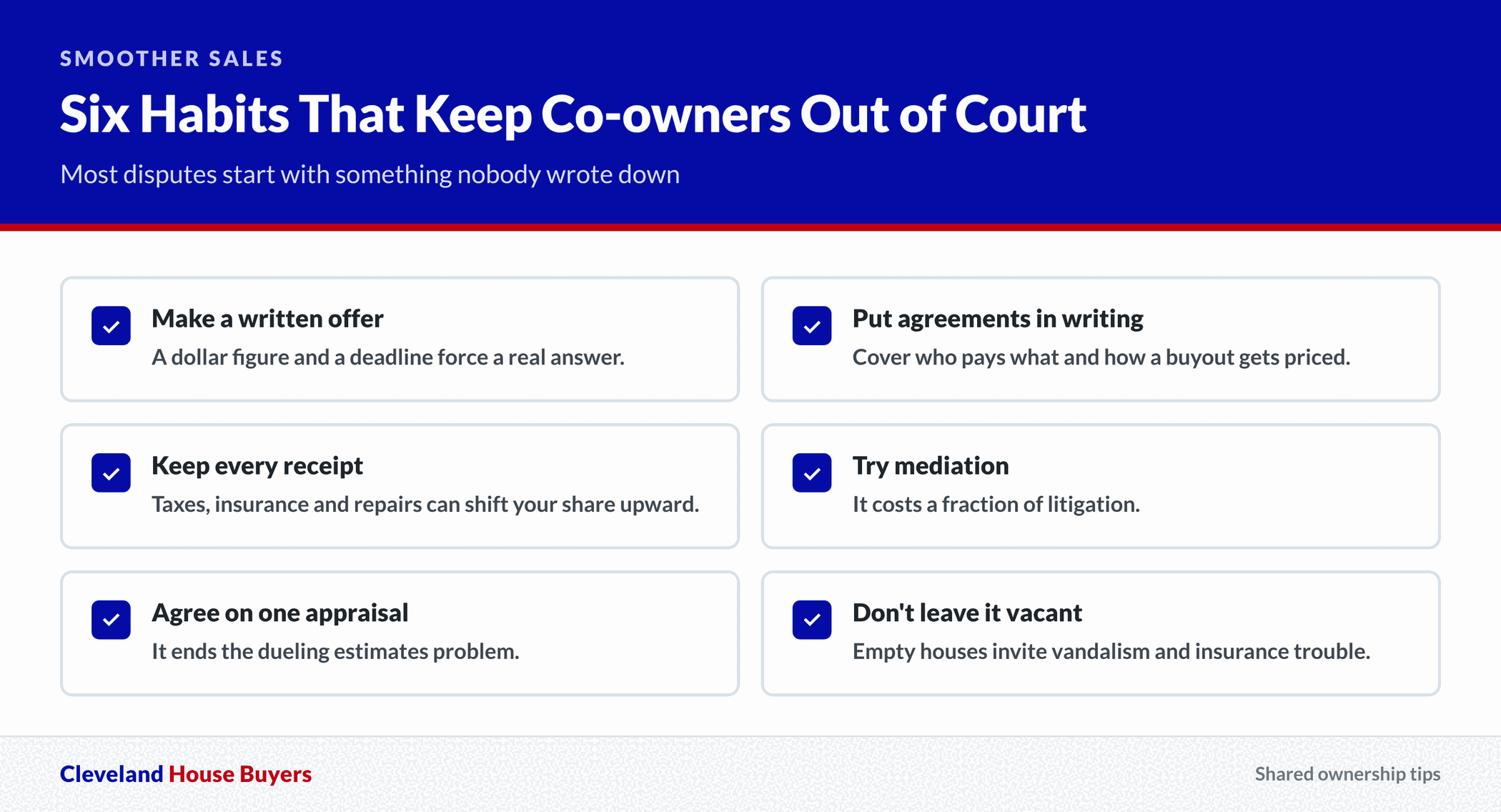
Talking about “fairness” in general terms gets you nowhere. A written offer with a dollar figure and a deadline forces a real answer.
Put every agreement in writing, even between siblings who trust each other. Most of the disputes I get called about would never have happened with a short co-ownership agreement. It only needs to cover who pays what, how a buyout gets priced, and what happens when someone wants out.
Save receipts for everything you’ve paid on the property. Tax bills, insurance premiums, the new water heater and the roof patch all count. If a court ever divides the proceeds, documented contributions can push your share of a house up by thousands.
Mediation costs a fraction of what litigation does. It works surprisingly often, too, when the real fight is emotional rather than financial.
Agree on one appraiser in advance. That single step kills the dueling-estimates problem that stalls half these negotiations.
Honestly, selling the whole property usually serves everyone better than carving up ownership. A clean sale of the entire house brings in more total dollars than a discounted fractional interest, and it ends the arrangement for good. If the co-owners can reach that agreement, a direct buyer who buys as-is takes the repair fights off the table. Those fights tend to reopen everything.
Don’t leave the property empty while you negotiate. Vacant houses draw vandals, insurance headaches, and slow deterioration that shrinks everyone’s proceeds. Rent it, keep it up, or sell it. Letting it sit idle is the one choice that costs every owner at once.
Frequently Asked Questions
Can One Owner Sell a Jointly Owned House Without the Other’s Permission?
You can sell your own ownership interest without anyone’s permission. You can’t sell the entire property out from under a co-owner, though. Selling only your portion means finding a buyer willing to step into shared ownership, and that’s a narrow market. To force a sale of the whole house, you’d file a partition lawsuit in the county where the property sits.
Do I Have to Pay Off the Mortgage Before I Sell a Share of a House?
Not necessarily. The transfer might trigger your lender’s due-on-sale clause, so read the note first. The bigger problem is that deeding away your interest doesn’t release you from the loan. As long as your name stays on the mortgage, you’re liable for it. That’s why most buyouts come paired with a refinance in the remaining owner’s name alone.
How Long Does a Partition Action Usually Take?
Think months, not weeks, and contested cases often run past a year. Uncontested filings where both sides basically want a sale move faster than cases with disputed contributions or heirs nobody can find. Your attorney can give you a realistic estimate based on how your local court is handling these cases right now.
Will I Owe Capital Gains Tax When I Sell My Share of a House?
That depends on your basis, how long you’ve owned it, and whether the home was your primary residence. Owners who meet both the ownership and use requirements can see the federal home sale exclusion wipe out the tax entirely. Heirs usually get a stepped-up basis at the date of death, which often leaves little or no taxable gain. Still, confirm your own situation with a tax professional.
Is It Better to Sell a Share of a House to My Co-owner or to an Outside Investor?
Your co-owner will almost always pay more, because they’re buying full control of the property, not a partial interest they’d have to share. Outside investors who buy fractional interests price in the risk and the illiquidity, and the discount shows it. Go to your co-owner first with a documented valuation and a specific offer.
What If My Co-owner Is Living in the House and Won’t Move Out?
Living there doesn’t give them veto power over a partition. A court can order a sale and appoint a referee to push it forward even when the owner in residence won’t cooperate. Depending on your state’s rules and the facts, you may also have a claim for the rental value of the time they had the property to themselves.
Can Heirs Be Forced to Sell Inherited Property They Want to Keep?
Generally, yes. Any co-owner can petition the court for a sale, even a single heir holding a small percentage. In states that adopted heirs-property protections, the family gets a real chance to buy out the heir who wants out before any sale happens. Those states also require an appraisal and an open-market sale. That safeguard matters, so check whether your state has it.
Stuck between co-owners and just want to know what the property is really worth as-is? We’re glad to go over it with you. The conversation costs nothing, carries no obligation, and nobody will nudge you toward a decision you aren’t ready for. Reach out to Cleveland House Buyers whenever you want a straight answer about your options.
Co-owned Houses in the Cleveland Market
Priced right, Cleveland homes don’t sit long. Over the three months ending October 2026, Redfin found homes in the city sold after about 34 days on the market. That pace gives co-owners a real window to sell the whole house together rather than fight over slices of it.
We also buy co-owned houses in the suburbs, including homes in Parma.
That includes co-owners in Lakewood who’d like an as-is number to bring to the table.
Find Out What Your Co-owned House Is Worth
Maybe you and your co-owners are stuck, or maybe you just want a real as-is number for the next family meeting. Contact us and we can talk through your options with no pressure. You can also fill out the short form below for a no-obligation cash offer.
Helpful Ohio Blog Articles
- How to Find a Realtor in Another State
- Can I Sell My House Before Paying Off the Mortgage
- What Home Sellers Must Legally Disclose to Buyers
- What Happens to Homeowners Insurance When You Sell Your House
- How Soon Can You Sell Your House After Chapter 7 Bankruptcy
- How to Choose a Title Company in Ohio
- How Long Does a Real Estate Contract Last in Ohio
- Selling Shares of Your Home