
A signed purchase agreement isn’t a deed. It’s a promise with an expiration date built in, and most people sign one without noticing where that date lands. I’ve bought houses across Northeast Ohio for years. Worried sellers ask me one thing more than anything else, and it usually boils down to this: how long am I stuck? That depends on what your real estate contract says. In Ohio, the paper you signed controls nearly everything about the clock.
The paper itself is where to start.
What Should Be in a Real Estate Contract Before You Sign in Ohio
One seller I worked with rushed through hers. Three weeks in, she found out it never named a closing date, and her buyer was using that gap to stall while he shopped around for financing.
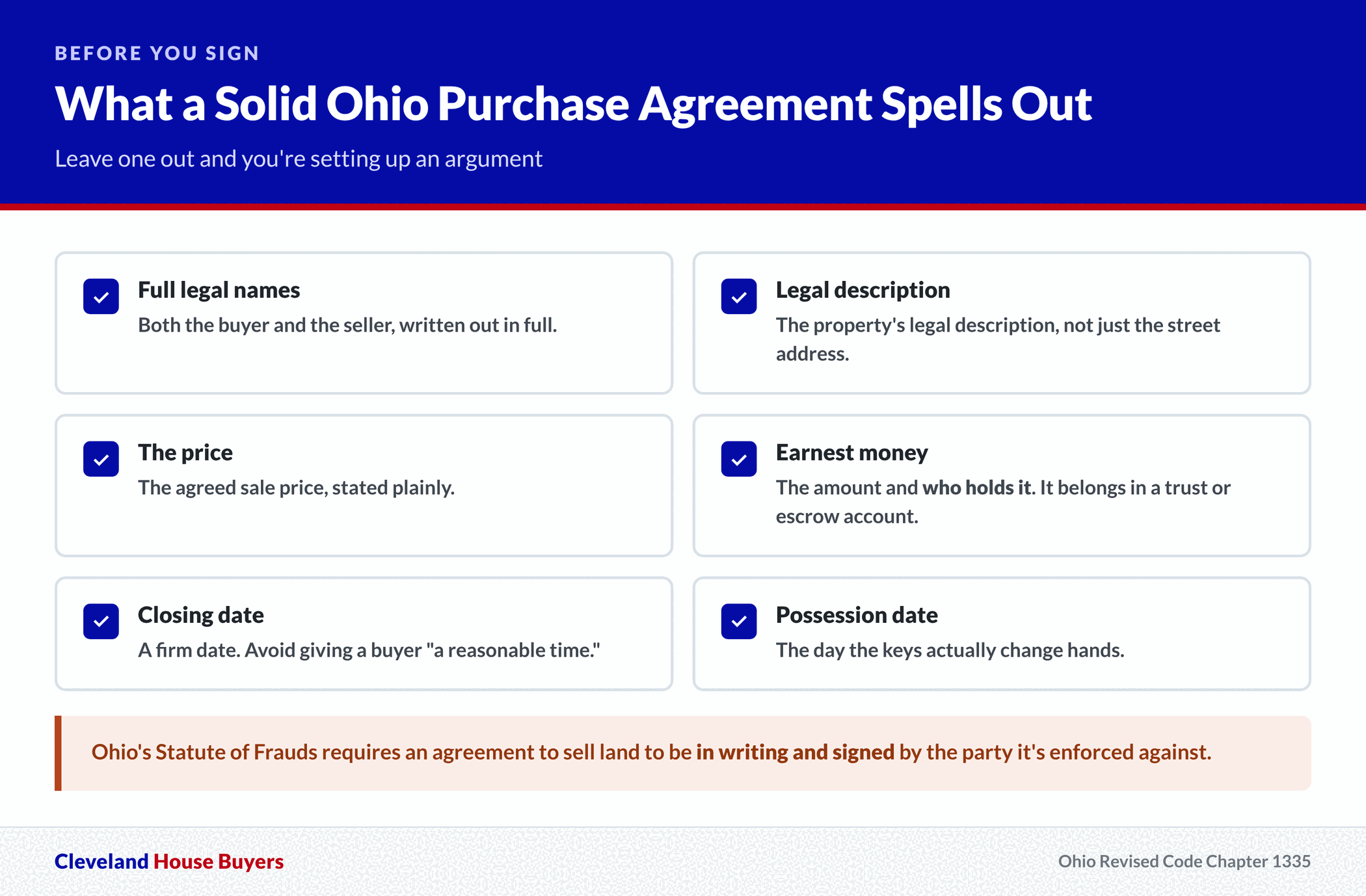
State law sets the floor. Under the state’s Statute of Frauds, an agreement for the sale of land has to be in writing and signed by the party you want to hold to it. It’s spelled out in Chapter 1335 of the Ohio Revised Code. A handshake won’t cut it, and neither will a text that says “we’re all set.”
What belongs in the document? Both parties’ full legal names, the legal description of the property, the price, the earnest money amount and who holds it, the closing date, and the possession date. Skip any of those and you’ve set up an argument for later.
A financing contingency with no deadline is an escape hatch for the buyer that never closes. Any real estate contract in the state that gives a buyer “a reasonable time” to do something deserves pushback.
Watch the earnest money language closely. Brokers in the state have to put those funds in the brokerage trust account soon after acceptance, so your purchase agreement should name the escrow holder in plain words. If the money is sitting in a buyer’s personal account, something’s wrong.
People skim right past one clause: time is of the essence. When that phrase appears in an agreement like this, every deadline in it turns hard, and missing one can count as a breach. Leave it out and courts have more room to forgive a late performance.
Think about who’s writing the document, too. Local brokerages around the state use board-approved forms that have held up in court. A buyer who shows up with his own homemade agreement isn’t automatically a problem. Still, have an attorney read it before your signature goes on anything.
How Long Does a Real Estate Contract Last in Ohio
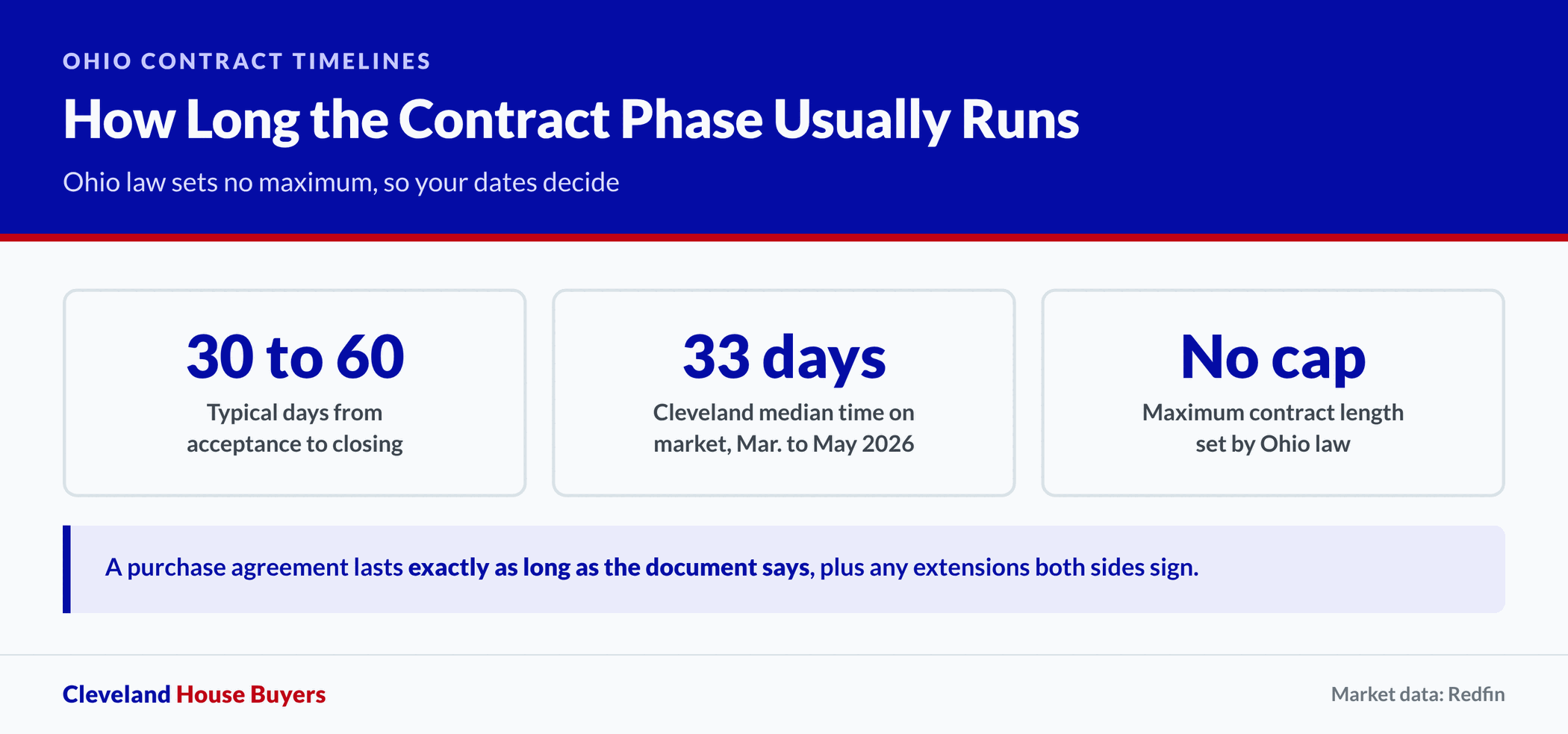
No Ohio law caps how long a purchase agreement can run, so the contract lasts exactly as long as the document says. If the parties keep signing extensions, it can stretch months past the original closing date.
Most residential sales here are written with a 30 to 60 day window between acceptance and closing. Around Cleveland, Redfin found homes went under contract after about 33 days on the market over the three months ending May 2026. Then the contract phase begins, and a lender usually adds another month or more.
Why is 30 days the short end? Lenders. An Ohio property agreement built around a conventional mortgage needs room for appraisal, underwriting, and title work.
Expired doesn’t mean void. Let the closing date pass while both sides keep acting like the sale is on, and conduct alone may still bind you. Courts look at what the parties did, not only at the calendar.
Nearly every Ohio property agreement runs three kinds of date at once: contingency deadlines, the closing date, and any survival clauses that outlive the closing itself. I’ve watched sales stall because someone mixed them up. An inspection deadline lands on day ten while closing is still forty days out.
Land contracts are another animal. With an installment land contract in Ohio, the seller agrees to hand over title later while the buyer makes monthly payments. Chapter 5313 of the Ohio Revised Code governs them, and they can stretch across years rather than weeks.
How Do Contingencies Affect an Ohio Real Estate Contract Timeline
Say a seller named Carol treats closing day as her real deadline. Then a buyer’s inspection contingency falls apart two weeks earlier. In your sale, the contingencies are the real deadline, not the closing date.
Most Ohio purchase agreements give the inspection period seven to fourteen days from acceptance. Inside that stretch, the buyer can walk for almost any reason and keep the earnest money.
Financing contingencies last longer and do more damage. If a buyer can’t land a loan commitment by the stated date, they can usually terminate, and the whole agreement unwinds.
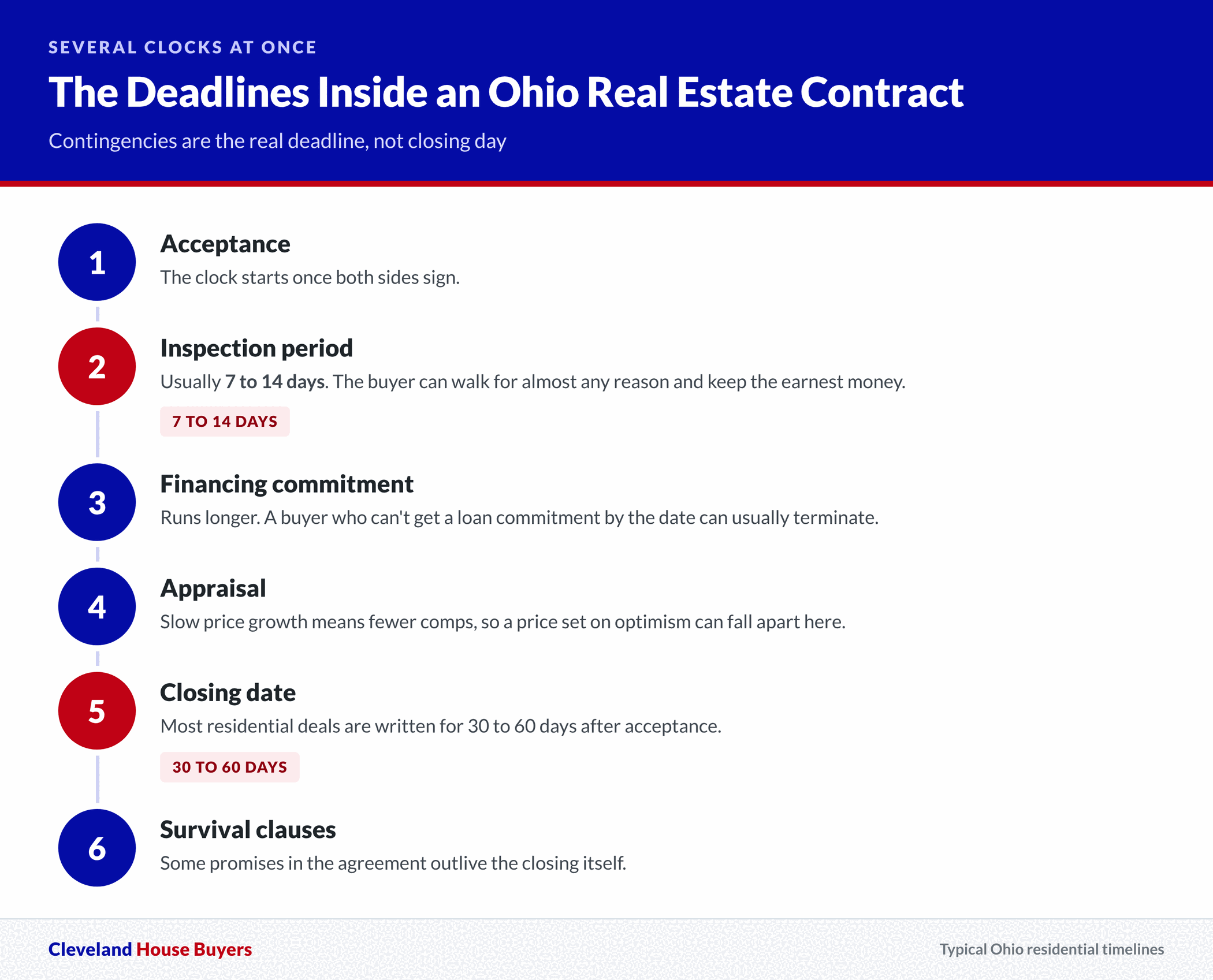
Appraisal gaps kill sales across the state without much noise. Redfin put Ohio home prices up 1.0% year over year in October 2026, to a median of $260,608. With appreciation that slow, appraisers find fewer comps pushing values up. A contract priced on optimism can come apart right there.
Years ago I looked at a two-family in Lakewood owned by a landlord who’d had it since the nineties. His contractor priced the kitchen at more than it would ever return. He’d already lost one buyer to an inspection contingency over that same room.
Home sale contingencies are the ones I most want sellers to refuse. That clause ties your Ohio agreement to a separate transaction you have zero control over. If their house in Strongsville doesn’t sell, yours doesn’t close.
Sellers grant extension after extension because they’re afraid of starting over, and I see it constantly. Each extension resets the buyer’s clock and costs you another month of carrying costs. One extension is a courtesy, while three means the buyer can’t perform.
Can You Cancel a Real Estate Contract in Ohio
Regret eventually raises the question everybody asks. In Ohio, canceling isn’t a right you just exercise.
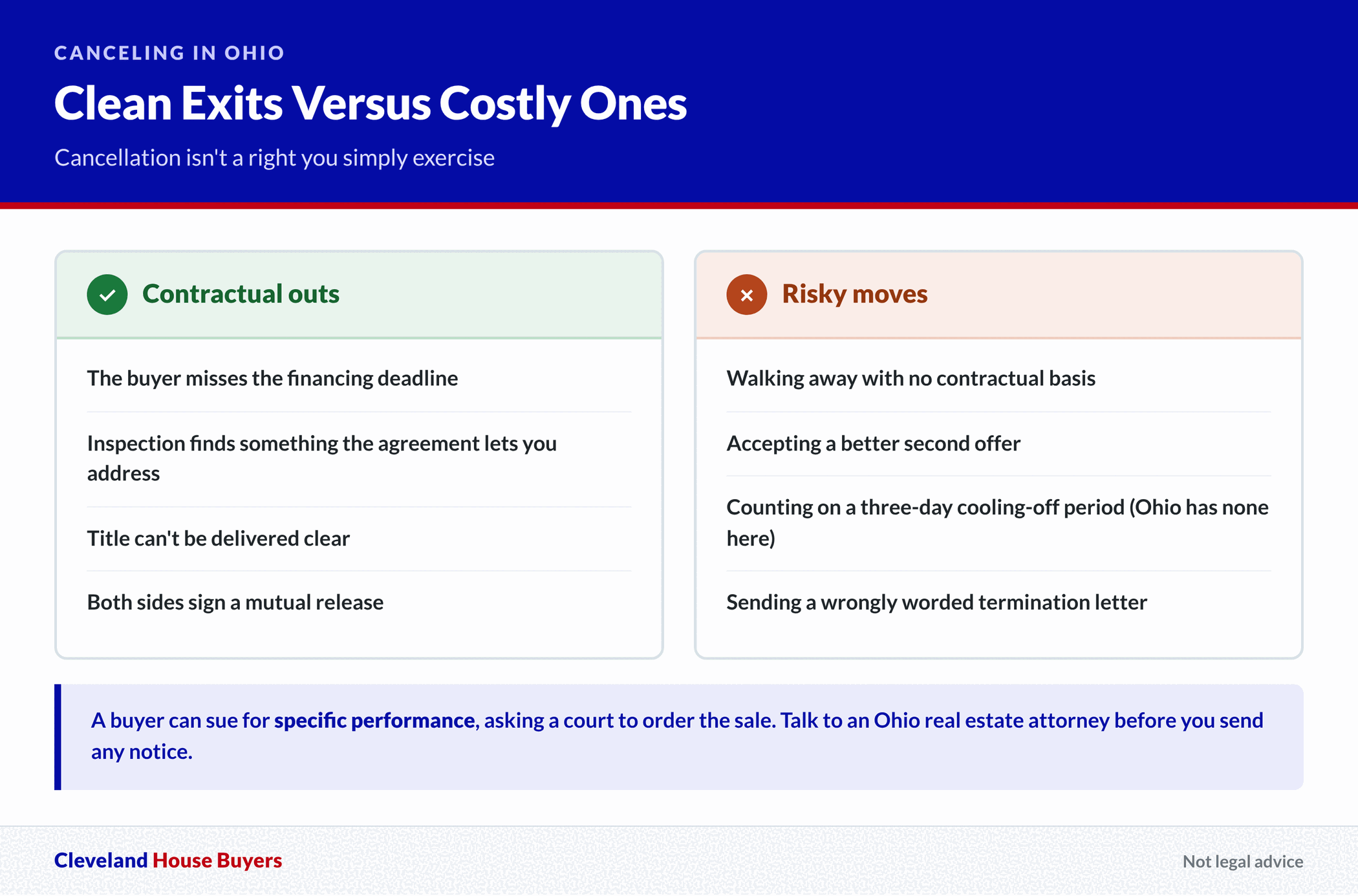
Ohio has no general three-day cooling-off period for residential purchase agreements. That rule covers certain door-to-door sales. It doesn’t touch the agreement you signed with a buyer.
Clean exits come from the contingencies themselves. A buyer who misses a financing deadline, an inspection that turns up something the agreement lets you address, title that can’t be delivered clear: those are contractual outs. Read the termination section of your Ohio real estate contract before you call anyone.
A mutual release is the other path, and it’s the one I’d pick. Both parties sign a written cancellation, the earnest money gets split however they agree, and everyone walks away.
Walking away without a contractual basis gets expensive fast. An Ohio buyer can sue for specific performance, which means a court orders you to sell the house anyway. Courts treat real estate as unique property, so money damages aren’t always seen as an adequate remedy.
A seller under pressure sometimes signs with the first buyer who shows up, then panics when a better offer lands on Tuesday afternoon. You can’t take the second offer while you’re still bound to the first buyer.
Stuck in that spot with a sale gone sideways? Talk to an Ohio real estate attorney before you send any cancellation notice. A badly worded termination letter can be the breach all by itself.
What Happens When a Real Estate Contract Expires in Ohio
Let the closing date slide by without addressing it, and you may give the other party grounds to say you defaulted.
An Ohio real estate contract that hits its closing date with nothing happening doesn’t just evaporate. The agreement lives on, and either party can declare the other in default, demand performance, or chase remedies.
Written extensions fix almost all of this. An amendment both sides sign, naming a new date, keeps the sale alive and protects everyone. Ohio purchase agreements generally require extensions in writing, so a verbal “let’s just push it a week” protects you from nothing.
What if the buyer just disappears? You’d usually send a written notice to perform, wait out the cure period your agreement sets, then declare default and go after the earnest money through escrow. Title companies in Ohio won’t release those funds without written agreement from both parties or a court order.
Relisting has a cost. Buyers in the state check days-on-market history and treat a failed contract as a red flag about the property. Across Ohio in October 2026, listings sat a median of 46 days, and 22.9% of them took a price cut, per market data compiled from Realtor.com research.
Your bills don’t pause either. Utilities, insurance, summer lawn care, snow removal come January in Cleveland and Akron: all of it keeps running on your dime while the contract sits dead.
At this point some sellers decide the traditional path isn’t working for them. A direct buyer like Cleveland House Buyers takes the financing contingency out of the picture, because no lender is setting the pace.
Who Enforces a Real Estate Contract in Ohio
I used to assume a real estate agent could enforce the agreement they’d written. They can’t.
In Ohio, enforcement runs through the common pleas court in the county where the property sits. Cuyahoga, Summit, Lorain, and Medina each have their own docket and their own pace.
Missing the filing deadline can end your case before it starts. Since June 2021, Ohio Revised Code 2305.06 has given parties six years after a cause of action accrues to bring a breach of contract claim on a written agreement, as Frantz Ward explains. Claims on an oral agreement get four years. An oral real estate contract rarely survives the Statute of Frauds anyway.
In practice, escrow agents and title companies do most of the enforcing in Ohio sales. They hold the funds and won’t record a deed until conditions are met. They also won’t release earnest money to one side alone. That neutrality protects both sides more than people realize.
The Ohio Division of Real Estate takes licensing complaints against agents and brokers, but it won’t settle your contract dispute. When the problem is the agreement itself, you need a lawyer and maybe a judge.
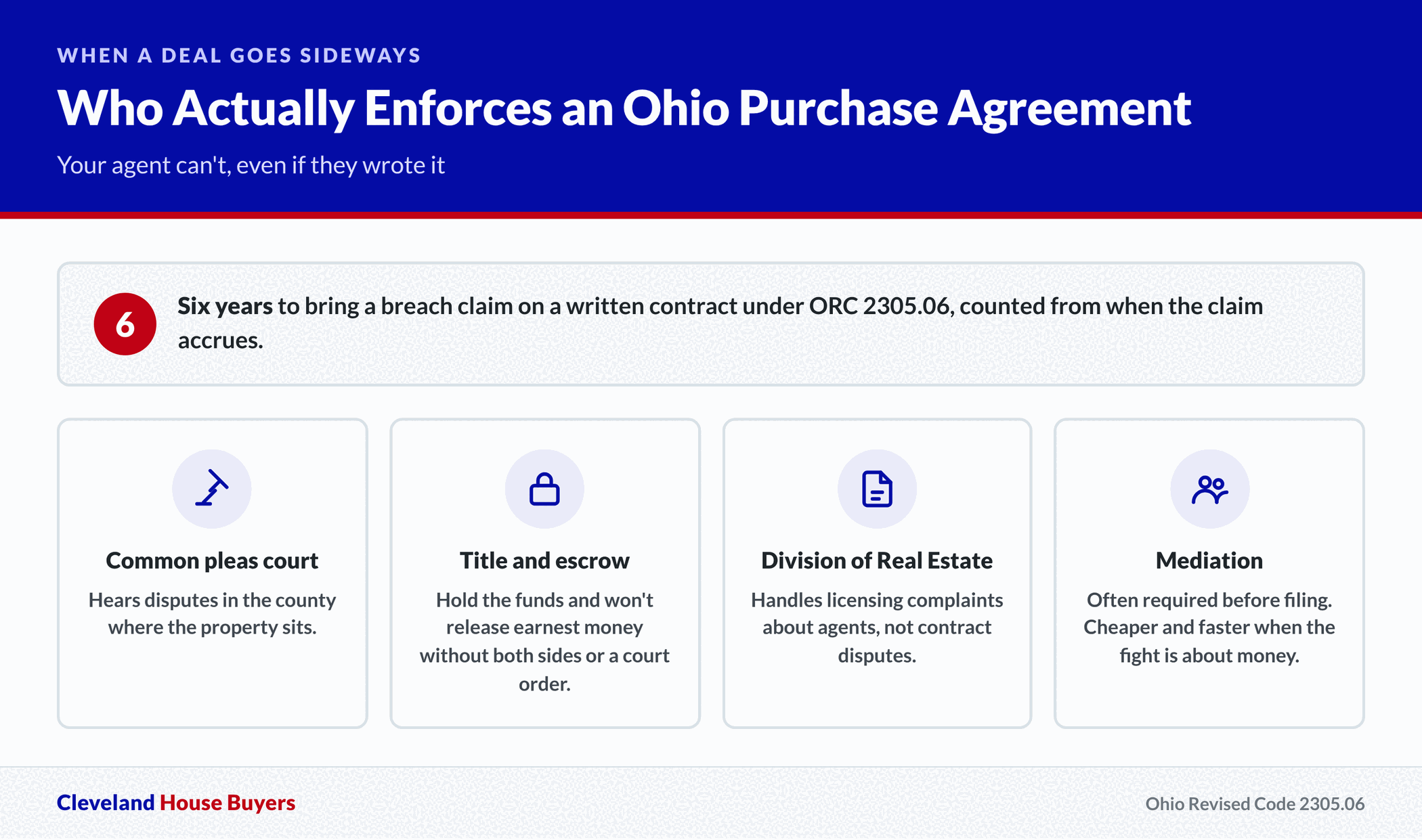
Mediation sits between a handshake and a lawsuit. Many Ohio purchase agreements include a clause requiring the parties to try it before anyone files. It costs less, moves faster, and usually works when the fight is about money rather than principle.
Common Questions About Real Estate Contract Deadlines in Ohio
If I were sitting at your kitchen table with a cup of coffee, I’d tell you what I tell every Ohio homeowner. The deadlines in your real estate contract are the most negotiable part of the whole document. Almost nobody negotiates them.
Sellers fixate on price and then sign whatever timeline the buyer proposes. Flip that around. Need sixty days to find your next place? Write sixty days into the real estate contract before you sign it, not after.
Ask about possession after closing too. A short post-closing occupancy agreement, documented properly, can save you from moving twice in an Ohio February.
Is an offer with no contingencies at all ever worth taking? From a cash buyer with proof of funds, yes. Coming from a financed buyer, a contingency-free offer should make you suspicious, not excited.
Got an Ohio house and a contract situation that’s turned into more than you signed up for? We’re happy to talk it through, whether or not you end up selling to us. The right answer might be finishing the sale you’re in. It might be starting over, or skipping the financing contingency altogether with a direct sale. There’s no pressure and no obligation, only a straight conversation about what fits your situation.
Frequently Asked Questions
How Long Do I Have to Sue Over a Broken Real Estate Contract in Ohio?
In Ohio, a written agreement gives you a six-year window, counted from the date the breach happened, not the date you signed. Unwritten agreements get a shorter period, though an oral promise about real estate usually can’t be enforced at all. Call an Ohio attorney early. Evidence gets harder to gather as the months go by.
Can a Buyer Back Out of an Ohio Real Estate Contract After Inspection?
Most of the time, yes, as long as the inspection period is still open. Inside that window a buyer can walk for almost any reason and get the earnest money back. After it closes, they need another contingency, like financing or appraisal, to leave cleanly. A buyer who walks without one risks losing the earnest money, so check the dates and the termination section in your agreement.
How Long Does a Land Contract Last in Ohio?
Far longer than a standard purchase agreement. An Ohio land contract runs until the buyer makes the last installment payment, and that can take years rather than weeks. Until that payment clears, the buyer doesn’t hold legal title, so they can’t refinance or easily sell. Once they’ve built meaningful equity, Ohio law makes the seller foreclose instead of simply forfeiting the agreement. So I tell Ohio homeowners to have a lawyer review any land contract before signing.
Does a Cash Sale Shorten a Real Estate Contract Timeline?
Usually, yes. With no lender involved, an Ohio cash sale skips loan approval, the loan commitment date and any appraisal gap, which are the longest clocks in a typical Ohio timeline. You still need clear title and a signed purchase agreement. The paperwork doesn’t vanish; it just runs on your schedule instead of an underwriter’s. Weighing a financed offer against a cash one? Compare the closing dates side by side, not only the prices.
Can a Real Estate Contract in Ohio Be Extended More Than Once?
Yes, as many times as both parties are willing to sign. Each extension should be a written amendment that names the new date and is signed by everyone on the original agreement. Verbal extensions create the kind of ambiguity that ends up in front of a judge. Put every change on paper, even when the other side seems trustworthy.
When Does the Clock Start on an Ohio Real Estate Contract?
On the date of acceptance. The standard Ohio Realtors purchase contract sets that as the moment the final version is signed by everyone and delivered back to the party who made the offer. The inspection period, the loan commitment date and the earnest money deposit all count days from there. Those are calendar days, so weekends and holidays count. Write the acceptance date on the agreement itself. If nobody agrees on when the clock started, nobody can agree on when it ran out.
Does an Ohio Real Estate Contract Expire on Its Own?
Not cleanly. A passed closing date doesn’t cancel the agreement; it just leaves one or both parties free to declare a default and chase remedies. If you want it truly dead, get a signed mutual release instead of assuming silence killed it.
Contract Deadlines in the Cleveland Market
Cleveland homes still sell at a steady clip. Redfin’s data for the three months ending October 2026 put the city’s median sale price near $145,399, up 6.9% from a year earlier. A buyer who stalls past a deadline can burn weeks of that momentum. Tight dates in your agreement protect your spot in the market.
We also buy houses in the suburbs, where the same contract rules apply. Give us a call if you’re selling in Parma and your buyer keeps stalling.
That goes for Lakewood homeowners watching a closing date slip, too.
Talk Through Your Contract Timeline With Us
Maybe your buyer keeps asking for more time, or your closing date has already come and gone. You don’t have to untangle that alone. Contact Cleveland House Buyers and we can go over your options together. You can also fill out the short form below for a no-obligation cash offer.
Helpful Ohio Blog Articles
- How to Find a Realtor in Another State
- Can I Sell My House Before Paying Off the Mortgage
- What Home Sellers Must Legally Disclose to Buyers
- What Happens to Homeowners Insurance When You Sell Your House
- How Soon Can You Sell Your House After Chapter 7 Bankruptcy
- How to Choose a Title Company in Ohio
- How Long Does a Real Estate Contract Last in Ohio
- Selling Shares of Your Home