
A flashlight, a pair of knees in wet gravel, and a sound like a dripping faucet coming from somewhere under the living room floor. That’s how most Ohio homeowners find out their crawl space has water in it. Usually it happens the week an inspector crawls under there for a buyer. I’ve bought houses across Northeast Ohio for years, and standing water under a floor joist is one of the most common sale-killers I see in this state. The good news is it’s also one of the most fixable, or sellable, depending on which road you pick.
Why Crawl Space Water Scares Off So Many Ohio Buyers
A buyer walks into a clean house with fresh paint and a newer roof, imagines a Saturday morning in the backyard, and signs. They’re looking at a liability with an unknown price tag.
Buyers in Ohio are especially jumpy about this. Our freeze-thaw cycles crack foundations, our clay soil holds water like a bowl, and anyone who’s lived through a Lake Erie spring knows what groundwater does in March. Any buyer in Lakewood or Grove City has probably heard a neighbor’s mold story.
Financing is the harder wall. An FHA or VA appraiser who spots active water under the house can call for repairs before the loan funds, and conventional lenders tend to follow suit.
Last year three siblings called me about their late mother’s ranch in Parma. They’d been quietly covering two mortgages for close to a year because every buyer who went under contract walked after the inspector photographed it. The youngest had already moved her father’s old tools out of the garage twice. Two listings, two failed inspections, eleven months of payments on a house nobody lived in.
How long can you carry a second payment while buyers come and go? Ohio homes went under contract at a median of 45 days in September 2026, according to statewide tracking of Realtor.com data. A wet one can double or triple that, since each failed contract resets your clock and stamps your listing with a days-on-market number buyers read as desperation.
What Is Really Causing the Water Under Your House?
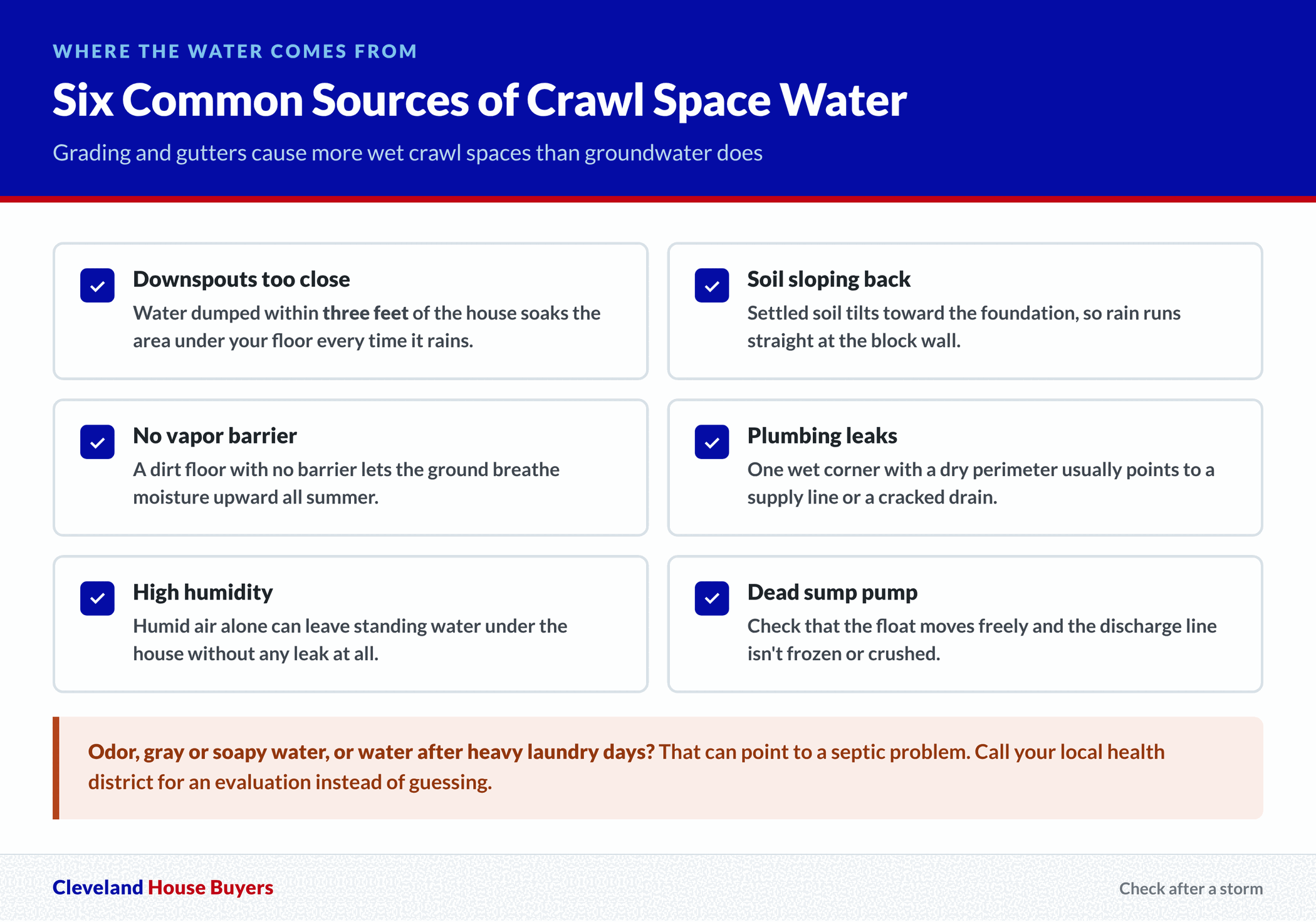
For a long time I blamed the water table for almost every wet crawl space I crawled into, and I was wrong most of the time. Grading and gutters cause far more of these than groundwater does.
Check your foundation after a storm. Downspouts that dump within three feet of the house irrigate the area under your floor every time it rains. Older Ohio homes, especially the pre-1960 stock in places like Elyria, Zanesville, and the near-west side of Cleveland, often had downspout tiles that collapsed decades ago.
Soil settling is the second culprit. It tilts back toward the foundation over the years, so every inch of rain runs straight at your block wall. Dirt floors with no vapor barrier make it worse, because the ground itself breathes moisture upward all summer long.
Plumbing causes its share of this too. A slow supply-line leak or a cracked drain under a bathroom will soak one corner while the rest stays bone dry. One wet spot with a dry perimeter usually points to a pipe.
High humidity alone can produce standing water without any leak at all.
Sump pump failure rounds out the list. Plenty of Ohio crawl spaces have a pump sitting in a pit. Many of those pumps died three years ago without anyone knowing. So it’s worth checking that the float moves freely and the discharge line isn’t frozen or crushed.
An unexplained wet crawl space reads as a mystery, and mysteries get priced for the worst case every single time.
Can a Septic Issue Be Behind Your Crawl Space Water?
Yes, and it’s the one cause you shouldn’t try to diagnose yourself. Septic-related moisture under a house is a health matter, not a handyman matter.
Rural and semi-rural Ohio properties run on household sewage treatment systems, so a failing leach field can saturate the soil around and under a foundation. If the water under your house has an odor, if it’s gray or soapy, or if it appears after heavy laundry days rather than after rain, stop guessing. Effluent reaching it is a different conversation from rainwater.
Septic questions in Ohio get handled at two levels. The Ohio Department of Health sets statewide standards for sewage treatment systems, but permitting, inspections, and enforcement run through your local health district, and those districts may adopt stricter rules of their own. Your county or city health district is the first call for an evaluation of a suspected failure.
ODH guidance notes that swapping like parts or adjusting how a system runs typically doesn’t need a permit, while altering or replacing a system does require one from the local health district. When your Ohio sale depends on clearing a septic issue, build the permit timeline into your plan from day one, not week six.
Something I’ve learned the expensive way: a septic problem discovered during a buyer’s inspection almost never gets resolved inside the original contract window. Buyers get nervous, lenders get involved, so the health district ends up running its own calendar. If you suspect sewage is behind the water in your crawl space, get the evaluation done before you list. You’ll either rule it out and sleep better, or you’ll know exactly what you’re selling.
Does Ohio Law Require You to Disclose Water in the Crawl Space?
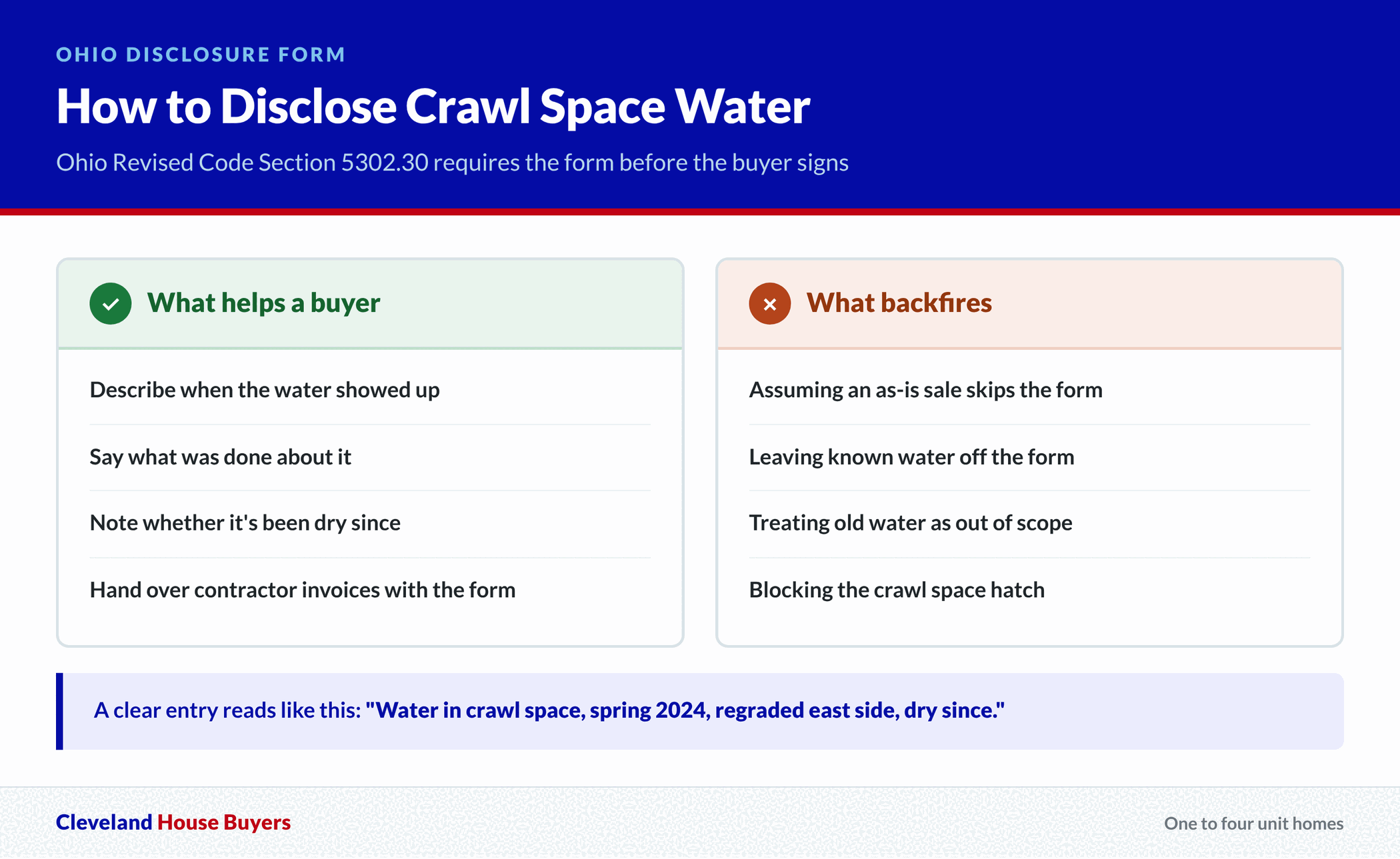
It does. Ohio Revised Code Section 5302.30 requires sellers of residential property with one to four dwelling units to complete the state’s Residential Property Disclosure Form. They must deliver it to the buyer before the buyer signs the sales contract. You can read the statute itself on the Ohio Revised Code site. Known water intrusion in a crawl space belongs on that form.
Ohio’s rule is built around what you personally know. The form reflects your actual knowledge at the time you complete it, not the findings of an inspection you were never required to order.
Selling as-is changes nothing here. An as-is Ohio sale still requires the disclosure form, and plenty of sellers get that backwards. Disclosure governs what the buyer gets told.
Guessing wrong here carries a real cost. Where a seller fails to disclose a known material defect, Ohio buyers have grounds to pursue a fraud claim, and proving the seller knew is the hinge the case turns on. A crawl space you’ve pumped out three springs running is hard to call unknown.
My opinion, plainly: disclose the water, describe it accurately, and price accordingly.
How Crawl Space Water Shows Up on the Ohio Disclosure Form
“What box does this even go in?” That’s the question I hear most once a seller accepts that disclosure isn’t optional.
Ohio’s form groups conditions by system, and water touches several of them. It also asks about the water supply source and known supply problems, about the sewer system, about the roof and any leaks, and about standing water on the property. One crawl space problem can legitimately land in more than one place depending on its cause.
“Water in crawl space, spring 2024, regraded east side, dry since” tells a buyer a story with a beginning and an end.
One practical note on the timeframe: the state’s disclosure form itself shows the water intrusion questions don’t carry the five-year limit that appears elsewhere on the disclosure. Treat your memory of crawl space water as fully in scope, however long ago it happened.
Receipts are your friend. Keep invoices from any Ohio contractor who pumped, sealed, graded, or installed a sump pump, and hand them over with the form. I’d rather see a thick folder of repair work than a clean form with nothing behind it, and so would most buyers.
The Ohio Department of Commerce publishes the current form, and your real estate agent or title company can get you the live version.
What Does It Cost to Fix a Wet Crawl Space Before Selling?
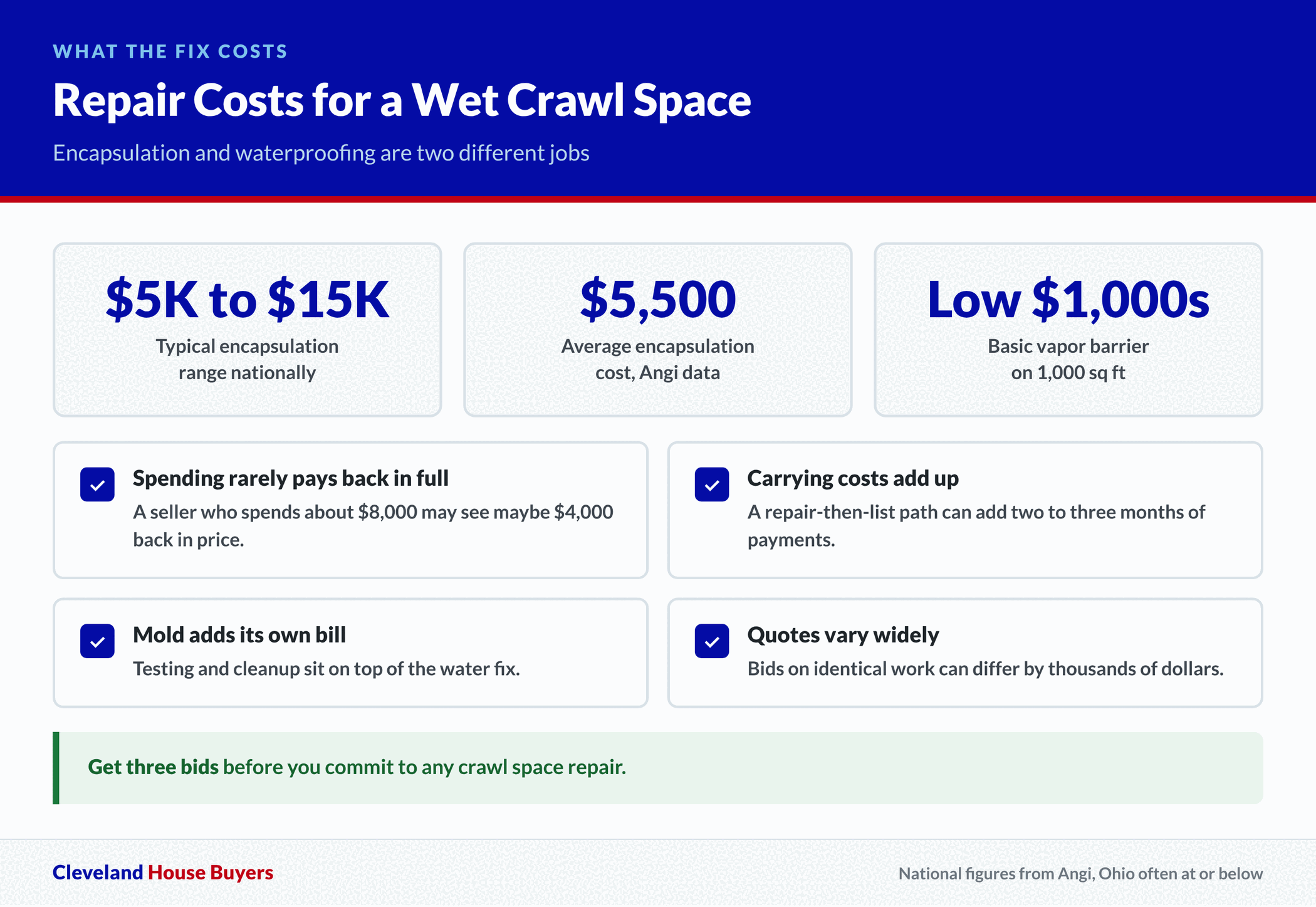
Most cost articles quote encapsulation numbers without mentioning that encapsulation and waterproofing are two different jobs. Encapsulation controls vapor with a sealed barrier and a dehumidifier.
Nationally, crawl space encapsulation runs between $5,000 and $15,000 with an average around $5,500, and Ohio quotes generally sit at or below those figures given our labor rates. Basic vapor barrier work on a 1,000 square foot space is far cheaper, often landing in the low thousands.
Once an inspector writes the word mold in a report, Ohio buyers want a remediation certificate, not a contractor’s promise. Testing and cleanup sits on top of whatever the water fix costs.
Here’s where sellers lose money. They spend eight thousand dollars on one such system in April, list in May, and discover the market gives them maybe four thousand back in price. Buyers don’t pay a premium for a dry one. They just stop subtracting for a wet one.
Timing compounds that. Ohio’s median sale price hit $285,000 in July 2026, according to Ohio REALTORS. At that price, a full repair-then-list path can eat two to three months of carrying costs on top of the repair bill. That math decides more cases than the repair quote does.
Get three bids. Ohio has excellent waterproofing contractors and some aggressive ones, and the spread between quotes on identical work can be thousands of dollars.
Repair It, Sell As-is, or Take a Cash Offer for Your Ohio House?

“A cash buyer is just going to lowball me.” I hear that constantly, and sometimes it’s fair. Any fair as-is offer should reflect the repair cost plus a reasonable margin, not pretend your whole house is worthless because the crawl space is damp. Ask any Ohio buyer to show you their repair math. The honest ones will.
Repairing first makes sense when the cause is simple and cheap.
Selling as-is on the open market tends to land in the middle. You’ll attract fewer buyers and more investors, and financing gets narrower, but you keep the MLS exposure. It works best when your Ohio property is otherwise in good shape and you can wait.
A direct cash sale earns its keep on speed and certainty, since there’s no appraiser calling for repairs underneath, no lender condition, no second inspection. Cash sales in Ohio frequently close inside a few weeks, which matters enormously when a deadline is looming on the calendar. This is where a company like Cleveland House Buyers fits: they buy Ohio houses with water problems as they sit, and the crawl space becomes their problem at closing.
That’s the question worth sitting with.
A homeowner in Barberton called me three months behind on his mortgage with a sheriff’s auction date already on the calendar. His crawl space had been taking on water since the previous winter. Repairing first was never on the table for him; the only workable path was a buyer who could close before the auction date.
There’s no universally correct answer, only the one that fits your timeline and your tolerance for carrying costs.
Frequently Asked Questions
Sit across a kitchen table with enough Ohio sellers and the same handful of questions come up before the coffee’s poured.
Is It Normal to Have Water in Your Crawl Space?
Moisture is common in Ohio crawl spaces; standing water is not. Our clay soil, wet springs, and older housing stock mean a lot of homes carry some dampness under the floor, and a sealed vapor barrier plus a working dehumidifier handles most of it. Actual pooling water, though, means something is failing: grading, a downspout, a pipe, a pump, or a septic system. Don’t let anyone tell you puddles under your house are just how it goes around here.
How Much Does Water Damage Lower a Home’s Value in Ohio?
It depends on whether buyers can see the bottom of the problem. A documented, repaired water issue with invoices attached usually costs you little or nothing at the negotiating table. An active, unexplained leak gets priced for the worst case, and Ohio buyers routinely ask for more off the price than the repair would cost, because they’re pricing in risk along with labor. Mold findings widen that gap further, since remediation adds a certificate requirement most buyers won’t waive.
Can I Sell an Ohio House with an Active Leak in the Crawl Space?
You can. Ohio law doesn’t prohibit selling a house with a wet crawl space; you just have to disclose what you know about it on the state’s form before the buyer signs. Financed buyers are your constraint, not the law, since appraisers and lenders can demand repairs before funding. Cash and investor buyers don’t face that hurdle, which is why as-is sales so often end up in that lane.
Will a Home Inspector Always Find Water in the Crawl Space?
Almost always, if the access hatch opens. Inspectors here enter crawl spaces as a standard part of a residential inspection, and water, efflorescence on block, rusted ductwork, and mold staining all photograph easily. Blocking access or declining to unlock the hatch raises bigger alarms than the water itself would. Assume the water gets documented and plan around that reality.
Should I Get the Crawl Space Inspected Before Listing in Ohio?
If you’re planning a traditional listing, yes, because knowing the cause gives you control over the conversation. A pre-listing evaluation lets you fix a cheap problem or price an expensive one honestly, instead of renegotiating under pressure after a buyer’s inspector beats you to the discovery. Selling directly to an Ohio cash buyer who’s taking the house as-is makes the inspection less necessary, since they’re already pricing the unknown into their offer.
Does Homeowners Insurance Cover Crawl Space Water in Ohio?
Rarely for the causes discussed here. Most Ohio policies exclude groundwater seepage, surface water intrusion, and long-term maintenance failures, though a sudden burst pipe is usually a covered loss. Call your insurance company and ask them to put the answer in writing before you count on a claim. Sellers who assume coverage and budget around it tend to find out at the worst possible moment.
How Fast Can I Sell an Ohio House with a Wet Crawl Space?
Through a traditional listing with financed buyers, plan on the normal statewide marketing window plus contract-to-close time, and add cushion for the repair negotiations that water under the floor invites. Direct sales move faster, frequently closing in a couple of weeks, because there’s no lender condition and no appraisal to satisfy. When an auction date, a job transfer, or a second mortgage payment is driving your timeline, speed may be worth more to you than the last few percent of price.
If you’re staring at a damp crawl space and a decision you didn’t ask for, you don’t have to sort it out alone. I’m happy to walk through what your Ohio house is worth as-is, what it might be worth repaired, and whether either path actually makes sense for your situation. Sometimes the answer is to fix the grading and list it. Other times it’s to sell it as it sits and be done. The folks at Cleveland House Buyers will give you a straight number and a straight answer either way, and if a cash sale isn’t your best move, they’ll tell you that too. No pressure, no obligation, just a conversation whenever you’re ready.
Wet Crawl Space Houses in the Cleveland Market
Cleveland homes still sell at a steady clip. Redfin’s mid-year 2026 figures put the Cleveland metro’s median sale price around $245,000, up 5.7% from a year earlier. That’s good news for you, since buyers are still out there, even for an older house with a damp crawl space. They’ll just price in the water unless you show them where it comes from and what it costs to fix.
If you’d rather skip the repair bids and the inspection back-and-forth, our team buys houses across Greater Cleveland in their current condition, water problems included.
Talk Through Your Options
You don’t need to have the cause figured out before you call. Tell us what you’ve seen in the crawl space, and we’ll walk you through what a repair-first sale, an as-is listing, and a cash offer might each look like for your house. If you’d like a no-obligation cash offer, reach out to Cleveland House Buyers or fill out the short form below.