
The furnace died on a Tuesday in February, and the quote came back at four figures. Right then, the seller stopped debating and picked up the phone. I’ve watched that exact scene play out across hundreds of kitchen tables, because the decision to move to apartment living almost never arrives as a spreadsheet. It arrives as a repair bill, a diagnosis, a job offer, or a staircase that stopped being worth climbing.
This is the real version, not the brochure one where everyone downsizes into a sunlit loft and lives happily ever after. Let’s talk through the real math, the real tradeoffs, and the questions worth asking before you sign a lease or list your house.
How Do You Know When It’s Time to Move to an Apartment?
Most people wait about two years longer than they should.
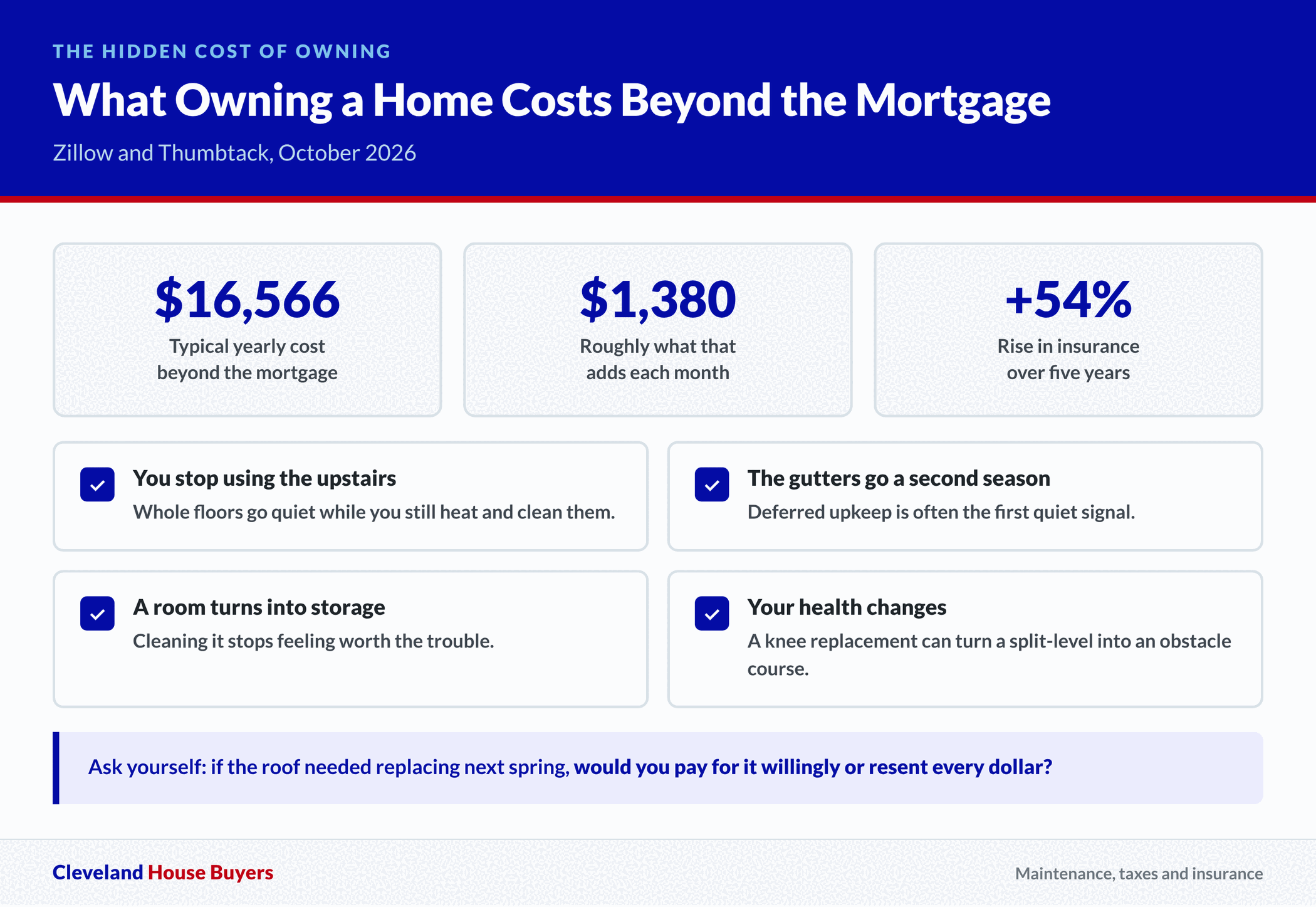
The signals usually show up as deferred maintenance. You stop using the upstairs. The gutters go uncleaned for a second season. A room becomes storage because cleaning it isn’t worth the trouble anymore. None of those things feel like a crisis, but stacked together they’re telling you the house has outgrown your life.
Money talks louder. Zillow and Thumbtack found in October 2026 that the typical American homeowner now burns about $16,566 a year on maintenance, property taxes, and insurance alone. Roughly $1,380 every month results, on top of whatever the mortgage costs. Over five years, that figure climbed close to 32%, with insurance premiums doing most of the damage at a 54% jump. You can read the full Zillow and Thumbtack breakdown here.
Health changes the calculus faster than anything else. A knee replacement turns a split-level into an obstacle course.
Some years back I worked with a widow whose employer moved her department to another state and gave her five weeks to report. Her late husband’s woodworking shop still filled half the garage, sawdust and all, and no agent was going to get that house sold, emptied, and closed inside her window. We bought it as it stood, shop included, and she flew out with her timeline intact. The choice to move to apartment housing wasn’t philosophical in that case; it was logistical.
Ask yourself a plain question: if the roof needed replacing next spring, would you pay for it willingly, or would you resent every dollar? Resentment is data.
Should I Sell My House and Move to an Apartment in Retirement?
“Am I giving up my biggest asset?”
Retirees most often voice this fear, and it deserves a straight answer: you’re not giving it up, you’re converting it. Equity sitting in drywall doesn’t buy groceries or pay for a hip replacement. Sold and reinvested, it does.
The tax picture is friendlier to sellers here. Under the federal home sale exclusion, a single filer can keep up to $250,000 of gain free of federal tax. Married couples filing jointly can shelter up to $500,000. This applies as long as you owned the place and lived in it as your main home for at least two of the five years before selling. The IRS spells out both tests in Topic 701. For a couple who bought in the eighties, that exclusion often wipes out the entire tax bill on decades of appreciation.
Where the retirement version gets complicated is community. A move to apartment living means leaving the neighbor who checks on you, the church five minutes away, the pharmacy that knows your name. I push back on advice that treats downsizing as pure arithmetic. Sellers I’ve worked with regret a cheap apartment in an unfamiliar suburb far more than they regret the money they spent staying put one extra year.
You should check lease terms here too. A twelve-month lease is a low-stakes experiment compared to buying a condo you may not be able to resell quickly, so it’s worth weighing that difference before signing anything. Retirees who move to apartment living with a one-year trial run give themselves an exit; the ones who buy a condo outright sometimes don’t.
Is It Smart to Move to an Apartment Right Now?
“I’ll just be throwing money away on rent.”
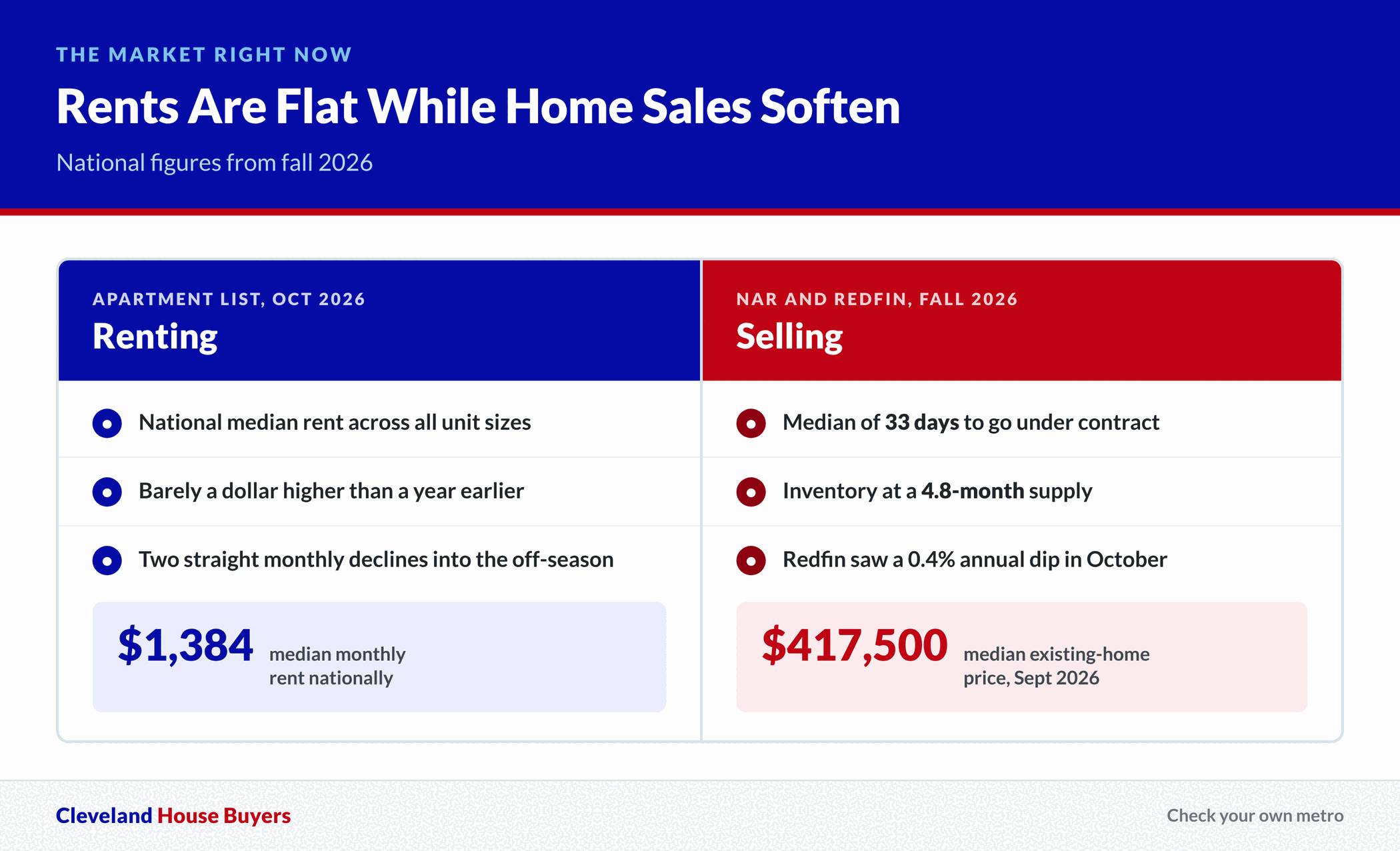
The assumption that owning is free ignores what the numbers say. Apartment List reported in October 2026 that the national median rent across all unit sizes sat at $1,384 a month, barely a dollar higher than a year earlier. Rents have been flat to falling nationally, with two straight monthly declines heading into the off-season. Their full data is published in the Apartment List National Rent Report.
Flat rent against rising ownership costs favors anyone planning a move to apartment living right now. It won’t hold forever, and it varies wildly by metro, so check your own market rather than trusting a national average.
Sellers are finding conditions have softened. The National Association of Realtors put the median existing-home price at $417,500 in September 2026, up 1.3% year over year. Homes took a median of 33 days to go under contract, with inventory sitting at a 4.8-month supply. Redfin measured a 0.4% annual dip in median sale prices in October 2026, the first decline in over three years, detailed in their October market report.
What does that mean for you? Buyers have leverage they didn’t have two years ago, so a listed house may need a price cut or a concession to move. Sellers who can’t absorb that risk sometimes take a direct offer instead. Firms like Cleveland House Buyers close on a set date without appraisal or financing contingencies, which takes the guessing out of a soft market.
Timing the peak is a losing game. Planning around your own life is winnable.
Should You Rent an Apartment or Buy Your Next Home?
Before: a seller with a four-bedroom colonial, a bad back, and two adult kids in other states. After: a two-bedroom rental nine minutes from her sister, with the roof, the lawn, and the water heater all somebody else’s problem.
Renting wins when your next chapter is uncertain. Job in flux, health in question, grandkids who might relocate again, a region you’ve never lived in: all of those argue for a lease. Buying ties up capital and costs real money to unwind, so the closing costs on a buy-then-sell cycle inside three years will eat whatever appreciation you capture.
Owning wins when you’re certain and your housing payment would drop. A paid-off condo with modest dues can beat rent, and it locks your housing cost against future increases.
One pattern I keep seeing: sellers buy their next place before selling the current one, then they’re stuck carrying two housing payments for months while the first house sits. Bad price decisions result from that pressure. Sell first, rent short-term if you must, and buy from a position where nobody can rush you.
There’s also a middle road nobody mentions enough. Rent for a year in the area you think you want, then buy there once you know the traffic patterns, the winter, the grocery store, the neighbors. In my experience buying houses, people who move to apartment rentals as a scouting trip tend to choose their next home better than people who commit sight unseen.
Would you rather own the wrong house or rent the right neighborhood?
What Are the Financial Benefits of Moving From a House to an Apartment?
$11,171. Zillow and Thumbtack pegged this as the typical homeowner’s annual maintenance spend in their October 2026 analysis, and it’s the single largest slice of ownership costs for most households. A lease hands that line item to the landlord.
Your insurance bill shrinks too. Renters insurance covers your belongings and your liability, not the structure, so premiums drop to a fraction of a homeowners policy. Property taxes disappear from your statement entirely; they’re baked into rent, but they’re no longer your bill to chase, appeal, or budget around when a reassessment lands.
Then there’s the equity itself. A seller who nets a few hundred thousand dollars and puts it into conservative income investments creates cash flow that didn’t exist when the money was trapped in a house. Freeing that cash is the part of a move to apartment living that changes a retirement.
Utilities fall with square footage. Heating 1,000 feet costs less than heating 2,600, and apartment units share walls, which cuts heat loss.
I’d flag one thing that gets oversold, though: people assume rent is pure expense while a mortgage builds wealth. Early in an amortization schedule most of your payment is interest, and interest doesn’t build anything. Run your own numbers before accepting the slogan. If your loan is nearly paid off, staying may genuinely win. Anyone who refinanced recently and is back at the front of a new 30-year schedule has a stronger case to move to apartment living.
How Do I Calculate the Real Cost of Moving to an Apartment?
For years I told sellers to compare rent against their mortgage payment, which was lazy advice and left out half the picture.
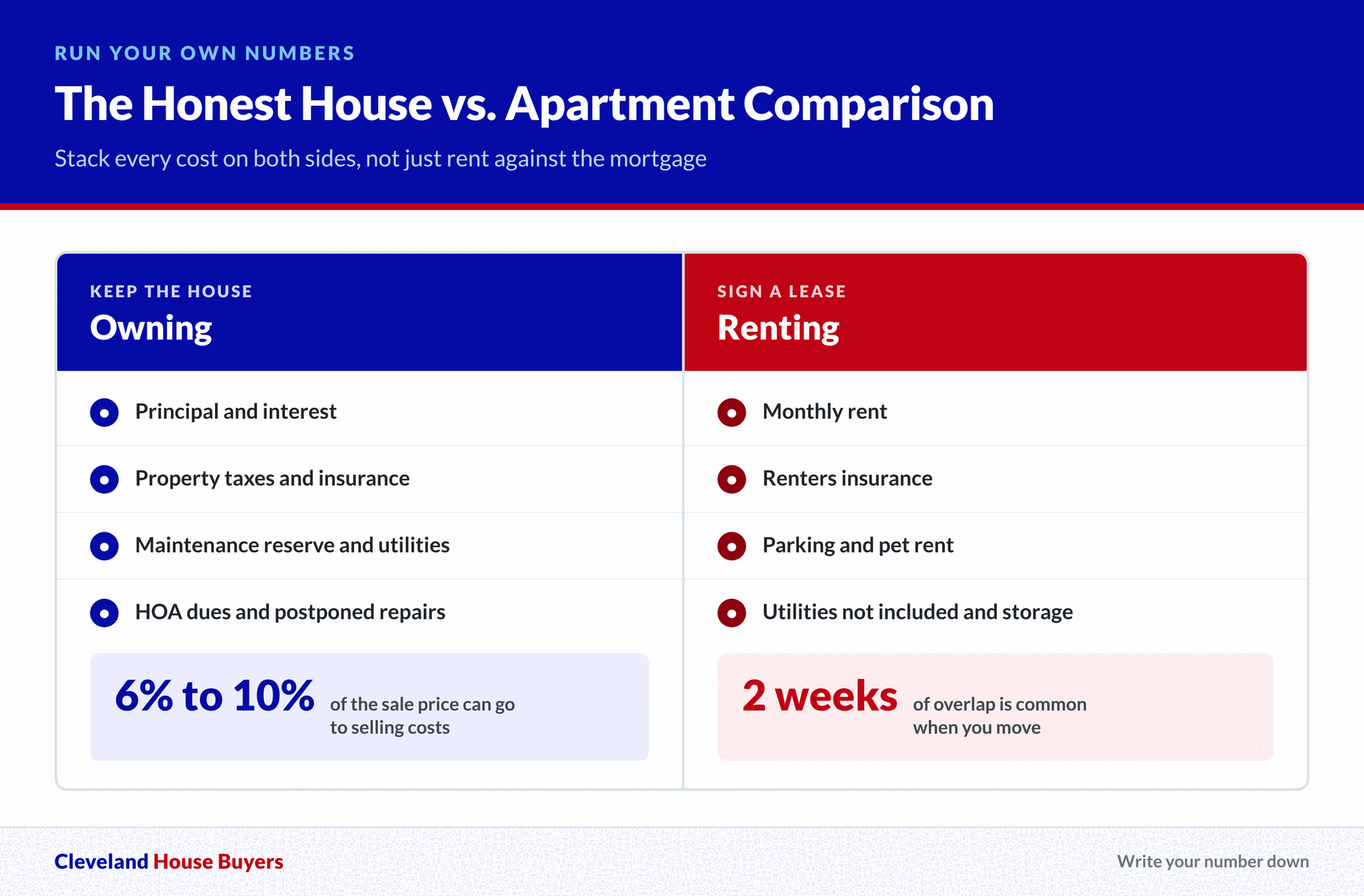
The honest comparison stacks everything on both sides. Owning: principal, interest, taxes, insurance, maintenance reserve, utilities, HOA dues if any, and the repairs you’ve been postponing. Renting: rent, renters insurance, parking, pet rent, utilities not included, storage unit if you’re keeping furniture.
The cost of the move to apartment life deserves its own line. Packing a long-occupied house runs into real money, and so does the dumpster, the estate sale commission, and the two weeks of overlap when you’re paying for both places.
Selling costs come next, and this is where estimates go wrong. Expect to surrender somewhere in the neighborhood of 6 to 10 percent of your sale price once agent commissions, title charges, and buyer concessions are counted. On a median-priced home that’s tens of thousands of dollars off the top. If your house needs work, add the repairs a buyer’s inspector will find, because in a market where homes take over a month to sell, buyers negotiate on every flagged item.
Compare that against a direct sale honestly. A cash offer typically comes in below retail, but it carries no commission, no staging, no repair credits, and no months of carrying costs, so the gap shrinks once you add those up. Some sellers net more that way; plenty don’t. Do the subtraction rather than assuming either path wins.
What’s your actual number if you sold today and signed a lease next month? Write it down. That one page settles most of these debates.
What Should You Ask Before You Move to a Smaller Apartment?
And square footage is only the first question on that list.
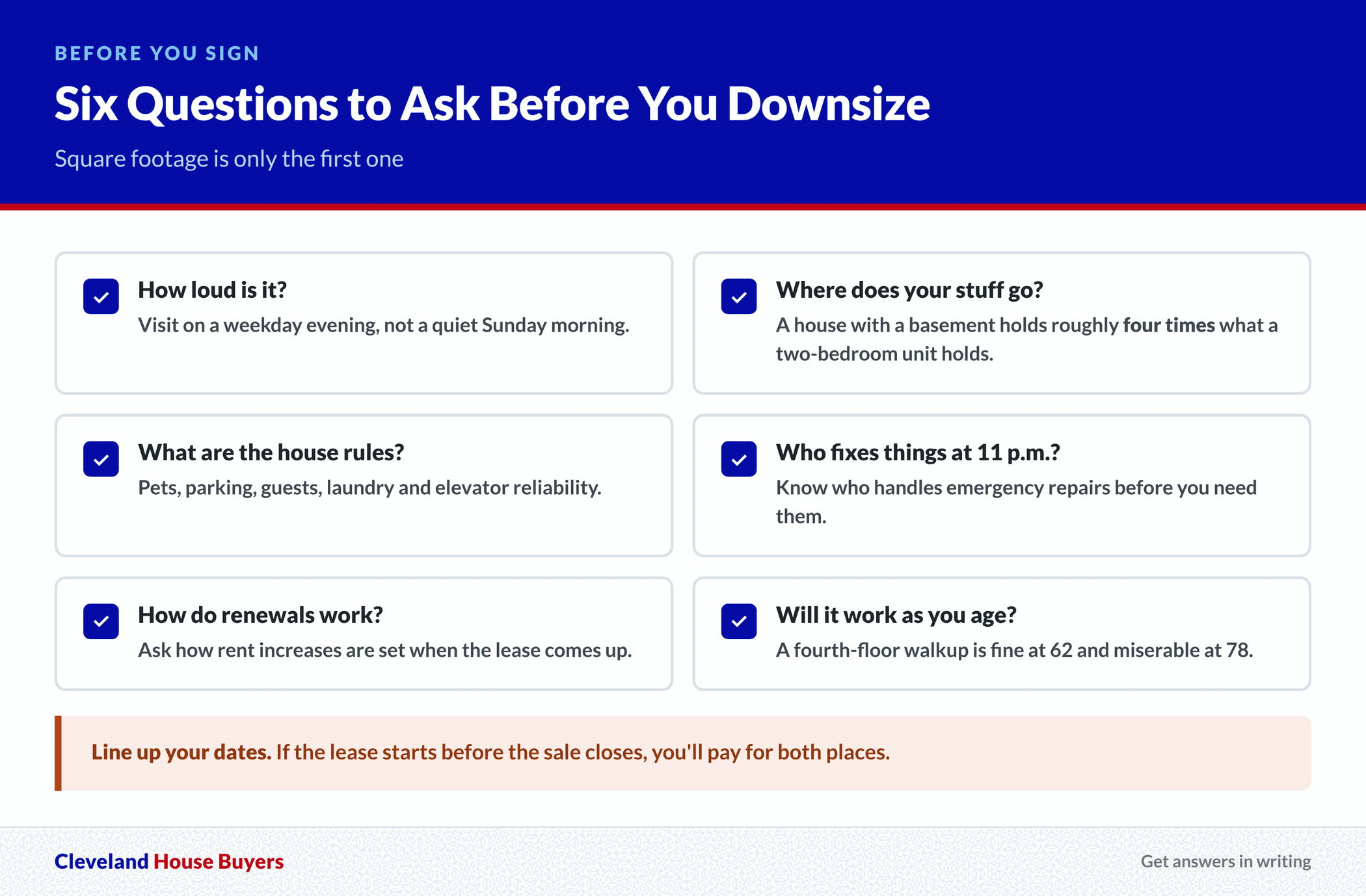
Ask about noise, because it’s the complaint that drives people out of apartments fastest. Top floor or ground floor? Does the building sit on a bus route? Swing by on a weekday evening, not a quiet Sunday morning, before you sign anything.
Storage is the second. A 2,400-square-foot house with a basement holds roughly four times what a two-bedroom unit holds. The gap gets settled through donation, sale, or a storage unit that quietly costs you every month for years.
Pets, parking, guest policy, laundry, elevator reliability, who handles emergency repairs at 11 p.m., and how rent increases work at renewal: get those in writing. Verbal assurances from a leasing agent don’t survive a management change.
Think about access as you age. Fourth-floor walkups are fine at 62 and miserable at 78.
Timing is the question that trips up the most sellers. Your lease starts on a date; your sale closes on a date; those two dates need to line up or you’re paying for both. That’s where a buyer who can commit to a specific closing day earns their keep. It’s the main reason some homeowners work with a local outfit like Cleveland House Buyers rather than hoping a financed buyer’s lender cooperates.
Another seller I worked with, this one in Parma, was three months behind on his mortgage with an auction date already on the calendar. His wife had left, he’d stopped opening mail, and there was a boat in the garage he hadn’t touched in six years. We closed before the sale date, he kept a chunk of equity that would’ve evaporated at auction, and he signed a lease across town the following month.
Frequently Asked Questions
A retired teacher I met had a paid-off house, a leaking basement, and an adult son telling her to hold on to it for the inheritance. She sold, leased a unit near her doctor, and told me later the only thing she missed was the garden.
Is It Better to Live in an Apartment or a House?
Neither one wins universally; it depends on what stage you’re in. Houses reward people who want space, control, and room for family to spread out, and who can absorb the upkeep costs described earlier in this article. Apartments reward people who’d rather spend their weekends and their cash on something other than the building they sleep in. If you’re caught between them, the question to answer first is how many more years you genuinely want to maintain a property.
Can You Live Comfortably on a $2,000 Monthly Apartment Budget?
In most of the country, yes, and comfortably so. That budget sits well above the national median rent figure cited above, which leaves room for utilities, renters insurance, and parking in a lot of markets. In high-cost coastal metros it gets tight quickly, sometimes covering only a modest one-bedroom. Pull up current listings in the specific zip codes you’re considering before you build a plan around a national average.
How Long Does It Take to Sell a House Before You Move to an Apartment?
On a traditional listing you’re looking at the market time noted earlier plus roughly 30 to 45 more days for a financed buyer to close. All told, budget two to three months from listing to keys. Repairs, inspection negotiations, and appraisal issues can stretch that. Selling direct compresses it to a few weeks, which matters when your lease start date is already locked in.
Do I Have to Clean Out the House Before I Move to an Apartment?
Not if you sell to a buyer who takes properties as-is. Traditional buyers want an empty, broom-clean house at closing, which means a full cleanout on your schedule and your dime. Direct buyers routinely close on homes with furniture, tools, and decades of belongings still inside, so you take what you want and leave the rest. That alone saves some sellers weeks of work they physically can’t do anymore.
Will I Owe Taxes on My Profit When I Move to an Apartment?
Possibly not, if you pass the federal ownership and use tests described in the retirement section above. Gain beyond that exclusion is taxed as a long-term capital gain, and your state may treat it differently than the federal government does. Anyone with a large gain, a rental history on the property, or a recent sale of another home should run the numbers past a tax professional rather than guessing.
Is Renting a Backward Step After Owning for Decades?
It isn’t, though plenty of people around you will frame it that way. Owning is a tool, and tools get swapped when the job changes. Freeing up equity, shedding maintenance, and choosing where you live based on proximity to people you love is a forward move by any reasonable measure.
If you’re weighing a sale, we’re glad to talk through what your house would realistically net. We can also put a direct offer next to a listing, or help you line up a closing date with a lease start. Call or reach out through Cleveland House Buyers and ask whatever you need to ask. No pressure, no obligation, and no hard feelings if you decide to stay right where you are.
What Cleveland Homeowners Should Know Before They Rent
If your house is in Greater Cleveland, the local market gives you some room to plan. Redfin data for May 2026 showed Cleveland-area homes going under contract in a median of 29 days. About 35.5% of listings went off the market within a week. Homes moving at that pace make it easier to line up a sale with a lease start date, as long as the house is priced right and in good shape.
If it needs work, or you’d rather not juggle showings while you pack, a direct sale lets you pick the closing day and move on your own schedule.
Ask Us What Your House Would Net
Leaning toward a lease or still on the fence? We’re happy to run the numbers with you. You’ll see what a listing might net next to a cash offer, so you can decide with real figures in hand. Contact Cleveland House Buyers or fill out the short form below, and there’s no obligation either way.