Forty-five days. That’s the median stretch an Ohio listing sat before going under contract this past September, and it’s the number almost every seller I meet has never heard. They’ve got a different figure in their head, usually something they absorbed from a cousin who sold in 2021. When you sell a house in Ohio today, the clock runs slower than that, so the gap between what people picture and what the calendar does is where frustration lives. I’ve bought houses across Northeast Ohio for years, and I’d rather give you the real timeline up front than let you discover it in week seven.
Is Your Ohio Home Ready to Sell?
You walk the house, decide it shows fine, and figure a weekend of decluttering gets you to list-ready. Then the first buyer’s inspector pulls the panel cover off a 1960s electrical box in a Lakewood colonial and writes four pages.
Readiness in Ohio isn’t about staging. It’s about whether the house can survive a stranger’s inspector and an appraiser on the same two-week stretch. Our housing stock is old. Cleveland’s bungalows, Dayton’s pre-war four-squares, the Victorians in German Village: they carry knob-and-tube remnants, clay sewer laterals, and basements that have taken on water during one bad spring or another. Buyers in this state are conditioned to look for that.
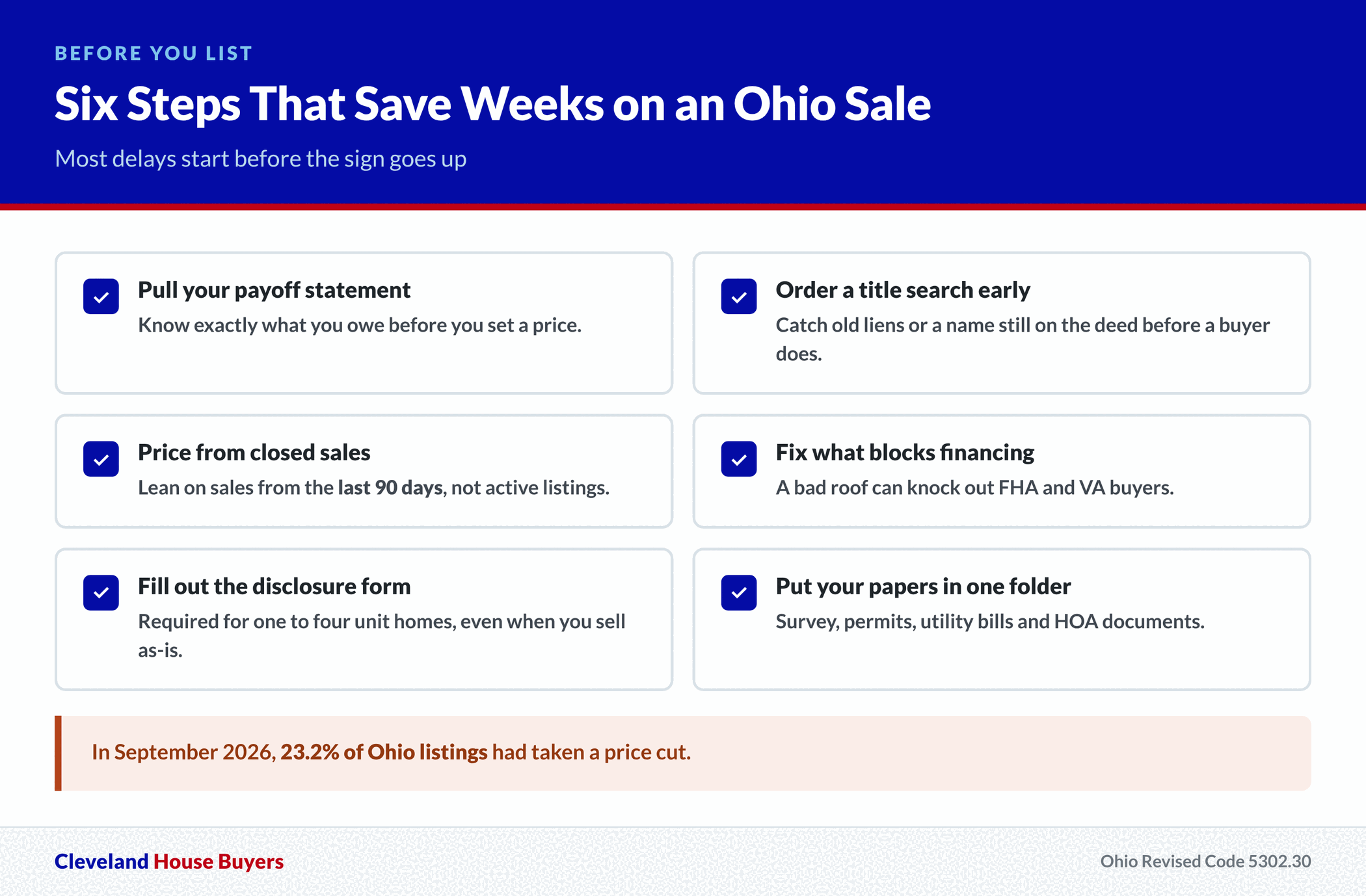
Before you can sell a house on the open market, Ohio law puts a form in your hand. Ohio Revised Code § 5302.30 requires sellers of residential property with one to four dwelling units to complete a Residential Property Disclosure Form. You can pull the current version straight from the Ohio Department of Commerce. Selling as-is doesn’t excuse you from filling it out.
Last year three siblings called me about a rental in Parma their mother had left them. None of them wanted to be a landlord, the tenant had moved out in March, and the garage still held her husband’s table saw and about forty paint cans. I’ve bought a few of these estate situations where nobody’s local enough to handle the cleanout, so we took it with the contents in place.
You can sell a house the traditional way, or you can sell it as-is. Those are two different kinds of ready, and pretending otherwise costs people months in Ohio.
What Should You Do Before Listing Your Ohio Home?
“Do I have to fix the roof first?”
That’s the question I get most, and the answer is usually no, but not for the reason sellers hope. A compromised roof doesn’t just cost you repair money. It knocks out FHA and VA buyers, and in a lot of Ohio price brackets those buyers are half the pool. What matters isn’t whether the roof bothers you, but which financing types your roof allows.
Pull your payoff statement early. Title problems surface in Ohio constantly: an ex-spouse never quitclaimed off the deed, a contractor filed a mechanic’s lien in 2019, a deceased parent’s name still sits on the record. A title company can run a preliminary search before you list, and that single step has saved more of my sales than any repair ever has.
Price is the other call to make before you sell a house, and most sellers get it backward: they start from what they need and work toward a number. Pricing above your comps in Ohio buys you weeks of silence, then a reduction that signals desperation anyway. Statewide in September 2026, 23.2% of listings had taken a price cut, which tells you how many sellers guessed high and paid for it in calendar days.
Ask your agent for a comparative market analysis that leans on closed sales within the last ninety days, not active listings. Asking prices are opinions.
Get your paperwork in one folder: survey, permits for that finished basement, utility bills, HOA documents if you’re in a Dublin or Mason development. Buyers who can get answers in a day don’t drift.
How Long Does It Take to Sell a House in Ohio?
The listing clock and the closing clock are two separate things, and sellers routinely quote only the first one. It’s sold when the money moves.
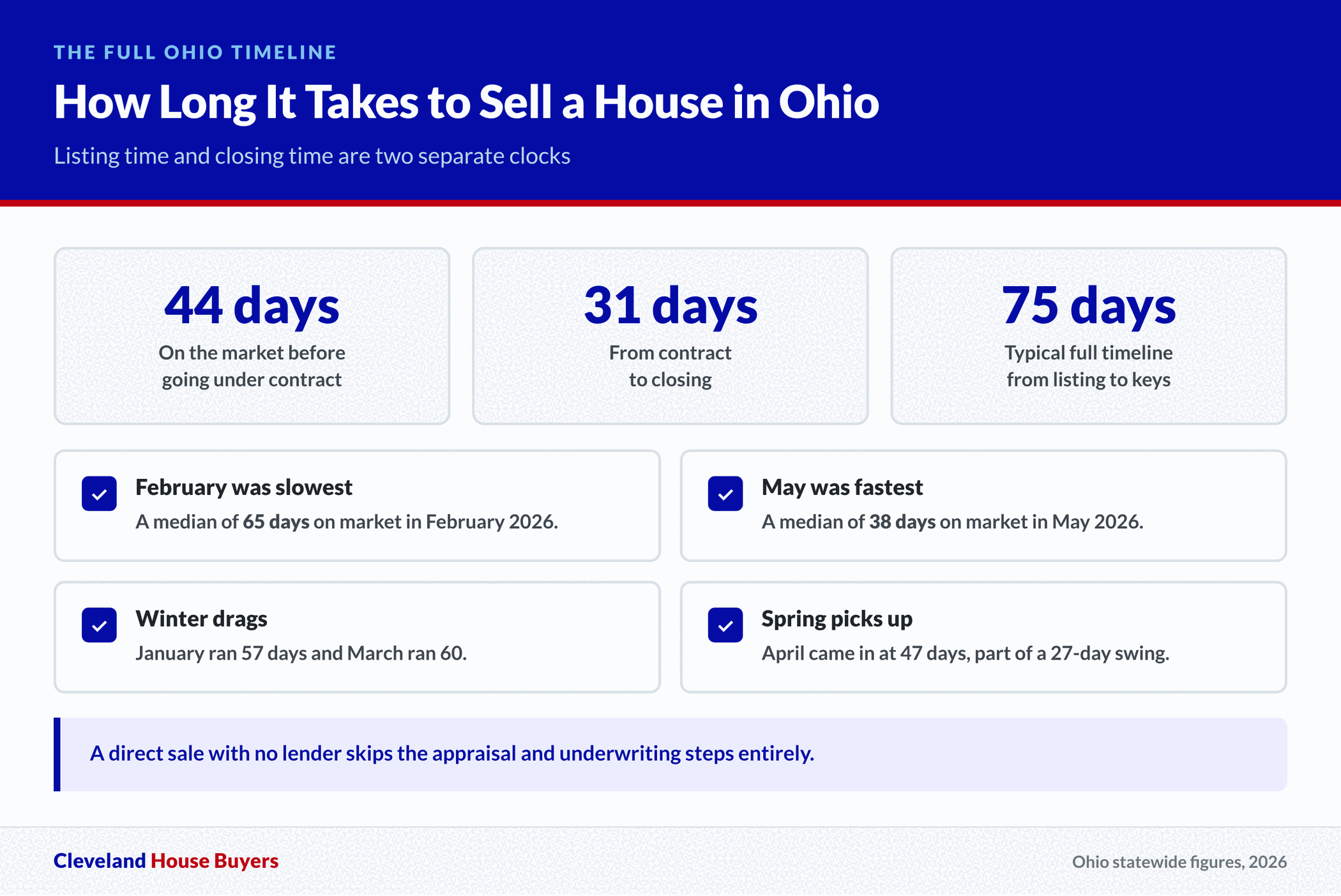
What matters here is the arithmetic that follows. Ohio’s average full timeline runs about 75 days: roughly 44 days on the market plus another 31 days to close once a buyer is under contract. So if you list in Ohio on a Saturday in March, a realistic handshake-to-keys window lands in late May.
Seasonality moves that number more in Ohio than people credit. Realtor.com-derived figures put January 2026 at 57 median days, February at 65, March at 60, April at 47, and May at 38. This is a 27-day swing between the worst month and the best inside a single year. Lake effect snow doesn’t just slow showings in Cuyahoga and Lorain counties. It slows inspections, appraisals, and the contractors you’ll need for repair requests.
Can you sell a house faster than that average? You can, in two situations. One is a well-priced, move-in-ready home in a high-demand school district during spring. The other is a direct sale, where no lender sits in the middle.
Companies like Cleveland House Buyers exist in this market because of that second path. When a buyer pays without financing, the appraisal and underwriting steps vanish, and a closing in Ohio can be scheduled around the title company’s availability rather than a lender’s queue.
I’ll say the unpopular thing: speed costs money, and anyone who tells you otherwise is selling something. The question worth asking is what those extra weeks are costing you in payments, taxes, insurance, and attention.
What Is the Average Time on Market for Ohio Homes?
Statewide, Ohio moves faster than the country. September 2026 data showed a median of 45 days on market for Ohio listings, up 4.7% from a year earlier, against a national median of 61 days in that same month. Affordability is driving that gap, so buyers priced out of Nashville and Denver can still find something here.
Columbus posted a median of 33 days on market in September 2026, three days slower than the year before, because metro by metro, the spread is real. Cincinnati historically runs behind Columbus. Toledo, Akron, and Youngstown each have their own rhythms, and a Canton seller shouldn’t plan around a Dublin timeline.
What moves your individual number? Price band, mostly. Entry-level homes in Ohio under the statewide median attract the deepest buyer pool and go quickest. Cross above $500,000 in most Ohio counties and your buyer pool thins out fast.
A dated kitchen can add weeks to the time it takes to sell a house. An active roof leak can stop it entirely.
What’s around the house matters more than the house itself. Two houses a mile apart in Shaker Heights can sit on the market for wildly different stretches depending on which side of a school boundary they fall on. Ohio buyers research districts before they research floor plans, and Upper Arlington, Solon, and Mason all carry premiums built on that research.
So when someone quotes you an Ohio average, treat it as a weather forecast for the whole state while you’re standing in one backyard.
How Long Before You Get an Offer on Your Ohio House?
That backyard question should matter to sellers, because the first offer usually arrives far earlier than the market-wide averages suggest, or it doesn’t arrive at all.
The first ten days of showing traffic tell you nearly everything. Strong interest produces offers inside two weeks in most Ohio metros, but thin traffic in that window is a pricing message, not a patience problem, and waiting it out rarely works.
In September 2026, 30.6% of Ohio homes sold above their list price, up 1.7 percentage points year over year. Nearly a third. That’s not a market where good houses languish; it’s a market where mispriced houses do.
One pattern I keep seeing: sellers fixate on the number of showings and ignore the feedback. Twenty showings with no offer isn’t bad luck. It’s twenty people telling you the same thing about your price or your condition, and you only need to listen once.
Your situation changes how fast you can sell a house, too. An inherited property with deferred maintenance in East Cleveland won’t draw the same retail attention as a maintained ranch in Westerville. For sellers in that first category, a direct offer often arrives within a day or two of a walkthrough. This is why I’d rather someone compare both routes, since the MLS isn’t the only door.
Trying to sell a house by owner removes the MLS exposure that most Ohio buyers’ agents search every morning, and a flat-fee listing service only partly closes that gap.
Sellers also receive offers unevenly through the week. We write most of ours Monday through Wednesday after weekend walkthroughs.
What Slows Down a Home Sale in Ohio?
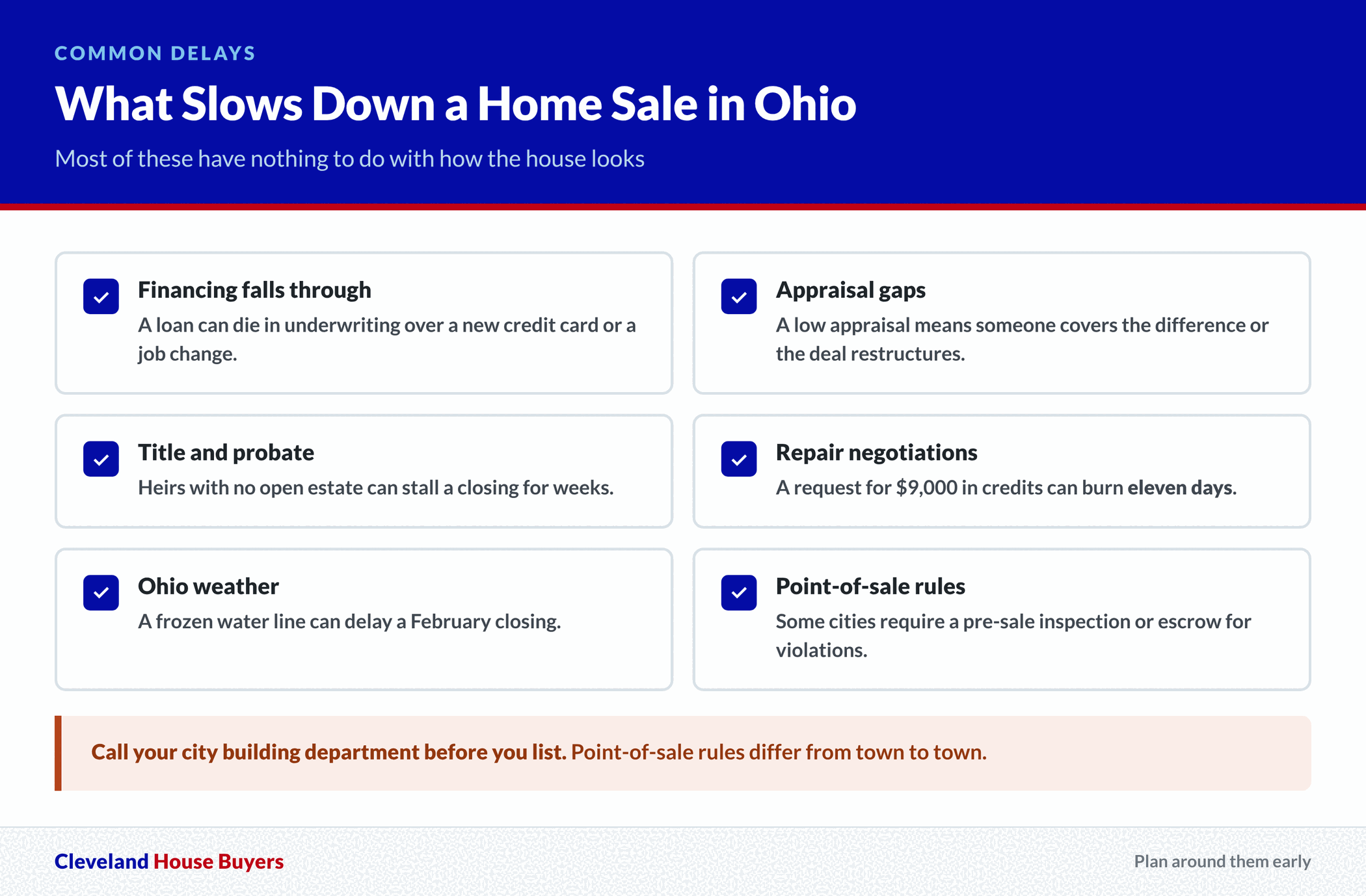
“My house is fine, so this should be quick.” Maybe. The things that stretch the time it takes to sell a house in Ohio usually have nothing to do with how it looks.
Financing is the big one. A buyer’s loan can die in underwriting during week three over a new credit card or a job change, and you’re back on the market with a stale listing. Freddie Mac’s national 30-year average crossed 7% in late September 2026, and at that cost every dollar of a buyer’s qualification is tight.
Appraisal gaps come next. When an appraiser values the property below the contract price, somebody has to cover the difference, or the contract gets restructured. I’ve seen this kill sales that looked solid on paper. Older Ohio neighborhoods with mixed housing stock produce more of these than new-build suburbs, since comparable sales get harder to find.
Title defects stall closings for weeks. Probate is the common one here: a house passes to heirs, nobody opened an estate, and now the county probate court has to catch up before anyone can convey clean title.
The buyer asks for $9,000 in credits, you counter, they counter, and eleven days evaporate before anyone orders the appraisal.
Ohio weather earns its own line. A February closing in Erie County can be delayed by a frozen water line the inspector couldn’t test, and a sump pump that passed in August fails its first real test in April.
Sellers in Northeast Ohio often overlook municipal point-of-sale requirements, and I’ve seen closings get held up because nobody checked this early. Several cities require a pre-sale inspection or escrow for violations before title transfers. Dayton, for instance, requires a Certificate of Disclosure for residential sales filed with its Housing Inspection Division, open violations or not. Call your city building department before you list, because these rules differ from town to town.
How Can You Sell Your House Faster in Ohio?
For years I told sellers to fix everything before listing. I was wrong about that, and I’ve watched too many people sink $20,000 into a rehab that returned maybe $12,000 at the closing table.
Target repairs at financing eligibility and the inspection items that sink sales instead. Roof, furnace, electrical panel, active water intrusion.
Price at or barely under the comps. A house priced right in Ohio creates urgency; a house priced to “leave negotiating room” creates nothing but days on market. Our inventory is still tight enough that correctly priced listings get competitive attention.
Sellers underestimate how much photos matter. The listing photo is your front door now, and a dim iPhone shot of a dark living room costs you showings before anyone sets foot in the Buckeye State home you’re trying to move.
When you can pick the season, late spring is the easiest time to sell a house in Ohio. The data above shows May as the fastest month of this year, and Ohio buyers with school-age kids are shopping hardest from April through June.
Want to skip the market altogether? A direct sale trades top-dollar potential for certainty and a closing date you pick. For a seller facing foreclosure, a job transfer to Columbus with a sixty-day start date, or a property full of a lifetime’s belongings, that trade often pencils out. This is especially true when there’s no time left to wait for the right buyer. Cleveland House Buyers works that way across Cuyahoga, Lake, Lorain, and Summit counties, and getting an offer from them costs nothing but a conversation.
Whatever route you use to sell a house, decide early. Sellers who list for ninety days, fail, and then look for a direct buyer have usually burned their best leverage.
What Happens Between Contract and Closing in Ohio?
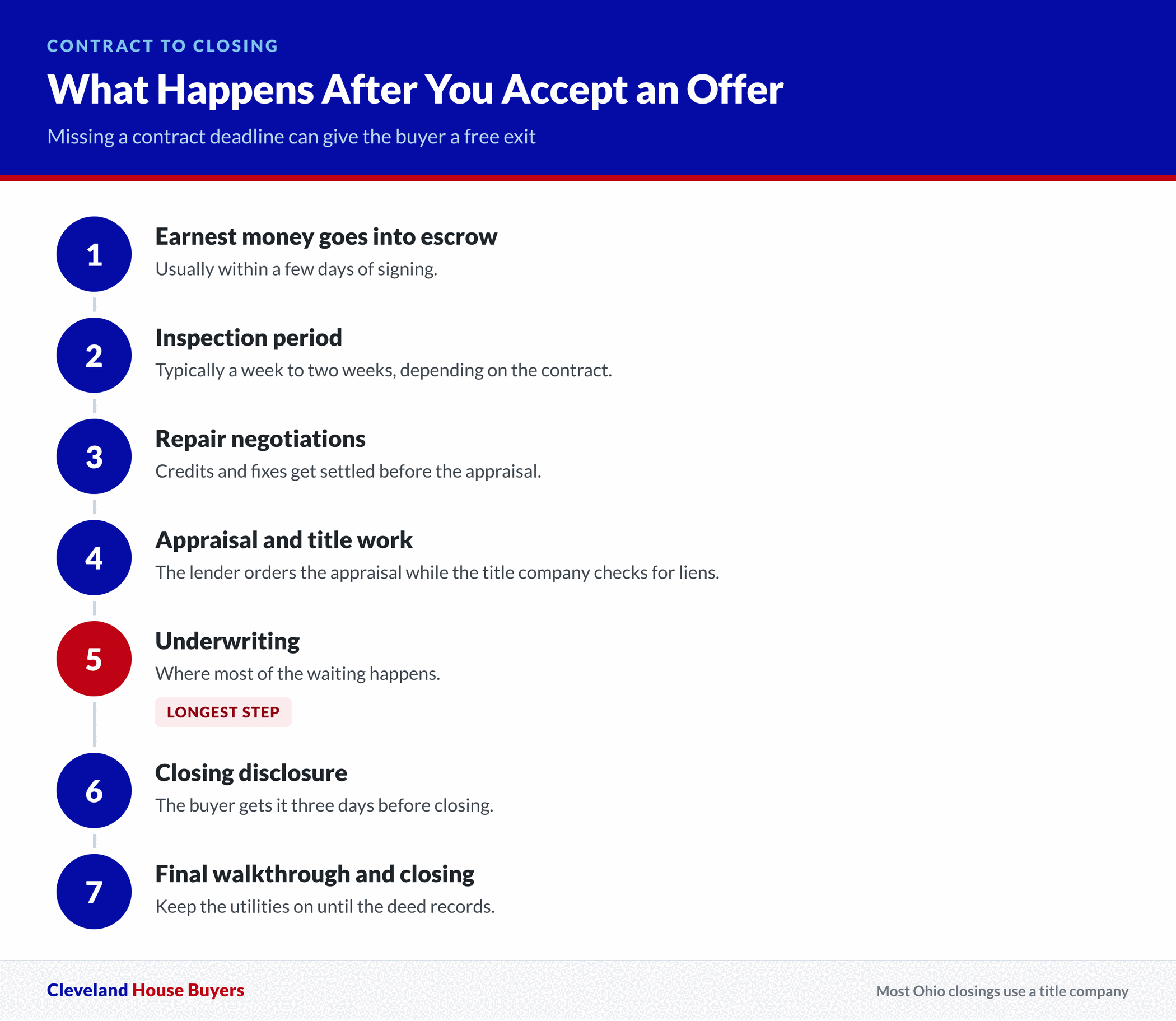
Miss a contract deadline in Ohio and you can hand your buyer a free exit along with their earnest money back. Deadlines in these agreements aren’t suggestions.
Here’s the usual order. Earnest money goes into escrow within a few days. The inspection period runs its course, typically a week to two weeks depending on what your contract says. Repair negotiations follow, then the lender orders the appraisal.
Title work runs in parallel. Your title company pulls the chain of title, checks for liens and judgments, and issues a commitment for title insurance. Ohio closings are usually handled by title companies rather than attorneys, though you can bring a lawyer in if your situation is complicated.
Underwriting is where most of the waiting happens. Your buyer’s lender re-verifies employment, pulls credit again, and asks for documents the buyer already sent twice.
Three days before closing, the buyer gets their closing disclosure. Then comes the final walkthrough, usually the morning of. Keep the utilities on until the deed records; I’ve watched a closing get pushed because a seller shut off the water a week early and nobody could verify the plumbing.
A seller in Strongsville called me in the middle of a divorce last spring. Neither party wanted the house, both attorneys were billing by the hour, so the only shared goal was a signed settlement statement before the next court date. We closed on a Thursday, split proceeds per the decree, and nobody had to coordinate a showing schedule with an ex.
When you sell a house through the conventional process in Ohio, the back half of the timeline belongs to a lender you’ve never met.
Frequently Asked Questions
Does the Time of Year Change How Fast You Can Sell a House in Ohio?
Yes, and the swing between the slowest and fastest months is large. Winter listings sit longer here because snow slows showings, inspections and appraisals. Late spring brings out the most buyers, so if your timing is flexible, that’s the strongest window to sell a house in Ohio.
Should You Cut Your Price if Your Ohio House Isn’t Getting Offers?
Usually, yes, when the first couple of weeks bring thin showing traffic and no offers. Thin traffic like that is a pricing message, and waiting it out rarely changes the result. Ask your agent for fresh closed sales nearby, then adjust once rather than trimming a little at a time.
Can a Title Problem Delay Your Ohio Closing?
It can, sometimes by weeks. An old lien, an ex-spouse still on the deed, or an estate nobody opened in probate all have to be cleared before the title company will insure the sale. Ordering a preliminary title search before you list is the simplest way to catch these while there’s still time to fix them.
What’s the Fastest a Home Sale Can Realistically Close?
With a cash buyer and a clean title, an Ohio closing can happen in roughly one to two weeks, limited mostly by how fast the title company finishes its search. Financed sales can’t go that quickly because underwriting and the appraisal both take time. If your title has a probate issue or an old lien attached, add weeks regardless of who’s buying.
Do I Have to Make Repairs Before I Sell a House in Ohio?
Not if you’re selling as-is to a direct buyer, who prices the property around its current condition. If you’re listing on the MLS, targeted repairs to the roof, mechanicals, and anything causing water damage protect your access to financed buyers. You still owe the state disclosure form either way.
If you’re weighing your options and want a straight read on your timeline, we’re glad to talk it through. No pressure, no obligation, and no hard feelings if listing with an agent turns out to be the better move for your situation.
How Fast Cleveland Homes Are Selling
Greater Cleveland tends to move a little quicker than the statewide numbers. Redfin data for May 2026 put the metro’s median at 29 days on market, and 48.3% of listings went off the market within two weeks. The time it takes to sell a house on your street can land well on either side of that, depending on price, condition, and which side of a school boundary it sits on.
If you need a firm date instead of a forecast, our local team buys houses across Cuyahoga County and the surrounding area as they are, on the closing day you choose.
Get a Straight Read on Your Timeline
Tell us about your house and your deadline, and we’ll lay out how long it might take to sell a house like yours with a listing versus a direct sale. You’ll get a fair cash offer with no obligation to take it. Contact Cleveland House Buyers or use the short form below to get started.